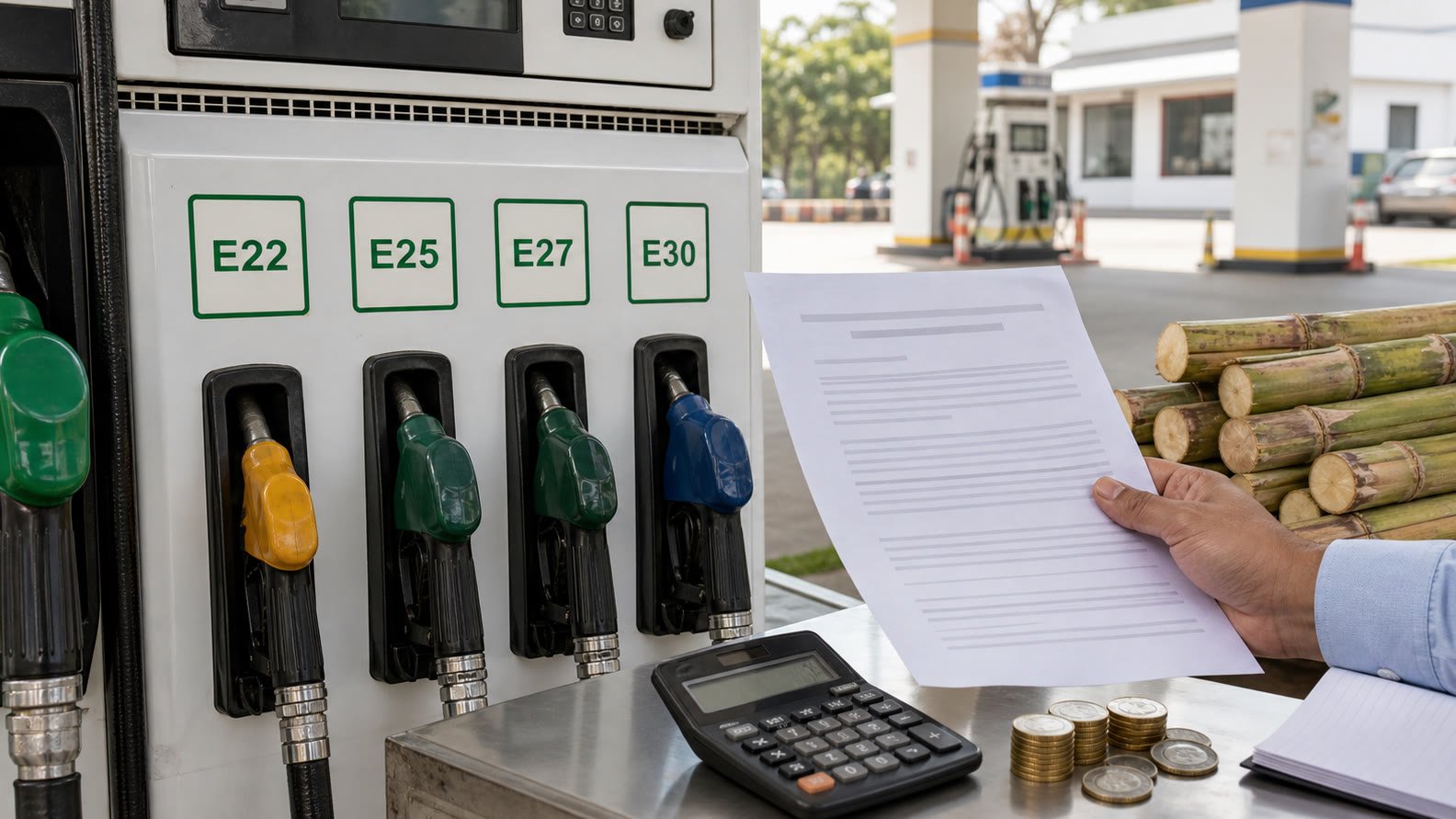
India has waived excise duty on higher ethanol-blended petrol grades E22, E25, E27 and E30, giving oil companies a clearer tax pathway to introduce petrol with more than 20 percent ethanol. The decision, reported by Times of India citing a finance ministry notification, is a significant fuel-policy move because it links ethanol blending directly with pump economics, not just emission and import-reduction goals.
For everyday fuel users, this does not mean every petrol pump will immediately sell E25 or E30, nor does it mean all existing petrol vehicles can safely use higher blends. The bigger meaning is that the government is preparing the market for a wider ethanol ladder beyond E20 while trying to avoid a sudden mandate that could create mileage, warranty or engine-compatibility concerns for older vehicles.
What changed now
The new tax relief applies to four specific petrol-ethanol blends. These grades contain progressively higher ethanol and lower motor-spirit content. The waiver reduces the central excise-duty burden on these higher blends, which can help oil marketing companies price and distribute them more competitively once supply, dispenser and vehicle-readiness issues are addressed.
| Fuel grade | Motor spirit share | Ethanol share | Why it matters |
|---|---|---|---|
| E22 | 78 percent | 22 percent | Small step beyond E20 |
| E25 | 75 percent | 25 percent | Key test for compatibility and mileage |
| E27 | 73 percent | 27 percent | Closer to high-blend petrol use |
| E30 | 70 percent | 30 percent | Requires careful rollout and suitable vehicles |
This follows the notification of BIS fuel specifications for E22, E25, E27 and E30 in May 2026. Those specifications created the technical standard; the latest excise waiver gives the policy a fiscal push. Together, they suggest that India is moving from a single E20 mass-market blend toward a multi-grade fuel market where higher ethanol blends can be sold selectively.
Why it matters for fuel prices
Excise relief can improve the economics of higher ethanol petrol, but users should not treat it as an automatic pump-price cut. Retail prices will depend on ethanol procurement cost, petrol base price, freight, dealer margins, state taxes, oil-company pricing decisions and the discount needed to compensate for ethanol's lower energy density.
The pricing lesson is already visible in E85. Oil Minister Hardeep Singh Puri recently said state-run oil companies would offer E85, a blend of 85 percent ethanol and 15 percent petrol, at a Rs 20 per litre discount compared with E20 petrol to offset lower energy content. That shows the government understands a basic consumer issue: a fuel can be cheaper per litre but still needs to deliver acceptable cost per kilometre.
For E22 to E30, the price gap may be smaller than E85, but the same principle applies. If a higher ethanol blend reduces mileage for some vehicles, pump pricing must be attractive enough for users to choose it voluntarily. Otherwise, the policy may help oil companies and ethanol producers, but not necessarily convince motorists.
Vehicle compatibility remains the main caution
The government may not immediately force a higher ethanol mandate. Times of India reported that authorities are considering letting buyers and fleet owners decide through flex-fuel vehicles rather than rushing from E20 to E25 across the entire market. This is important because many petrol cars and two-wheelers on Indian roads were originally designed around lower ethanol blends.
Vehicles made from April 2023 are described as E20 material-compliant, while fully E20-compliant vehicles entered the market later. Moving beyond E20 will need more clarity from automakers, fuel retailers and testing agencies. ARAI-related studies and industry feedback will matter because higher ethanol can affect fuel-system materials, calibration, mileage and long-term engine durability if the vehicle is not designed for it.
That does not mean ethanol blending is unsafe by default. The petroleum ministry has previously argued that E20 use does not void insurance and has cited lower emissions and broader economic benefits. But E25, E27 and E30 are a different step from E20. The practical approach is likely to be separate dispensers, clear labelling and targeted availability for compatible vehicles rather than a sudden universal change.
Who benefits from the waiver
- Oil marketing companies: They get a clearer tax structure to test higher ethanol grades without carrying the full excise load.
- Flex-fuel vehicle buyers: More blend options can make flex-fuel vehicles more useful if pumps and pricing support adoption.
- Ethanol producers and farmers: Higher blending can increase demand for ethanol from sugarcane, maize and other feedstocks.
- Fuel users: Benefits will depend on real pump prices, vehicle compatibility and cost per kilometre, not just the sticker price per litre.
- Automakers: The policy nudges the industry toward flex-fuel readiness, but also puts pressure on clear compatibility communication.
What changes now and what to watch
The immediate change is policy readiness. The government has removed one tax barrier for E22-E30 blends after setting fuel standards. The next stage will be about execution: how many pumps get separate dispensers, which cities get early supply, whether oil companies announce discounts, and how clearly vehicle makers identify models that can use each grade.
For most motorists, E20 remains the main petrol grade to watch in the near term. Higher blends should be treated as a targeted option until automakers, fuel retailers and regulators provide clear guidance. For FuelPrice readers, the takeaway is simple: this waiver is a strong signal that India wants to use ethanol to reduce crude-oil dependence and soften fuel-price pressure, but the consumer benefit will only become real when price, mileage and vehicle compatibility are all aligned.
Sources: Times of India excise waiver report, Times of India higher mandate report, Times of India E22-E30 standards report, Economic Times E22-E30 explainer, Economic Times E85 pricing report, Economic Times E20 ministry clarification report.