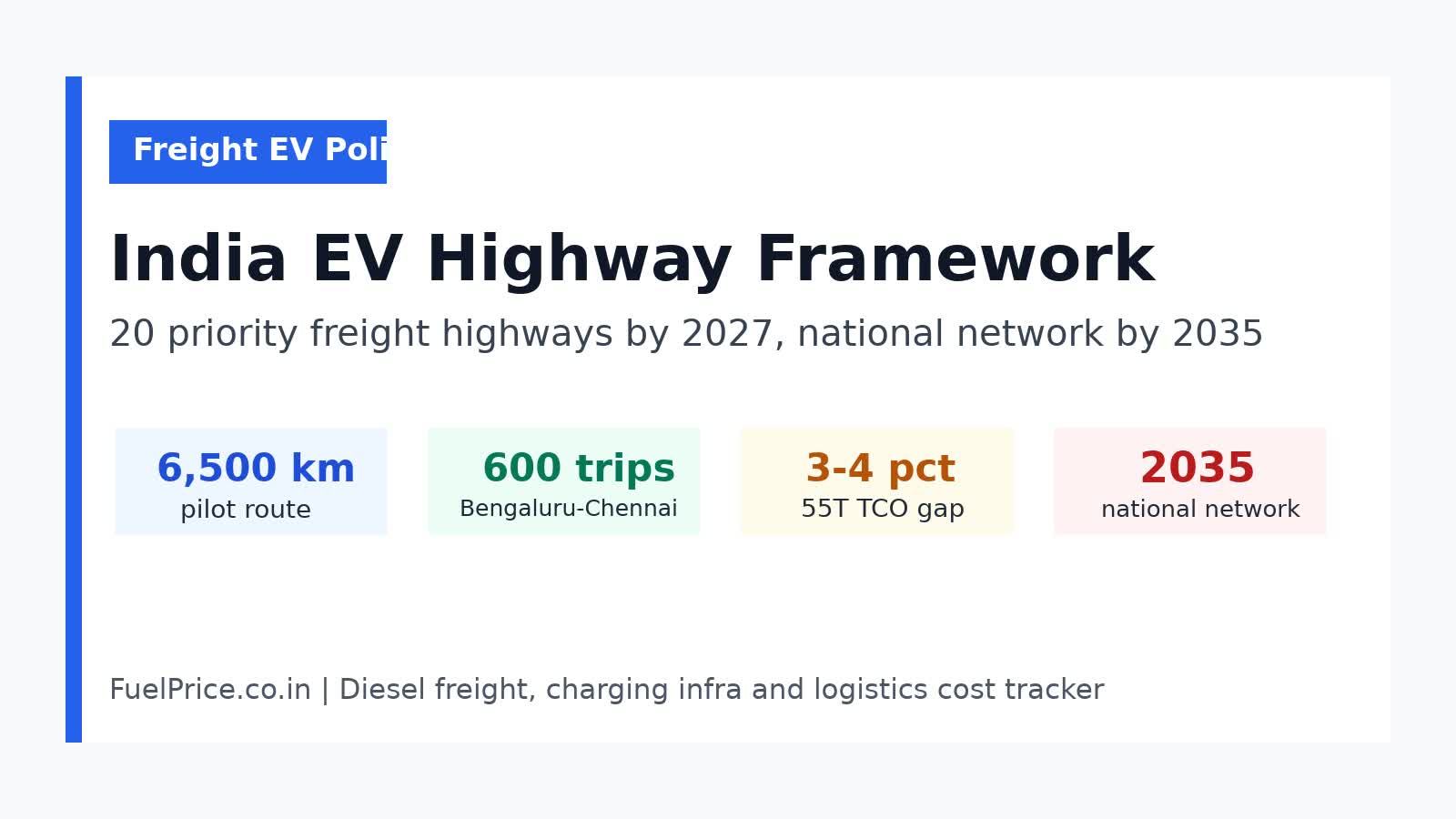
Quick brief: The Climate Pledge and C40 Cities have released the National EV Highway Guidance Framework for India, an evidence-led roadmap to move priority road freight corridors from diesel trucks to battery-electric trucks. The headline target is clear: 20 priority highways by 2027 and a wider EV-ready national freight network by 2035.
The framework focuses on diesel freight replacement, charging readiness and commercial viability for battery-electric trucks on high-volume Indian highways.This is not a passenger EV story. It is a freight cost and diesel demand story. Road freight is one of the hardest parts of transport to electrify because trucks run long distances, carry heavy payloads, operate on tight turnaround windows and need dependable charging where the load actually moves.
The framework matters because it moves the discussion from ambition to route planning. Its evidence base includes 600 electric-truck trips on the Bengaluru-Chennai corridor, more than 200,000 km of commercial running, and a 6,500 km pilot across the Golden Quadrilateral. For FuelPrice readers, the real question is whether electric trucks can begin reducing diesel exposure for logistics operators without breaking freight economics.
The biggest takeaways
- 20 corridors first: The framework starts with 20 high-priority national highways identified by the Ministry of Heavy Industries.
- 2035 network goal: The plan aims to expand from early freight corridors to a seamless EV-ready national freight network by 2035.
- Real pilot data: Electric trucks completed 600 trips on Bengaluru-Chennai and a 6,500 km Golden Quadrilateral pilot.
- Cost gap narrowing: Hindustan Times reported that 55-tonne electric trucks are only 3-4 percent higher in total cost of ownership than comparable diesel trucks, according to the framework.
- Freight impact: The policy value is strongest for high-utilisation routes where diesel cost, charger uptime, payload and financing can be planned together.
What actually happened
The Climate Pledge, co-founded by Amazon, launched the National EV Highway Guidance Framework in collaboration with C40 Cities on 14 May 2026. The framework is built under the Laneshift programme and is designed to help public and private stakeholders scale zero-exhaust-emission freight corridors in India.
The plan begins with the busiest freight routes rather than spreading charging investment thinly across every road. That route-first approach is important because commercial truck electrification depends on predictable use. A battery-electric truck becomes more viable when the same routes are run repeatedly, charging points are reliable, load patterns are known and fleet operators can secure long-term contracts.
Why this matters for diesel and logistics costs
Diesel is the backbone fuel for Indian freight. Any serious change in truck energy use has a direct link with logistics cost, fuel demand, urban air quality and supply-chain planning. If battery-electric trucks become viable on dense freight corridors, the first impact will not be a sudden fall in diesel sales. The first impact will be route-level substitution in corridors where the economics already work.
That is why the framework is relevant even before mass deployment. It gives logistics companies, truck makers, charging operators and financiers a common map: where to start, what route data to collect, what charging infrastructure is needed, and what commercial conditions can make the transition credible.
Evidence from the pilot phase
The Bengaluru-Chennai corridor is the most useful proof point because it involved real commercial operations rather than only a showcase drive. According to the project details, electric trucks completed over 600 trips and covered more than 200,000 km across sectors. The longer Golden Quadrilateral pilot then tested scalability over a much larger route network connecting major metros.
| Metric | Reported number | Why it matters |
|---|---|---|
| Priority highways | 20 by 2027 | Creates a focused first market for freight charging, not scattered infrastructure. |
| National network target | 2035 | Gives fleet operators and OEMs a long-range planning horizon. |
| Bengaluru-Chennai pilot | 600 trips, over 200,000 km | Shows real logistics use rather than only prototype testing. |
| Golden Quadrilateral pilot | 6,500 km | Tests whether e-truck routing can scale beyond one corridor. |
| 55-tonne TCO gap | 3-4 percent higher than diesel, as reported by Hindustan Times | Suggests cost parity may be close on high-utilisation routes, subject to charging and financing conditions. |
Who is affected first?
The first movers are likely to be large logistics operators, e-commerce fleets, organised 3PL companies, charging operators, truck OEMs and fleet financiers. These are the players that can plan fixed routes, commit to utilisation, negotiate long-term contracts and absorb early operational learning.
- Fleet operators: Need route-level energy planning, charger access contracts, driver training and maintenance support.
- Truck makers: Need payload, range, battery warranty and uptime confidence for heavy-duty buyers.
- Charging companies: Need freight-grade charging locations, not only passenger-car charging points.
- Retail and e-commerce logistics: Could use electric freight on predictable hub-to-hub lanes first.
- Diesel fuel ecosystem: May see corridor-specific demand changes over time if high-utilisation electric trucks scale.
What can slow adoption?
The framework is promising, but electric freight will not scale just because a route map exists. The hardest issues are practical: charger uptime, land availability, depot charging, payload penalties, vehicle financing, battery life, grid connection timelines and emergency support on highways.
The commercial case also depends on utilisation. An electric truck that runs long daily distances on a predictable corridor can recover its higher upfront cost faster. A truck with irregular routes, uncertain loads or long idle periods may not see the same economics.
Reader takeaway
For FuelPrice readers, this framework should be read as a diesel-freight transition signal. It will not change pump diesel prices immediately, but it can reshape the long-term economics of high-volume freight corridors. The important next update will be whether the 20 priority highways move from framework to visible charging deployment, committed fleet contracts and measurable diesel displacement.
What to watch next
- The list and sequencing of the 20 priority highways.
- Charging-station capacity, uptime standards and grid connection timelines for freight routes.
- Electric truck financing terms and battery warranty structures.
- OEM order books for medium and heavy-duty battery-electric trucks.
- Diesel freight cost comparison on Bengaluru-Chennai and other early lanes.
Sources checked
- The Climate Pledge and Amazon India: National EV Highway Guidance Framework, May 14, 2026
- Autocar Professional: C40 Cities and The Climate Pledge framework for zero-emission trucking in India
- Hindustan Times: Electric trucks near commercial cost parity with diesel vehicles
- PIB: Government EV and PM E-DRIVE context for charging and electric mobility support