India’s EV retail registrations rose 44.88% year on year to 3,54,625 in October 2026, an all-time high, according to Federation of Automobile Dealers Associations (FADA) data. For Indian buyers, riders and fleet operators, the result points to faster growth in electric two-wheelers, three-wheelers and cars, but it should be read as retail registrations—not factory dispatches—and against a festival-shifted comparison.
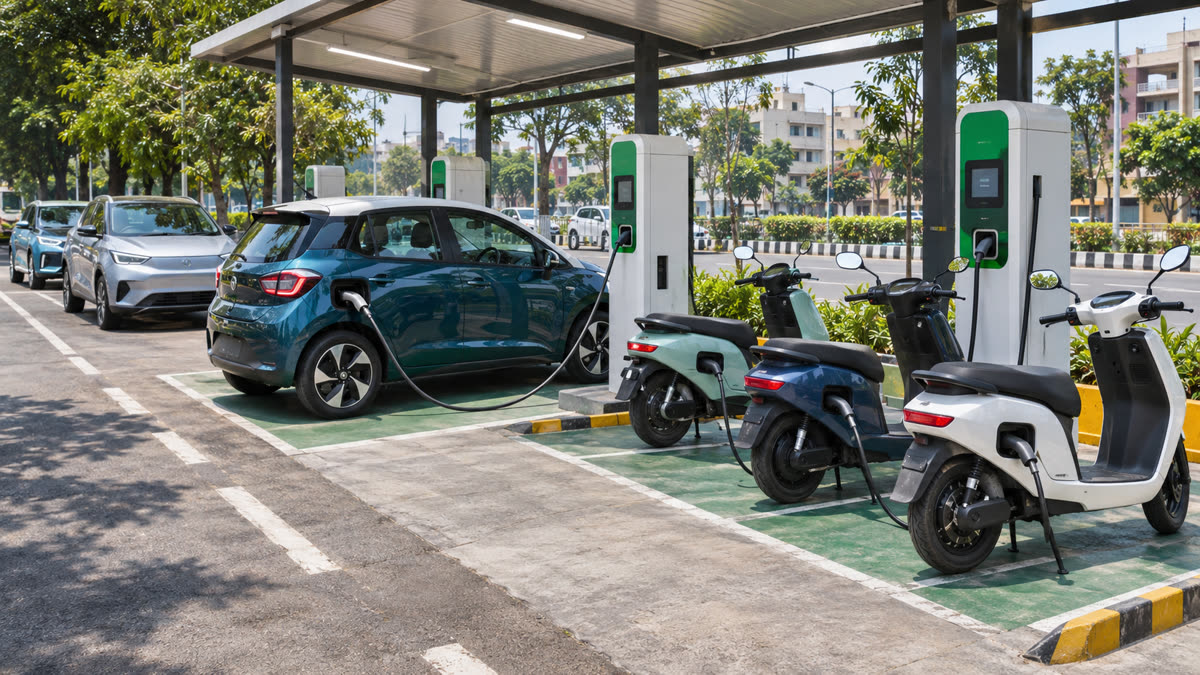
Illustrative image: an AI-generated public EV charging hub in India; it is not an official product photograph.
Key takeaways
- FADA recorded 3,54,625 EV retail registrations in October 2026, compared with 2,44,764 in October 2025.
- Overall EV penetration reached roughly 11.5% of vehicle retail, up from about 6% a year earlier.
- Electric two-wheelers contributed 2,24,064 registrations, while electric passenger vehicles reached 37,049.
- Electric car registrations rose 76.47% year on year, although cars remain a smaller part of the total EV market than two- and three-wheelers.
- The data is a registration snapshot; buyers still need to compare purchase cost, charging access, running cost and vehicle availability.
What the October EV data shows
FADA released its October 2026 vehicle-retail data on 6 Nov 2026. A 16 Nov 2026 report by Construction World highlighted the EV result: 3,54,625 electric vehicles were registered in October, compared with 2,44,764 in October 2025. That is a 44.88% year-on-year increase and the strongest October EV result cited in the FADA release.
FADA said EVs accounted for roughly 11.5% of all vehicle retail in October, compared with about 6% a year earlier. The broader vehicle market needs context: total vehicle retail was 31,72,466 units in October 2026, down 23.80% from October 2025 but up 25.05% from September 2026. FADA attributed much of the year-on-year distortion to the festival calendar, with Diwali falling in November 2026 rather than October.
| Segment | October 2026 | Year-on-year change | Segment share |
|---|---|---|---|
| All EVs | 3,54,625 | +44.88% | About 11.5% of all vehicle retail |
| Electric two-wheelers | 2,24,064 | +48.49% | 9.65% of two-wheeler retail |
| Electric passenger vehicles | 37,049 | +76.47% | 7.30% of passenger-vehicle retail |
| Electric three-wheelers | 88,570 | +24.76% | 62.63% of three-wheeler retail |
Source: FADA October 2026 retail data, as reported by FADA and Construction World on the dates listed in Sources below. Percentages are rounded where the source reports an approximate total.
Electric two-wheelers remain the volume engine
Electric two-wheelers were the largest part of the October result, with 2,24,064 registrations versus 1,50,890 in October 2025. FADA’s segment table puts their share at 9.65% of two-wheeler retail in October 2026, compared with 4.66% a year earlier. The rise is relevant to daily commuters, delivery riders and small fleet operators because two-wheelers typically cover high-frequency local trips, where fuel and maintenance decisions are felt quickly.
FADA President Sai Giridhar said demand had run ahead of supply and attributed the shift to elevated petrol and diesel prices, improved driving ranges and EV prices moving closer to comparable petrol and diesel models. That is an attributed industry assessment, not a promise that every electric scooter or motorcycle will cost less for every owner. Actual running cost still depends on electricity tariffs, charging losses, usage, maintenance and financing.
Electric cars are growing from a smaller base
Electric passenger-vehicle registrations reached 37,049 in October 2026, up 76.47% from 20,995 in October 2025. Their share of passenger-vehicle retail rose to 7.3% from 3.5% over the same comparison. The growth is significant, but the mix shows why the overall EV number should not be read as a car-only market measure: electric two- and three-wheelers still account for much of India’s monthly EV activity.
For car buyers, the practical signal is expanding choice rather than a completed market switch. More registrations can encourage wider model availability and service support, but the October data does not establish the price, range, waiting period or resale value of any individual vehicle. Those details must be checked model by model and location by location.
What the numbers mean for Indian drivers
A record registration month does not automatically make an EV the lower-cost option for every trip. A useful comparison should include the vehicle’s purchase price, insurance, loan cost where applicable, electricity rate, public-charging fee, expected kilometres, charging time and maintenance schedule. Readers comparing an EV with a petrol or CNG vehicle can use the fuel cost calculator to model a typical route or monthly distance, then compare that result with the charging cost available at home or at work.
Charging access is equally important. A driver who can charge overnight at home faces a different operating pattern from a taxi or delivery rider dependent on public fast charging. The EV station directory can help check the charging network by state, while live fuel prices provide the current petrol, diesel and CNG reference for a like-for-like running-cost comparison.
For three-wheeler and commercial users, the relevant question is uptime as well as energy cost. FADA’s October data shows electric three-wheelers at 62.63% of three-wheeler retail, but an operator still needs to assess route length, payload, charging turnaround, battery warranty, financing and the availability of service support before calculating a vehicle’s monthly economics.
What to watch next
November’s registration data will be important because the 2026 festive calendar moved the major Diwali buying period into that month. It will show whether October’s EV momentum continued when the wider retail market had its main festive window, and whether supply could keep pace with demand.
The next useful indicators are the split between electric two-wheelers, cars and commercial vehicles; local charging availability; and whether new registrations are accompanied by shorter waiting periods. A single monthly record is a strong signal, but a sustained run across several months would say more about adoption than one festival-adjusted comparison.
Reader takeaway
India’s October EV retail data shows that electric mobility is moving beyond a niche, especially in two- and three-wheelers, while electric-car registrations are growing quickly from a smaller base. The practical takeaway is to treat the record as a market signal, then check the route, charger access and total running-cost assumptions that apply to the vehicle and city being considered.