India's battery-electric vehicle (BEV) share of new-car sales has stayed above the United States every month since April 2026, according to an analysis published by Ember on 14 Oct 2026. That does not mean EVs make up most cars on Indian roads, but it is a clear market signal for people comparing a new petrol, hybrid or electric car while fuel-price volatility remains a concern.
ETEnergyWorld independently reported the finding from Ember's tracker and said the US BEV share was 6% of light-duty vehicle sales in the first eight months of 2026. For Indian drivers, the useful takeaway is not a promise that fuel prices will fall or that every EV will cost less to own; it is that electric cars are becoming a more important part of the new-car market and the choice deserves a closer look.
Key takeaways
- Ember says India's BEV sales share was higher than the US in every month from April 2026.
- The US recorded a 6% BEV share of light-duty vehicle sales in the first eight months of 2026, while 49 of the 56 countries tracked by Ember were ahead of it.
- Tata Motors and Mahindra together accounted for more than 60% of India's EV sales in the first half of 2026, according to Ember.
- The comparison concerns new-car sales, not the share of all cars already on Indian roads.
What Ember measured
Ember's 14 Oct 2026 analysis compares the share of fully electric cars in new-car sales across 56 countries. Its monthly tracker counts passenger cars registered for the first time and separates battery-electric vehicles from plug-in hybrids, hybrids, petrol and diesel models. The data are compiled from national registration authorities, statistics offices and industry associations, and the latest month can differ between countries as official figures are released.
That scope matters. A higher BEV sales share means a larger portion of newly registered cars is fully electric; it does not mean that India's existing car fleet has already turned electric. Petrol and diesel vehicles will remain on the road for years, so current owners should not read the comparison as an immediate change to fuel availability or retail pump prices.
Ember says the US BEV share fell to 6% in the first eight months of 2026 after federal EV support was rolled back. It also says 15 countries, including India, overtook the US for the first time in 2026. ETEnergyWorld reported the same findings and noted that Tata and Mahindra together held more than 60% of India's EV sales in the first half of the year.
What the shift means for Indian buyers
The market signal is mainly about choice and scale. A larger electric-car market can support more model options, more service experience and stronger local supply chains, although those benefits will not arrive evenly across every city or price band. It also gives buyers a clearer reason to compare the practical ownership questions behind a powertrain decision rather than focusing only on the headline price.
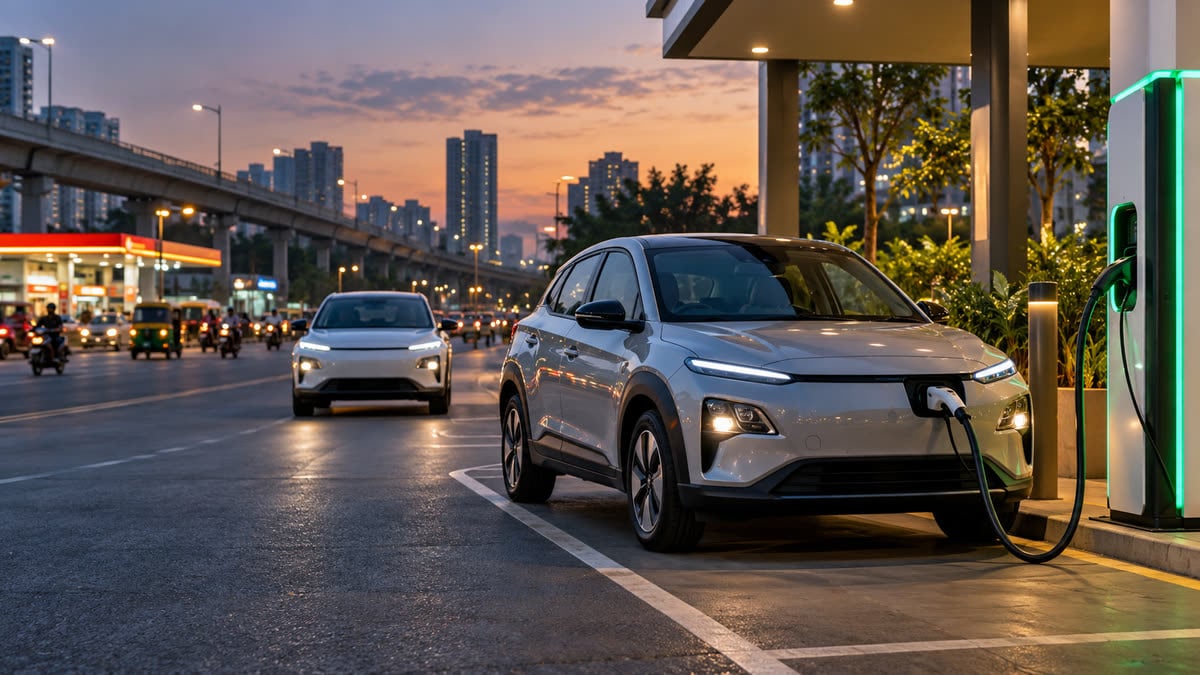
Charging access is the first check. A buyer comparing an EV with a petrol or hybrid car needs to consider whether home charging is possible, how often public charging would be needed and whether reliable stations exist along regular routes. FuelPrice's state-wise EV charging directory can help readers check the current public-charging landscape before treating a claimed range figure as a complete ownership picture.
Running cost is the next check, but it depends on the vehicle, electricity tariff, charging mix, kilometres driven and maintenance pattern. A simple comparison of petrol price with an EV's claimed per-kilometre cost can mislead if it ignores installation, financing, insurance or charging time. Readers can use the fuel cost calculator to establish their current petrol or diesel baseline, then compare that baseline with the EV's actual charging assumptions.
FuelPrice has separately covered India's rising EV penetration and the industry expectation of a 10% share by year-end in its earlier EV market report. The new Ember comparison adds an international benchmark; it does not replace India-specific registration data when a buyer is assessing local demand, resale or service support.
Fuel impact is long term, not a price promise
Ember links the EV shift to energy security. It estimates that electric-car fleets in oil-importing countries displaced about 200 million barrels of crude between March and August 2026, worth roughly $20 billion at the report's valuation. That is a global estimate, not a rupee saving for an individual Indian driver and not an estimate of India's share alone.
The Indian effect is therefore gradual. As more vehicles use electricity instead of liquid fuel, the fleet can become less exposed to a sudden crude or shipping shock. But retail petrol and diesel prices still reflect several factors, including international crude, taxes, currency movements and oil-company pricing decisions. Existing owners can monitor live fuel prices in India rather than assuming that a stronger EV sales share changes the pump rate immediately.
What to watch next
The next useful test is whether India's lead over the US persists as later registration data arrive and Ember revises earlier months. The tracker itself warns that figures can be updated as source agencies publish or revise data, so a single month should not be treated as a permanent ranking.
For the Indian market, the practical indicators are more local: whether charging networks expand beyond major urban corridors, whether new models reach more price points, and whether service and battery-support capacity keep pace with sales. Fleet operators will also need to assess route length, charging downtime and depot power availability separately from passenger-car trends.
Reader takeaway
India moving ahead of the US in BEV share is a meaningful market development, but it is not a blanket recommendation to switch powertrains. For a new-car decision, compare the vehicle's real charging access, total running assumptions and support network with the way the car will actually be used. For current petrol and diesel owners, the immediate task remains tracking the cost of each trip while watching how quickly the wider market builds the infrastructure needed for electric travel.