India’s electric passenger vehicles accounted for 8.45% of new passenger-vehicle retail sales in September 2026, up from 7.63% in August 2026 and 5.74% in September 2025, according to the Federation of Automobile Dealers Associations (FADA). A senior JSW MG Motor executive told PTI, in a report published by The Economic Times on 13 Oct 2026, that passenger-EV penetration could reach double digits by the end of 2026. That is a company expectation, not a confirmed national forecast.
+ +Key takeaways
+-
+
- Electric passenger vehicles reached an 8.45% share of India’s retail passenger-vehicle market in September 2026. +
- FADA-based reports put September electric passenger-vehicle retail at 36,108 units, up 94.56% year on year and 17.63% from August. +
- JSW MG’s double-digit year-end view is an attributed industry expectation, not a government, regulator or FADA target. +
- For buyers, charging access, daily distance, route needs and the full ownership cost matter more than the national share alone. +
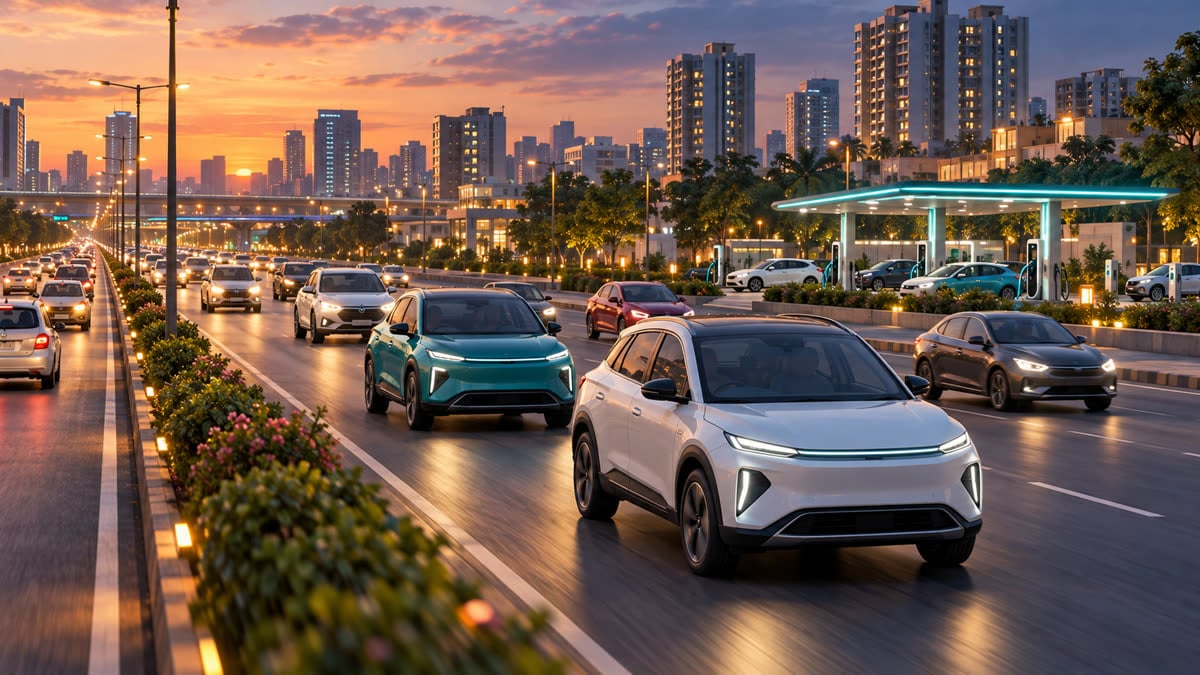
Illustrative image: a representative urban EV market scene; it is not a photograph of a specific vehicle model.
What the September EV data shows
+September’s result marks a clear change in the mix of new cars sold in India. FADA’s 6 Oct 2026 release recorded 4,27,213 passenger-vehicle retail sales during the month, a 32.10% year-on-year increase and a 6.17% rise from August 2026. Within that larger market, electric passenger vehicles reached their highest share in the FADA series at 8.45%.
+ +India Today and the Financial Express, both citing FADA data, reported 36,108 electric passenger vehicles retailed in September 2026. That was 17.63% above the 30,696 units recorded in August 2026 and 94.56% above the 18,559 units retailed in September 2025. The figures show that EV growth was not only a result of a larger overall car market: electric-car volumes also expanded sharply year on year.
+ +The broader EV picture was larger still. FADA recorded about 3.34 lakh electric vehicles across two-wheelers, three-wheelers, passenger vehicles and commercial vehicles in September 2026, taking overall EV penetration across those categories to roughly 13%. That figure should not be confused with the 8.45% passenger-car share: the categories have different purchase cycles, use cases and levels of electrification.
+ +What is confirmed and what is still a projection?
+The confirmed development is the September retail data. It is a historical measure of vehicles registered through the dealer-retail channel and gives buyers a useful picture of how common electric cars have become in new-car purchases.
+ +The double-digit year-end figure is different. The Economic Times reported on 13 Oct 2026 that Lakshmi Ram Kumar Subbaraj, JSW MG Motor’s director for sales, told PTI he would not be surprised if passenger-EV penetration reached 10% or more during the festive period or by the end of the calendar year. His view was linked to more model choices, longer driving ranges, expanding charging infrastructure, Battery-as-a-Service and stronger festive demand.
+ +That statement is useful as a market signal, but it is not a promise that the national share will reach 10%. October, November and December retail results will decide whether the threshold is crossed. The next FADA releases and independent registration data will be more reliable than any single company’s expectation for judging that outcome.
+ +Why the shift matters to Indian drivers
+A higher EV share changes the choice set available to vehicle buyers. More manufacturers are competing in the electric-car market, and the September data included meaningful volumes from established automakers as well as newer entrants. That broader supply can make it easier to compare body styles, range claims, charging arrangements and ownership terms instead of treating an EV as a niche purchase.
+ +Charging remains the practical filter. A buyer who can charge at home or at work has a different ownership pattern from someone who depends on public chargers. Before comparing running costs, it is useful to check the distance covered on a normal day, the time available for charging, the tariff or session fee at likely stops and whether the vehicle’s connector is supported. The fuel cost calculator can help compare a petrol or diesel commute with the energy-cost assumptions for an EV.
+ +Long-distance use needs a separate check. A rising national sales share does not guarantee that every highway corridor has a convenient or available charger when a particular trip is planned. The state-wise EV charging directory is a starting point for checking possible stops, while the road-trip planner can help map distance and break points before a longer journey.
+ +Fuel prices are also part of the comparison, but they are only one input. Buyers can check current petrol and diesel rates on the live fuel prices page, then compare the result with electricity costs, charging time, maintenance, insurance, financing and expected resale value. Actual ownership economics vary by vehicle, location, usage and charging access; a national penetration number cannot settle that calculation for an individual driver.
+ +What to watch through the festive quarter
+The first question is whether October retail converts the strong September momentum into another high EV share. FADA has described the festive quarter as a test of real demand, because the comparison with the previous year becomes harder once the base includes earlier tax-led buying. A second question is whether supply, pricing and charging availability keep pace with interest from buyers outside the largest cities.
+ +For vehicle buyers, the useful signal is not simply whether the market crosses 10%. It is whether electric cars remain usable for the intended commute and trips after the complete purchase and charging plan is written down. The September data shows that EVs are becoming a larger part of India’s new-car market; the next step is to see whether infrastructure, model availability and day-to-day convenience grow at the same speed.
+ +Sources
+-
+
- The Economic Times — “India EV penetration may cross 10% by year-end, says JSW MG Motor executive” — 13 Oct 2026 +
- Federation of Automobile Dealers Associations — “FADA Releases Sep’26 Vehicle Retail Data” — 6 Oct 2026 +
- India Today — “Electric passenger vehicle retail sales rise 94.56% in September 2026” — 7 Oct 2026 +
- Financial Express — “EV retail hits record as PV, 2W demand surges” — 8 Oct 2026 +