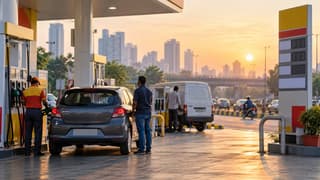
The government on Monday hiked the price of cooking gas by Rs 50 per cylinder and raised the excise duty on petrol and diesel by Rs 2 per litre each, but without changing retail prices.
The increase in cooking gas price will be for the Ujjawala - poor beneficiaries who got LPG connection free of cost - and the general users, and will be effective from April 8, Oil Minister Hardeep Singh Puri said.
Cooking gas for Ujjawala users will cost Rs 553 per 14.2-kg cylinder from the current Rs 503 in the national capital.
The same for general users will now cost Rs 853.
The rates, which vary from state to state depending on local tax incidence, were revised in March last year when they were cut by Rs 100.
Alongside, the government hiked excise duty on petrol and diesel by Rs 2 per litre each, but there will be no change in retail prices as the increase will be adjusted against the price cut that was warranted because of falling international oil prices.
The special additional excise duty on petrol has been increased from Rs 11 per litre to Rs 13, and that on diesel from Rs 8 to Rs 10 a litre.
With this, the total incidence of taxes imposed by the central government on petrol has increased to Rs 21.9 a litre (Rs 1.40 a litre basis excise duty, Rs 13 special additional excise duty, Rs 2.50 agriculture cess and Rs 5 road and infrastructure cess) from Rs 19.9 a litre.
On diesel, the total incidence has gone up from Rs 15.80 per litre to Rs 17.80 (Rs 1.80 per litre basic excise duty, Rs 10 special additional excise duty, Rs 4 agriculture cess and Rs 2 road and infra cess).
Puri said the average Saudi CP - the international benchmark used for LPG pricing since India is majorly import-dependent to meet its needs - has risen by 63 per cent to USD 629 per tonne in February 2025 from USD 385 in July 2023.
This necessitates LPG to be priced at Rs 1,028.50 per 14.2-kg cylinder in Delhi.
“But the public sector oil marketing companies have been so far modulating the prices,” he said, adding that the oil PSUs suffered under-recoveries or loss of Rs 41,338 crore in the fiscal year ended March 31 (2024-25) on account of selling LPG below cost.
In view of the mounting losses, the prices have been moderately increased.
“At current prices, the cost of cooking per day using LPG for Ujjawala household is around Rs 6.10 and that for general users is Rs 14.58, which is reasonable,” he said.
The rates, he said, will be reviewed every month and any softening will be passed on to consumers.
The Rs 50 per cylinder hike will only cover the future cost and for the past cost, the oil ministry will seek budgetary support from the finance ministry.
The additional accruals from the excise duty hike can be used to compensate the oil companies for their losses, he said.
“It is our commitment to make good their losses.
” As much as 16,000 crore litres of petrol and diesel is consumed annually in the country and the Rs 2 a litre excise hike could yield up to Rs 32,000 crore to the government.
The increase in duties will “come into force on the 8th day of April 2025”, an official order on the excise duty hike said.
While any change in taxes is normally passed on to consumers, the retail selling price of petrol and diesel will not change as the excise hike will be set off against the reduction in retail prices that was warranted by the fall in international oil prices.
Pressure mounts on Govt for petrol, diesel price cut with Brent in free-fall
International oil prices have slumped to their lowest since April 2021 as escalating trade tensions between the United States and China stoked fears of a recession that could cut oil demand.
Brent futures lost USD 2.43 or 3.7 per cent to USD 63.15 a barrel on Monday while US West Texas Intermediate crude futures were down USD 2.42, or 3.9 per cent, at USD 59.57.
India is 85 per cent dependent on imports to meet its oil needs.
“PSU Oil Marketing Companies have informed that there will be no increase in retail prices of #Petrol and #Diesel, subsequent to the increase effected in Excise Duty Rates today,” the oil ministry said in a post on X.
The Modi government, during its 11-year rule, hiked excise duty whenever international oil prices fell.
The government had between November 2014 and January 2016, raised excise duty on petrol and diesel on nine occasions to take away gains arising from plummeting global oil prices.
In all, the Rs 11.77 per litre hike in duty on petrol and 13.47 per litre on diesel in those 15 months helped the government’s excise mop-up more than double to Rs 2,42,000 crore in 2016-17 from Rs 99,000 crore in 2014-15.
The government cut excise duty by Rs 2 in October 2017 and by Rs 1.50 a year later.
But, it raised excise duty by Rs 2 per litre in July 2019.
It again hiked excise duty in March 2020 by Rs 3 per litre each.
The excise duty was raised by Rs 13 and Rs 16 per litre on petrol and diesel between March 2020 and May 2020.
But in the following years, it rolled back the Rs 13 and Rs 16 per litre excise duty hike, as international oil prices soared.
This helped bring down petrol prices from a record hike of Rs 105.41 a litre in Delhi and the highest-ever diesel rate of Rs 96.67.
Just before general elections were announced last year, the government had cut petrol and diesel prices by Rs 2 a litre each.
Petrol currently costs Rs 94.77 a litre in Delhi and Rs 87.67 is the price for a litre of diesel.
Published on April 7, 2025