India's June domestic natural gas price has moved lower, and the update is more important than it may first appear. PPAC's latest tracker lists domestic natural gas at $10.93 per MMBTU on a gross calorific value basis for the period from 1 June 2026 to 30 June 2026. Informist reported that the June price is down by nearly 6 percent from $11.59 per MMBTU in May.
For everyday fuel users, this is not the same as an immediate CNG or PNG retail price cut at the pump or on the household bill. But it is a key input signal for city-gas companies, transport fleets, auto-rickshaw operators, taxi users, small businesses, and households connected to piped natural gas. In a month when fuel costs remain a live concern for commuters and operators, a softer domestic gas price gives the market a reason to watch city-gas tariffs closely.
What changed in June
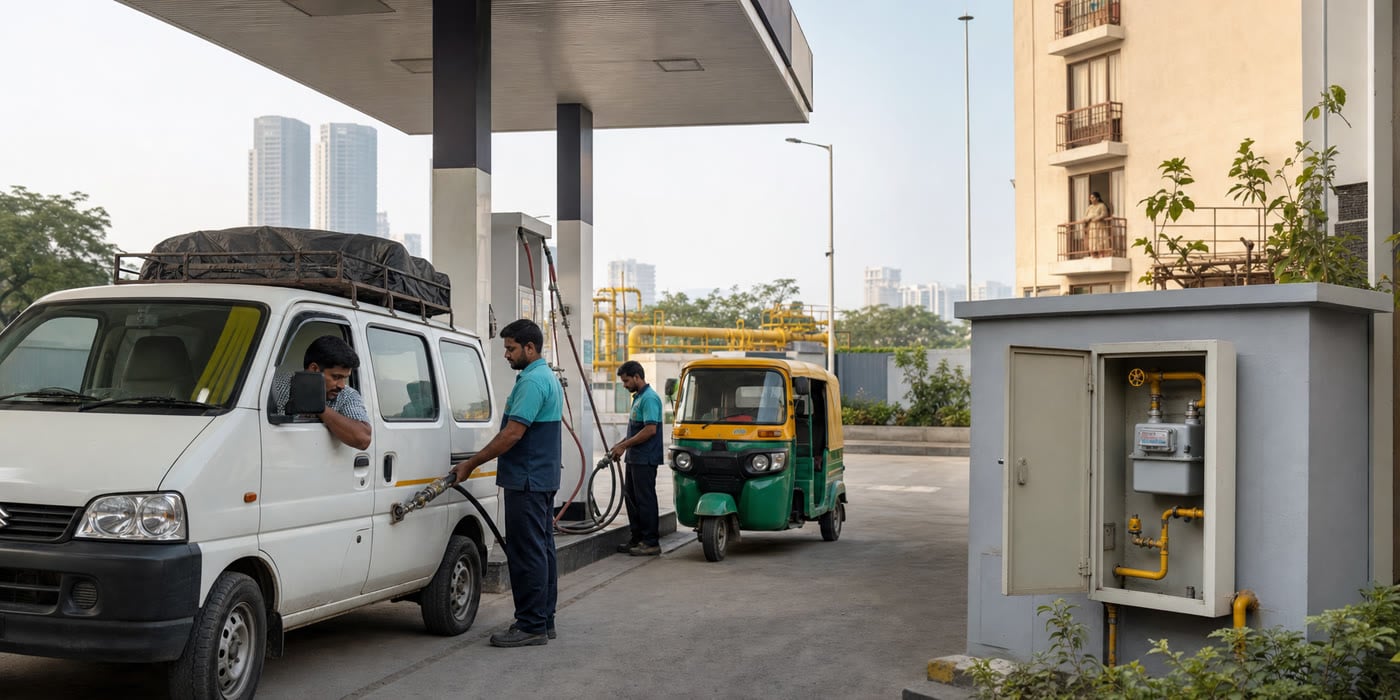
The headline number is $10.93 per MMBTU for domestic natural gas in June 2026. PPAC lists this figure for the full June period, while the same official tracker shows 1,69,49,377 domestic PNG connections and 8,916 CNG stations as of 31 March 2026. It also lists alternate fuel CNG/CBG availability at 8,001 retail outlets as of 1 April 2026. Those infrastructure numbers show why a monthly gas price notification is not a narrow upstream-market item; it connects directly to a large consumer and mobility network.
The price also sits within India's revised domestic gas pricing framework. The Cabinet-approved 2023 rules link domestic natural gas prices to 10 percent of the monthly average Indian crude basket and require monthly notification. For gas from ONGC and Oil India nomination fields under the Administered Price Mechanism, the framework also has a floor and ceiling structure. Informist reported that the ONGC and Oil India nomination-field gas ceiling for June is $7.00 per MMBTU on a gross calorific value basis.
Why CNG users should not expect an automatic cut
The biggest user question is simple: will CNG become cheaper in June? The honest answer is that the upstream price cut improves the cost signal, but it does not automatically rewrite retail CNG prices across cities. City-gas companies buy gas through a mix of allocations and contracts. They also carry distribution costs, taxes, station costs, compression expenses, margins and local market factors. Retail revisions therefore depend on each operator's cost pool and pricing decision, not just the monthly PPAC number.
Even so, the direction matters. A lower domestic gas price can ease pressure on CNG economics, especially where city-gas distributors rely heavily on domestic gas allocation for transport and household demand. It can also reduce the urgency for fresh retail hikes if crude-linked gas costs remain soft. For high-mileage users such as taxi drivers, auto-rickshaw drivers, delivery fleets and light commercial vehicles, even small CNG price changes can affect daily operating margins because fuel is a repeated cash expense, not a one-time purchase.
What it means for PNG households
PNG households should read the update as a cost signal rather than a guaranteed bill reduction. Piped gas bills depend on local tariff decisions, metered consumption, taxes and city-gas company pricing. The relevance is still direct: the same pricing framework that shapes CNG also affects household PNG procurement costs. If lower domestic gas prices persist and distribution companies pass through the benefit, monthly household cooking-gas costs can become more stable.
The scale is no longer small. PPAC's tracker shows more than 1.69 crore domestic PNG connections. That makes gas-price stability a consumer issue, not only a market issue. For urban households that compare PNG with LPG cylinders, the final decision often depends on convenience, billing transparency, connection reliability and the effective cost per unit of useful heat.
Impact on fleets, inflation and city-gas companies
The transport impact is strongest in cities where CNG is common in taxis, auto-rickshaws, buses and small commercial vehicles. When CNG costs rise, fleet operators either absorb lower margins or pass on higher fares and delivery charges. When gas procurement costs soften, the reverse may not be immediate, but it creates room for tariff stability. That matters for last-mile delivery, app-based mobility, school transport, small traders and urban freight movement.
For city-gas distribution companies, the June number can affect margin expectations and pricing flexibility. If retail CNG or PNG prices are unchanged while procurement costs decline, margins may improve. If companies pass the benefit to consumers, volumes and user sentiment may improve. The choice can vary by geography because city-gas economics differ across mature networks, newly authorised areas and regions where gas pipeline access is still developing.
Key numbers to track
| Metric | Latest figure | Why it matters |
|---|---|---|
| Domestic natural gas price | $10.93/MMBTU for June 2026 | Input-cost signal for CNG and PNG markets |
| Previous month reference | $11.59/MMBTU in May 2026 | Shows nearly 6 percent month-on-month softening |
| Domestic PNG connections | 1,69,49,377 as of 31 March 2026 | Shows household exposure to gas pricing |
| CNG stations | 8,916 as of 31 March 2026 | Shows transport-network dependence on city gas |
What changes now
For users, nothing changes until city-gas retailers announce local CNG or PNG tariff revisions. The June PPAC number is still useful because it tells users whether the cost pressure is moving up or down. It also helps fleet operators decide whether to delay price renegotiations, watch for pump-price changes, or reassess the CNG versus petrol and diesel cost gap for high-utilisation vehicles.
For policymakers, the update reinforces why the 2023 crude-linked pricing formula was introduced. The aim was to reduce volatility, make prices more current, protect consumers from extreme international gas-price shocks and keep producers incentivised. The monthly mechanism means changes in crude-price direction can feed into domestic gas pricing more transparently than the older six-month formula.
What to watch next
The next practical indicators are local CNG and PNG price announcements from city-gas companies, the July domestic gas price notification, movement in the Indian crude basket, and whether high-mileage transport users see actual retail relief. Users should also watch the gap between CNG and petrol or diesel because buying decisions for CNG cars, commercial vehicles and fleet conversions depend on per-km savings, not only on the headline price per kg.
The final takeaway is clear: June's lower domestic gas price is a positive cost signal, but not an automatic consumer-price cut. It matters because India now has a large CNG and PNG user base, and monthly gas pricing affects the economics of urban mobility, household cooking fuel, last-mile freight and city-gas distribution. For FuelPrice readers, the number to remember is $10.93/MMBTU, and the action point is to watch city-wise CNG and PNG tariff updates through June.
Sources: PPAC official tracker and important news; Informist commodity report; PIB revised domestic gas pricing guidelines; PPAC city gas distribution network; PPAC natural gas consumption data.