India’s L5 electric passenger autos overtook e-rickshaws in the July–September 2026 quarter, with 1,28,010 units against 93,036, according to EVreporter’s analysis of Vahan Dashboard data. The shift matters for last-mile operators because a confirmed Central Motor Vehicles rule requires e-rickshaws and e-carts manufactured from 1 Apr 2027 to use lithium-ion battery packs meeting AIS-156 requirements.
The data shows a change in the mix of new electric three-wheelers, not an automatic order to scrap every older lead-acid vehicle. Operators still need to distinguish the manufacturing deadline from separate registration, fitness, permit and enforcement directions that may apply in their state.
Key takeaways
- L5 electric passenger autos reached 1,28,010 sales in Q2 FY27, compared with 93,036 e-rickshaws.
- EVreporter said L5 sales were up about 122% year on year, while e-rickshaw sales fell about 16%.
- G.S.R. 835(E), notified on 11 Nov 2025, requires lithium-ion packs in e-rickshaws and e-carts made on or after 1 Apr 2027.
- The rule applies to vehicles manufactured from that date; it does not by itself state that all existing lead-acid vehicles must be removed immediately.
The market has crossed a visible threshold
EVreporter’s Q2 FY27 analysis, published on 11 Nov 2026 and based on Vahan Dashboard data as on 22 Oct 2026, places the L5 passenger category ahead of the traditional low-speed e-rickshaw category for the first time in the comparison presented. L5 sales rose from 57,738 units in the same quarter a year earlier, while e-rickshaw sales were reported at 93,036 units after a year-on-year decline.
| Category | Q2 FY27 units | Year-on-year movement |
|---|---|---|
| L5 passenger electric autos | 1,28,010 | Up about 122% |
| E-rickshaws | 93,036 | Down about 16% |
That is a gap of about 34,974 vehicles, or roughly 35,000 units, between the two categories in the quarter. EVreporter also said L5’s share of the combined passenger segment rose from about 34% to about 58%. L5 EV penetration reached 53.78%, up from 46.95% in the previous quarter, suggesting that the change is not only a shift between two body types but also a deeper move towards formal electric-auto platforms.
Why L5 sales are gaining
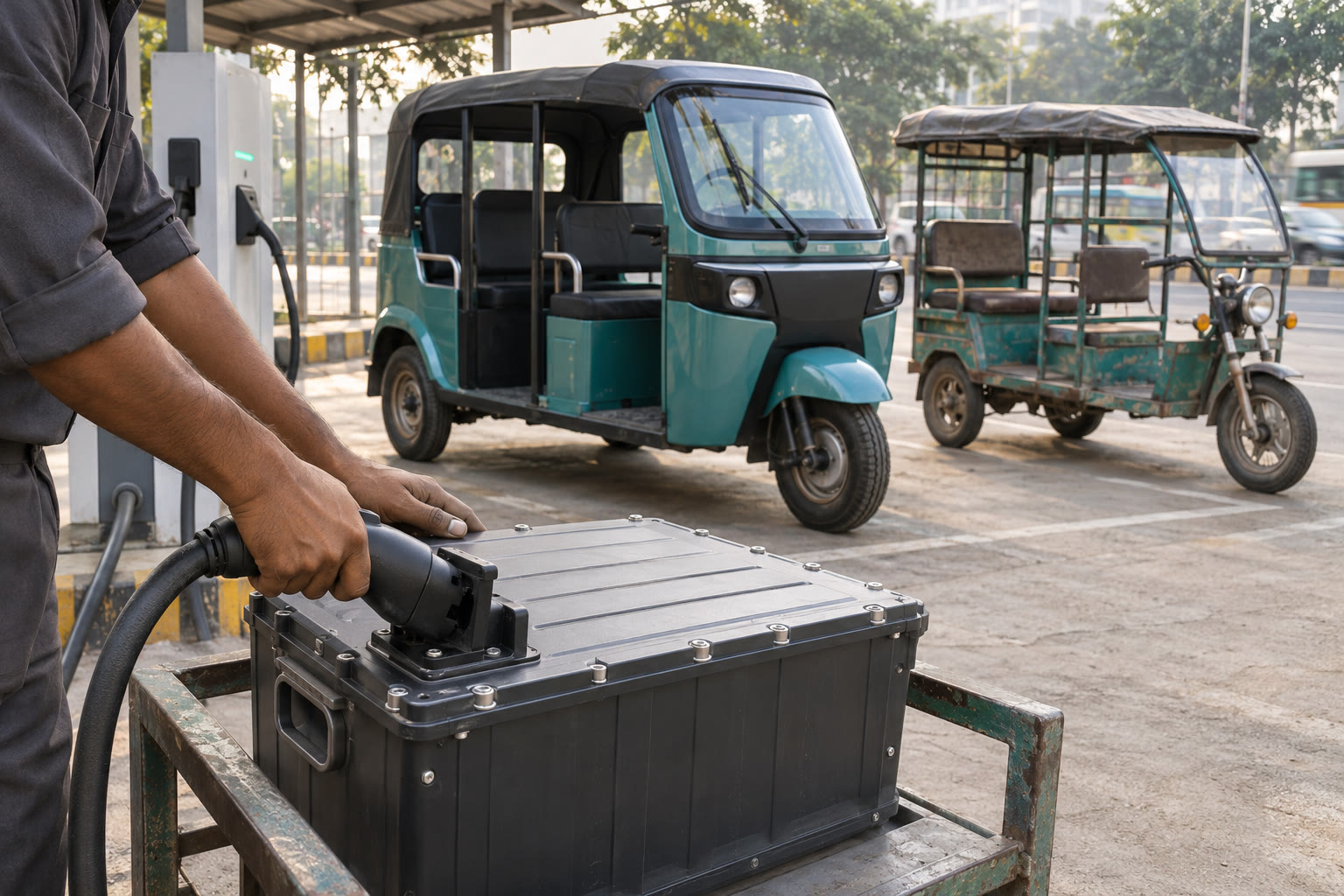
The regulatory framework is one part of the explanation. The final G.S.R. 835(E) brought e-rickshaws and e-carts into a more explicit Central Motor Vehicles Rules framework. It also introduced manufacturing-facility and process audits as part of type approval from 1 Apr 2026. For vehicles manufactured on or after 1 Apr 2027, the rule requires lithium-ion battery packs whose performance follows AIS-156 Parts 1 and 2.
Mahindra Last Mile Mobility managing director Suman Mishra linked the sales shift to regulation during Mahindra & Mahindra’s 5 Nov 2026 analyst call. He said a stronger rule would mean lead-acid e-rickshaws could no longer ply after April 2027 and that customers wanting to continue operating would move towards L5 products. That is the company’s interpretation of the market effect; the Gazette clause itself states the battery requirement for vehicles manufactured from the effective date.
The L5 category also offers manufacturers a more standardised platform for safety, type approval and fleet sales. That does not mean every L5 vehicle will suit every route. Capacity, charging access, permit conditions, passenger demand and financing costs remain separate questions for an operator.
What the change means for owners and buyers
New vehicles face a clearer compliance test
For a new e-rickshaw or e-cart planned for manufacture from 1 Apr 2027, the battery type and relevant AIS-156 compliance become central checks. Documentation around type approval, battery warranty, service support and registration will matter more than a seller’s broad claim that a vehicle is “electric”. The official PM E-DRIVE dashboard also separates e-rickshaw/e-cart and L5 categories in its Vahan-linked reporting, which helps readers avoid treating all electric three-wheelers as one market.
Existing vehicles need a separate status check
The 2027 wording is a manufacturing requirement. It is not, on its face, a universal scrappage notice for vehicles already made and registered. An owner with an older lead-acid e-rickshaw should therefore check the vehicle’s manufacturing date, registration status, fitness certificate and local permit conditions with the relevant transport authority before assuming either continued operation or compulsory replacement.
For an operator comparing a replacement with a petrol or diesel vehicle, the route’s current fuel outlay is only one part of the calculation. FuelPrice’s fuel-cost calculator can benchmark the existing fuel side, but an electric-auto comparison also needs the electricity tariff, charging time, battery warranty, maintenance, financing and downtime.
Charging and fleet economics will decide the next phase
The sales data confirms demand for L5 vehicles; it does not prove that every fleet will recover its purchase cost at the same speed. A vehicle that runs many hours daily may value charging turnaround and service availability differently from an owner using it for short local trips. Operators should also check whether a public charger supports the vehicle’s connector and charging rate, whether it is open during operating hours and how payment is handled. FuelPrice’s EV station directory can help locate public charging points, but availability should be confirmed before a route is planned around one.
The broader market signal is still important for drivers and fleet financiers: the L5 category is no longer a small alternative inside electric three-wheelers. If the trend continues, manufacturers, dealers, service networks and lenders will have to support a larger installed base of higher-spec electric autos, while e-rickshaw makers will need to meet the battery and safety framework.
What to watch before 1 Apr 2027
- Whether MoRTH or state transport authorities issue additional guidance for vehicles manufactured before the lithium-ion deadline.
- How type-approval agencies and registration offices document AIS-156 compliance for new e-rickshaws and e-carts.
- Whether the next Vahan data releases show L5 growth continuing after incentives and regulatory changes.
- Whether charging, service and battery-replacement networks expand alongside the larger L5 vehicle base.
Reader takeaway
India’s Q2 FY27 registration data marks a clear market shift: L5 electric passenger autos sold about 35,000 more units than e-rickshaws in the quarter. For operators, the immediate takeaway is to treat 1 Apr 2027 as a confirmed manufacturing-compliance milestone, while checking separate state-level rules before making claims about existing vehicles, permits or replacement costs.
Sources
- EVreporter, “E-Rickshaws Lose Ground as L5 Electric Auto Sales Surge in India”, 11 Nov 2026.
- Ministry of Heavy Industries, PM E-DRIVE Sales Dashboard, Vahan-linked data as on 5 Nov 2026.
- Ministry of Road Transport and Highways, G.S.R. 835(E), Central Motor Vehicles (Seventh Amendment) Rules, 2025, 11 Nov 2025.
- Mahindra & Mahindra, Q2 FY27 Analyst Meet transcript, 5 Nov 2026.