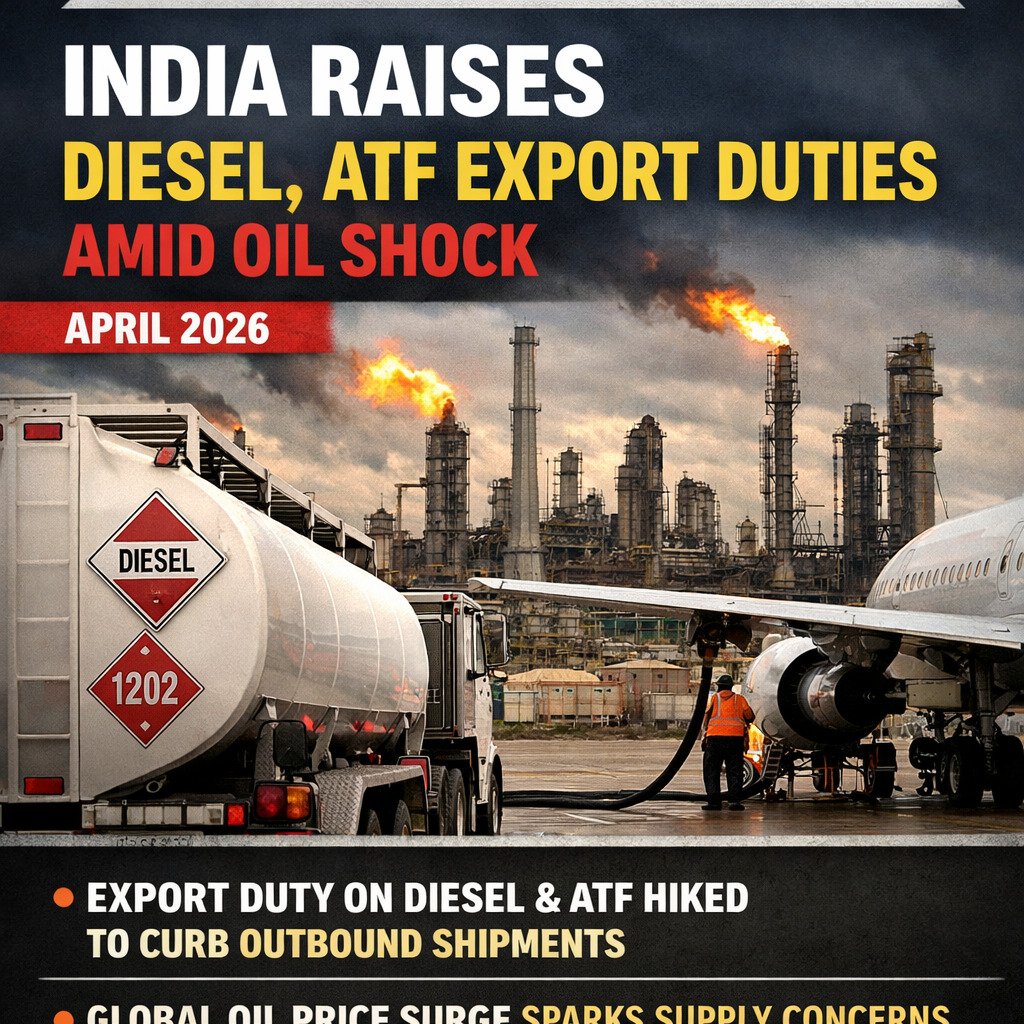
India has raised export duties on diesel and aviation turbine fuel in one of the clearest policy signals yet that the current oil shock is no longer being treated as a temporary price spike. The move is aimed at protecting domestic supply, limiting stress on local fuel markets and reducing the risk of an even sharper pass-through to transport and aviation costs.
This matters because India is balancing two competing priorities at once. On one side, it wants refiners to remain commercially viable and competitive. On the other, it cannot allow a global supply shock to turn into a domestic fuel-availability or airfare crisis. The new export duties are part of that balancing act.
Key points
- Diesel export duty has been increased sharply.
- ATF export duty has also been raised effective immediately.
- India previously cut excise duty on petrol and diesel by ₹10 per litre.
- The government has also capped monthly ATF price increases for domestic airlines at 25 percent in April.
Why the government acted now
The immediate backdrop is clear: global oil prices have moved above $100 per barrel as Middle East supply and transport routes remain under stress. For India, this is especially serious because a large part of its crude-import chain depends on flows through the Strait of Hormuz. When that route becomes unstable, the country’s energy risk rises sharply.
By raising export duties on diesel and ATF, the government is effectively making it less attractive to ship these fuels out when domestic stability is the higher priority. This does not eliminate the global shock, but it can slow the pace at which domestic shortages or price surges become unmanageable.
What it means for fuel markets
For the domestic market, the move is designed to improve availability and reduce the risk that refiners prioritise external realizations too aggressively during a crisis. In a tight global market, export economics can become very attractive. Policy steps like this are meant to preserve supply for local buyers, especially in transport and aviation.
For refiners, however, the decision is a mixed one. The domestic market gets protection, but export margins become less attractive. That may be acceptable in a crisis, but it also means the government is effectively redistributing some of the shock from consumers to refiners and exporters.
Airline and transport impact
ATF is one of the biggest cost lines for airlines, often accounting for a very large share of total operating expenses. That is why the government’s decision to cap monthly domestic ATF price increases in April is equally important. Without intervention, rising jet-fuel prices can very quickly lead to fare hikes, capacity pressure and reduced travel demand.
Diesel matters even more broadly. It influences trucking, logistics, industrial transport and large parts of the goods supply chain. A diesel shock raises costs across agriculture, retail distribution, construction and manufacturing. In that sense, diesel is not just a transport fuel; it is an inflation channel.
Who gains and who loses
Consumers and domestic transport-linked users stand to benefit if the move successfully reduces local stress and limits price spikes. Airlines also gain from the cap on domestic ATF increases, at least temporarily. Export-focused refiners, by contrast, face a less favourable pricing environment when duties rise.
The government is therefore making a strategic choice: give up some export-side freedom in order to preserve domestic fuel stability. That is usually what countries do when an international supply shock risks turning into a domestic inflation event.
Wider economic reading
The latest action shows how quickly energy shocks move from commodity markets into policy. It also shows that fuel management is now a macroeconomic issue, not just an oil-industry issue. If crude stays elevated, more interventions on taxation, pricing and supply management could follow.
FuelPrice view: The export-duty hike is less about punishing refiners and more about buying time for the domestic economy. The real test will be whether crude cools soon enough for these controls to remain temporary rather than becoming part of a longer fuel-management regime.