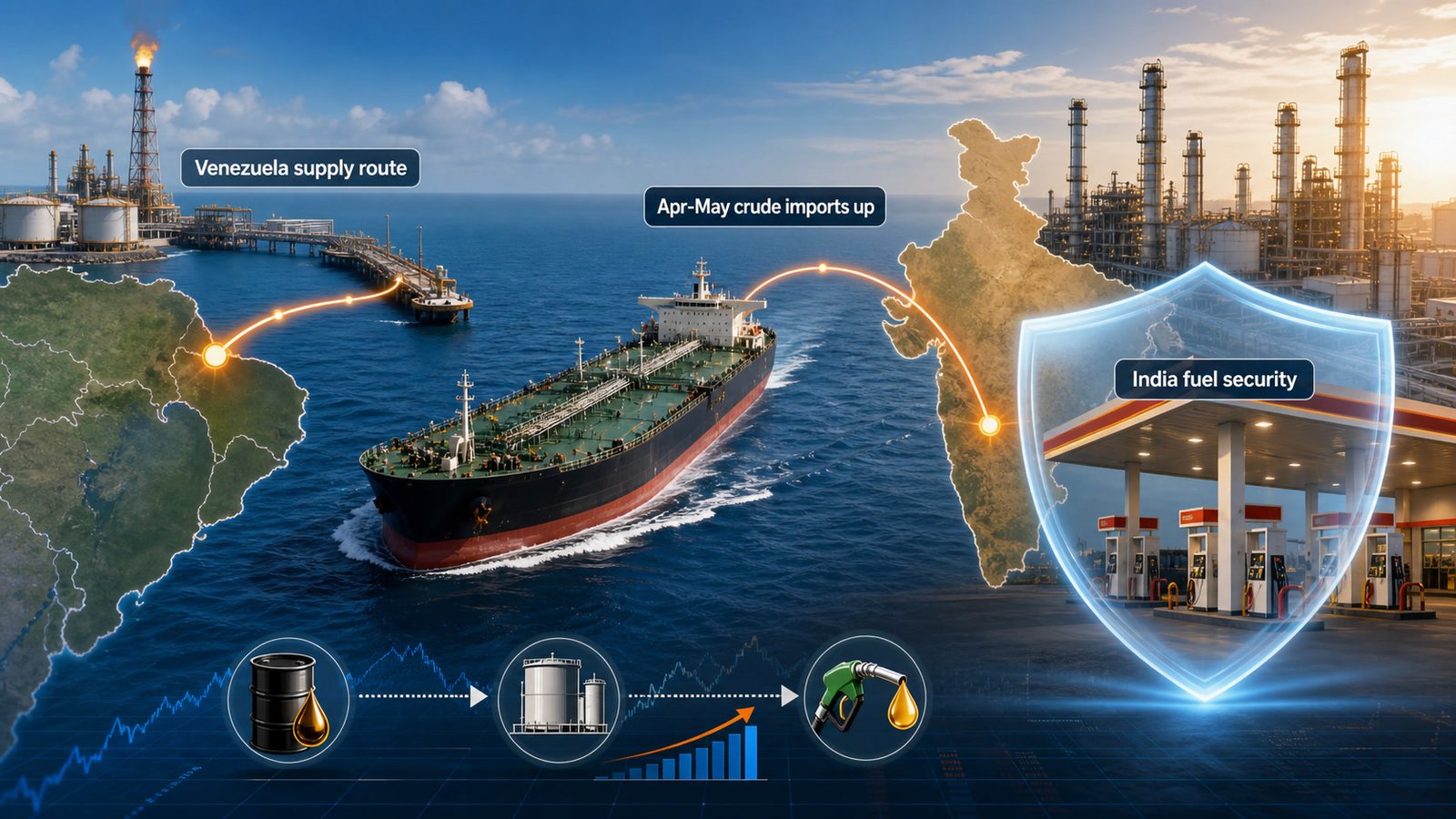
India has moved another step toward widening its crude oil supply base, with Petroleum and Natural Gas Minister Hardeep Singh Puri holding talks in New Delhi with Venezuela's Acting President Delcy Rodriguez on June 4, 2026. The Petroleum Ministry said the discussion focused on building an enduring energy partnership, deeper Indian company participation in Venezuela's oil and gas sector, and stronger bilateral energy trade.
For regular fuel users, this may sound like a distant diplomatic update. It is not. India imports most of the crude it processes into petrol, diesel, ATF, LPG-linked products and petrochemicals. When supply routes become uncertain or crude grades become expensive, the pressure eventually reaches refiners, oil marketing companies, transporters, airlines, fleet operators and household budgets. A broader crude basket is one of the ways India tries to reduce that pressure.
What Happened
According to the official PIB release, Puri reaffirmed Venezuela's importance in India's energy diversification strategy and said Indian companies are ready to deepen their presence in Venezuela. Rodriguez, in turn, welcomed Indian companies to participate in Venezuela's reformed oil and gas sector and invited an Indian delegation to visit Venezuela to explore further collaboration.
The timing is important. The ministry said geopolitical and supply disruptions have affected crude imports from the Gulf, making Venezuela a strategic partner for diversification. Venezuela is among India's largest crude suppliers in April and May 2026, and India's average monthly imports from Venezuela increased from 64.027 thousand metric tonnes during FY 2025-26 to 1,047.148 thousand metric tonnes in April-May of FY 2026-27.
| Key point | Reported detail | FuelPrice impact |
|---|---|---|
| Talks held | Puri met Rodriguez in New Delhi on June 4, 2026 | Energy trade is now a direct bilateral priority. |
| Import surge | 64.027 TMT monthly average in FY 2025-26 to 1,047.148 TMT in Apr-May FY 2026-27 | Venezuela is no longer a marginal crude source in the current window. |
| May crude purchases | Reuters reported Indian purchases around 427,000 barrels per day in May | Higher volumes can help refiners balance supply shocks. |
| Indian investment | About USD 1 billion in San Cristobal and Petrocarabobo-1 projects | Existing upstream exposure gives India a base for deeper participation. |
Why Venezuela Matters To Indian Refiners
Venezuela is not just another supplier name. It has the world's largest proven oil reserves and is known for heavy crude grades. India has a sophisticated refining system, including large complex refineries that can process heavier and more challenging crude grades. This matters because every refinery cannot handle every crude in the same way. A refinery that can process heavy crude can sometimes capture better margins if the grade is available at the right price and logistics cost.
That flexibility is valuable when global oil trade is unsettled. India has already had to balance Russian flows, Gulf dependence, freight risk, sanctions-linked uncertainty and product-market pressure. Adding more Venezuelan crude does not remove those risks, but it gives refiners another option. For fuel pricing, optionality matters because a narrow supplier base can make supply shocks more expensive and harder to manage.
Who Is Affected
The first affected group is refiners. Venezuelan heavy crude can fit specific refinery configurations, but it also requires careful planning around quality, shipping, payment, storage and product yield. Public sector oil companies are important because the official meeting included chairpersons of various public sector oil companies, and Indian PSUs already have a presence in Venezuela's upstream sector since 2008.
The second group is oil marketing companies and transport users. If crude procurement becomes more diversified and stable, OMCs get more room to manage refinery feedstock and product supply. That does not automatically mean petrol and diesel prices will fall at the pump. Taxes, exchange rates, freight, refinery margins and government pricing decisions still matter. But a stronger import mix can reduce the chance that one regional disruption immediately becomes a domestic fuel-supply stress point.
The third group is logistics and industry. Diesel-heavy freight, buses, construction equipment, agriculture transport and ports all depend on steady fuel availability. A crude-supply disruption can pass through to diesel availability, transport surcharges and delivery costs. Any serious diversification effort is therefore not only an energy-diplomacy story; it is a freight-cost and inflation-risk story.
What Changes Now
The immediate change is policy signalling. India is publicly treating Venezuela as a strategic crude partner rather than a small opportunistic supplier. The import jump in April-May gives that signal weight. The next practical step would be deeper technical engagement, possible visits by Indian energy delegations, and commercial discussions involving upstream projects, crude lifting, refinery compatibility and long-term supply arrangements.
The risks remain clear. Venezuelan oil flows are exposed to geopolitics, sanctions, shipping finance, insurance and internal production constraints. Heavy crude also requires compatible refinery units and commercial discipline. If the price advantage narrows or logistics becomes difficult, refiners may reduce intake. That is why this story should be read as a diversification move, not a guarantee of cheaper fuel.
Reader Takeaway
India's Venezuela outreach is important because crude sourcing sits upstream of every petrol, diesel and logistics cost discussion. More Venezuelan crude can help India diversify away from overdependence on a few routes and grades, especially during Gulf-linked disruptions. The benefit for consumers will depend on whether the volumes are stable, competitively priced, technically suitable for refineries and insulated from geopolitical shocks. For now, the message is clear: energy security is being built barrel by barrel, and Venezuela has moved back into India's serious crude-supply conversation.
Sources: PIB Petroleum Ministry release; Business Recorder / Reuters; Hindustan Times / Reuters; DD India; Indian PSU; The Federal.