Indian Bank has launched IND Green Charge, a financing scheme for public, captive and fleet electric-vehicle charging stations, and is targeting ₹100 crore of lending in the remaining five months of financial year 2026–27. The bank says the scheme can offer loans of up to ₹10 crore for a maximum tenure of eight years, giving charging operators a new commercial-finance route but not an assured approval or a consumer EV discount.
Business Standard, Moneycontrol and The Economic Times reported the announcement after Indian Bank managing director and CEO Binod Kumar told PTI about the product on 1 Nov 2026. The reports describe the lending target and broad eligibility, but do not publish an interest rate, promoter margin, collateral requirement or processing fee. That missing information is important: a headline loan limit is not the same as a project’s final borrowing cost.
Key takeaways
- IND Green Charge covers public, captive and fleet charging stations under standalone and franchise models.
- Indian Bank is targeting ₹100 crore of lending during the remaining five months of FY27 and ₹250 crore in the following financial year.
- The reported maximum loan size is ₹10 crore, with repayment extending up to eight years.
- Interest rates, margin, security, fees and any moratorium were not specified in the public announcement reviewed.
- For EV users, the scheme could support more charging sites over time, but it does not announce a charger count or a rollout timetable.
What Indian Bank has announced
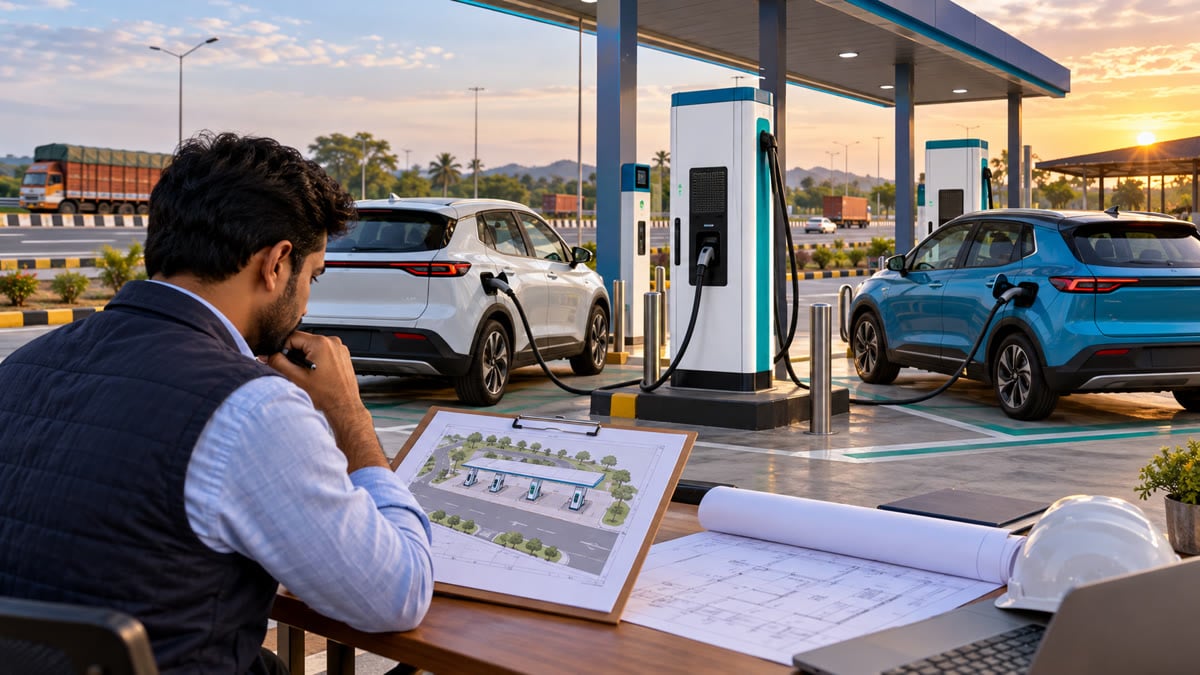
The scheme is aimed at businesses and entrepreneurs setting up charging facilities rather than people financing a private electric car. The reported coverage includes stations open to the public, captive facilities for a company or premises, and charging infrastructure serving vehicle fleets. Both a standalone station and a franchise model are included in the announcement.
| Announced item | Reported detail | How to read it |
|---|---|---|
| FY27 lending target | ₹100 crore | Target for the remaining five months of FY27; reported 1 Nov 2026 |
| Following-year target | ₹250 crore | Management target for the coming financial year; reported 1 Nov 2026 |
| Maximum loan size | Up to ₹10 crore | Reported ceiling, not a guaranteed sanction |
| Maximum tenure | Eight years | Reported maximum repayment period |
| Station models | Public, captive and fleet | Standalone and franchise models are included |
Who the scheme is meant to cover
Indian Bank said it would consider proposals in smaller cities and semi-urban areas as well as larger markets. The bank’s stated assessment factors include local demand, location suitability, expected charger utilisation and repayment capacity. It also said it had reviewed AC, DC and high-capacity DC charging projects under different utilisation scenarios before introducing the product.
Those statements describe the bank’s lending approach, not a promise that a station at any particular location will be funded. A project’s electricity connection, land or lease rights, local permissions, equipment standards, maintenance plan and expected usage would still affect its feasibility. The reports do not establish a universal checklist or approval threshold for every applicant.
What has not been disclosed yet
The announcement does not state the interest-rate range, whether the rate is fixed or floating, the required promoter contribution, collateral or primary security, processing charges, insurance requirements, moratorium, or the treatment of interest during construction. These are material terms for a charging project because revenue depends on how quickly a site reaches usable demand.
The official Indian Bank press-release index available at publication did not show a full public product sheet for IND Green Charge. The most detailed figures currently come from the managing director’s PTI briefing, reproduced by several outlets. Operators therefore need to distinguish the reported scheme outline from terms that have not yet been issued in a formal document.
What it could mean for EV users
More bank finance can make it easier for eligible businesses to evaluate charging sites, especially where equipment and electrical work create a large upfront requirement. But the announcement does not say how many stations will be built, where they will be located or when they will open. The practical effect for a driver will depend on whether funded projects reach high-demand corridors and remain operational after launch.
Drivers planning an electric trip can check the state-wise EV charging station directory for currently listed locations rather than treating the loan announcement as evidence of a live charger nearby. The road-trip planner can help place charging stops into a route, while operators comparing an EV fleet with petrol or diesel vehicles can use the fuel-cost calculator to model the conventional-fuel side of a trip. Those tools do not replace a lender’s project assessment or a site-specific electricity and tariff study.
How this differs from a government subsidy
IND Green Charge is a commercial bank-finance product. It is separate from the central PM E-DRIVE programme, which supports electric mobility and charging infrastructure through a government scheme. A bank loan can create a repayment obligation; it should not be described as a subsidy, grant or guaranteed return for a charging-site operator.
What to watch next
The next useful development would be a product circular or application document showing the interest-rate method, security, margin, fees, eligible project costs and disbursement conditions. The bank’s actual lending and the number of projects reaching construction will matter more for the charging network than the headline target alone. Until those details are published, the scheme is best understood as a new announced funding channel, not a confirmed expansion count.
Sources
- Business Standard — Indian Bank targets ₹100 crore lending under EV charging scheme in FY27: MD — 1 Nov 2026
- Moneycontrol — Indian Bank targets Rs 100 crore lending under EV charging scheme in FY27: MD — 1 Nov 2026
- The Economic Times — Indian Bank targets Rs 100 cr lending under EV charging scheme in FY27: MD — 1 Nov 2026
- Indian Bank — Press Releases and Latest Announcements — accessed 1 Nov 2026
- Press Information Bureau — PM E-DRIVE Scheme factsheet — 1 Oct 2026
- Zevpoint — EV Charging Station Loan: SBI EV Mitra and IND Green Charge — 1 Nov 2026
This article is for general information only and is not financial, insurance or legal advice.