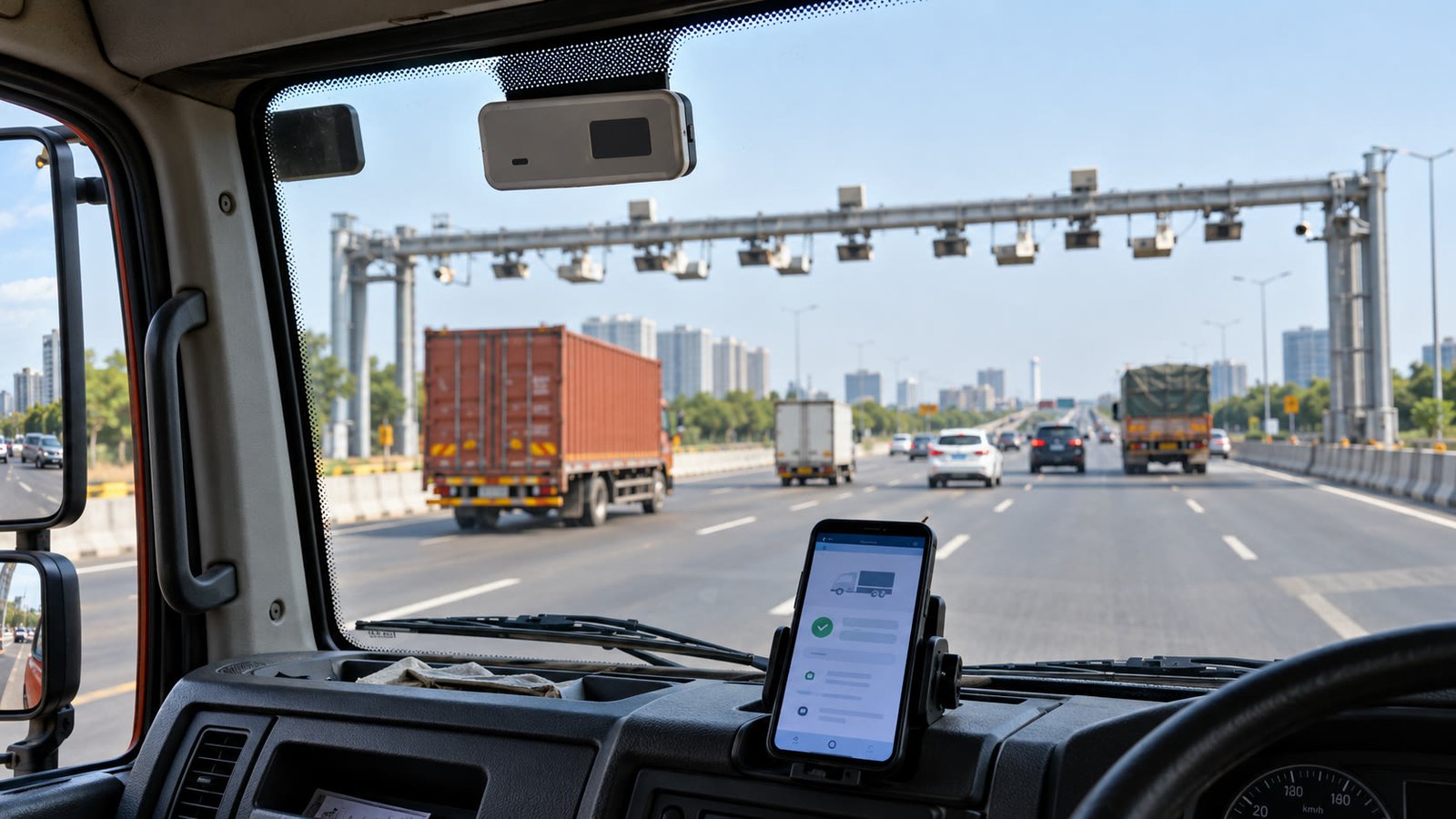
Delhi’s Municipal Corporation has approved a barrier-free, multi-lane free-flow (MLFF) upgrade for its RFID toll network, with 20 major entry points targeted in the first phase. The change is intended to let commercial vehicles pass under gantries while RFID and automatic number plate recognition (ANPR) systems identify the vehicle and collect road tax and environmental compensation charge (ECC), reducing stop-and-go queues at Delhi borders.
Key takeaways
- The immediate plan targets 20 major entry points out of the wider Delhi border network; the locations are expected to cover nearly 85% of traffic entering the city, according to The Times of India.
- Hindustan Times and The Tribune described the approved upgrade at 126 toll collection points, while the Times of India report referred to 154 toll points. These are different scope counts in the reports, not a reason to assume the whole network is already live.
- RFID readers and ANPR cameras are meant to record moving vehicles, deduct the applicable charge and generate digital notices where a payment is not completed.
- The approval is part of a wider project reported at about ₹924 crore by Hindustan Times and ₹923.57 crore by The Tribune; that package also includes mechanical road sweeping, so it is not a toll-only cost.
- The latest reports describe a planned trial and phased rollout, not a confirmed full-city go-live or a new toll tariff.
What the approval covers
The MCD standing committee approved an upgrade of the existing RFID collection system to MLFF technology, according to reports published on 31 October 2026 by Hindustan Times and The Tribune. In practical terms, the change is designed to move toll collection away from a vehicle stopping at a booth and towards a gantry that reads the vehicle while it is moving.
The financial figures need careful reading. Hindustan Times put the combined project at ₹924 crore, while The Tribune reported ₹923.57 crore. Both reports said the package includes 70 mechanical road-cleaning machines as well as the toll-system upgrade. A driver should therefore not read either figure as the price of installing MLFF alone.
How barrier-free tolling is expected to work
Under the reported design, a commercial vehicle approaches a gantry fitted with RFID equipment and ANPR cameras. The RFID system checks the tag, while ANPR records the registration number for verification. The applicable road tax and ECC can then be processed without the vehicle joining a conventional barrier queue. If a passage is recorded but the charge is not paid, a digital notice can be generated.
An official Indian Highways Management Company Limited (IHMCL) RFP for an ANPR-RFID MLFF system in the Delhi-NCR region describes the same broad operating model: gantry-mounted sensors capture vehicle information, the data connects to the electronic toll ecosystem and the system can support e-notice management. That document is a technical procurement reference, not proof that every MCD location has gone live.
Why the numbers look different
The first-phase count comes from the deadline story. The Times of India reported that MCD was targeting 20 of 154 toll points by 31 October, with the selected locations accounting for nearly 85% of traffic entering Delhi and the remaining points planned by the end of December. Hindustan Times, reporting on the standing committee approval, described the existing RFID system as covering 126 toll collection points. The Tribune also referred to 126 entry points.
The safest reading is that 20 refers to the priority rollout locations, while 126 and 154 describe broader administrative or border-network scopes used in separate reports. Until MCD publishes a live-location list and go-live notice, operators should not assume that every entry point has switched to barrier-free collection.
What it means for fleet operators
For trucks, buses and other commercial vehicles entering Delhi, the potential gain is less stopping and idling at border collection points. That may make journey times more predictable, but the reports do not promise a fixed time saving and do not announce a change in the underlying tax or ECC rates. The main operational change is how a passage is identified, charged and followed up.
- Check the tag-vehicle match: make sure the FASTag or RFID identifier used for the vehicle is linked to the correct registration details.
- Monitor the balance and alerts: a moving-vehicle system still depends on a valid tag, an active account and a successful payment response.
- Keep payment records: retain transaction messages and reconcile them with trip logs, especially while trial operations and manual fallback arrangements may overlap.
- Watch for digital notices: an e-notice should be checked against the vehicle, date, location and charge before it is treated as a valid liability.
Operators planning a Delhi corridor can use the toll-charge calculator to estimate the known trip charges, then keep a separate allowance for any MCD entry tax or ECC that applies to their vehicle category. The new technology changes collection, not the need to verify the applicable charge.
What private motorists should know
The current reports focus on commercial vehicles and MCD border-entry collection. A private car driver should not assume that this approval changes ordinary National Highway toll rates or activates a universal free passage. The immediate benefit being pursued is smoother movement at selected entry points, while the exact vehicle categories and payment rules will depend on MCD’s operating notices.
For a mixed road trip that includes Delhi entry traffic, the fuel cost calculator can help separate fuel spending from toll and entry charges. Readers following the national shift to barrierless collection can also review our earlier report on the planned 154-point MCD rollout; this is a material follow-up because the committee has now approved the upgrade and identified a 20-point first phase.
What happens next
The Times of India reported that MCD planned a trial run at the 20 priority locations in the following week. The same report said the remaining points were expected to be covered by the end of December. Those are implementation targets, so the practical test will be whether vehicles can pass without barriers, whether the correct RFID and ANPR records are created and whether disputed or unpaid passages can be resolved through a clear notice process.
For now, the reader takeaway is straightforward: Delhi is moving towards barrier-free toll collection, but the first phase is limited and the system is not yet confirmed as live across the city. Fleet operators should continue to follow existing toll instructions, keep tags and vehicle records current, and wait for location-specific MCD notices before changing payment or route procedures.
Sources
- Hindustan Times — “MCD clears ₹924-cr plan for mechanical sweeping, barrier-free toll” (31 Oct 2026)
- The Times of India — “MCD races against time to make multi-lane free flow tolling system operational at 20 entry points” (30 Oct 2026)
- The Tribune — “Delhi civic body clears Rs 923-cr road sweeping project” (31 Oct 2026)
- Indian Highways Management Company Limited — “RFP for Selection of Acquirer Bank for FASTag-ANPR based Multi Lane Free Flow (MLFF) User Fee Collection at 14 Fee Plazas in the Delhi NCR Region” (10 Mar 2026)