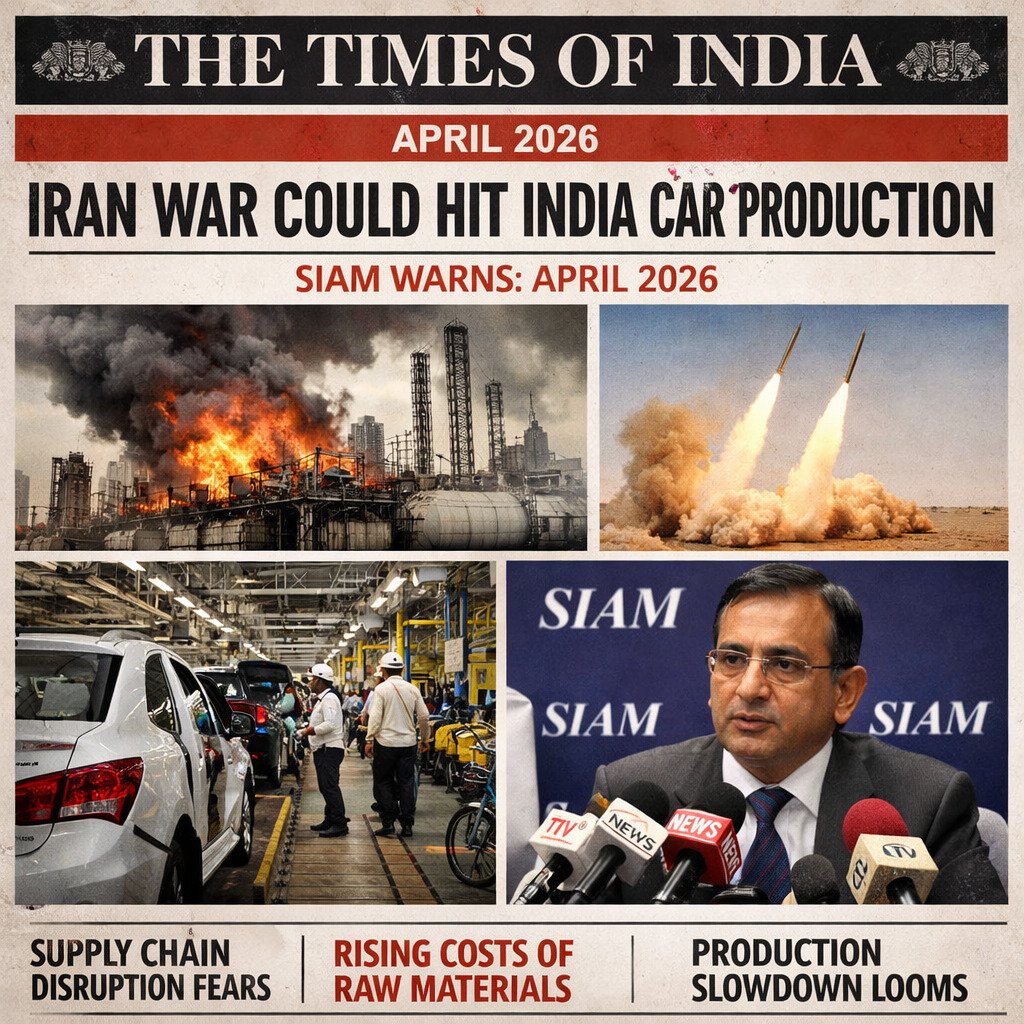
India’s automotive sector has entered a more fragile phase after the industry body SIAM warned that the ongoing West Asia conflict could begin to hurt vehicle production, export flows and cost structures. This is not just another geopolitical headline for the auto sector. It directly affects fuel prices, freight routes, imported inputs, buyer sentiment and the economics of making and moving vehicles in one of the world’s largest auto markets.
The warning matters because India’s auto sector is extremely sensitive to oil-linked shocks. When crude rises, the effect does not stop at the fuel pump. It travels through plastics, paints, tyres, logistics, shipping, steel and aluminium pricing, dealer dispatches and ultimately showroom conversions. SIAM’s remarks effectively confirm that the industry is now looking beyond demand and watching the cost side with much more urgency.
Key points
- SIAM says the West Asia conflict could create short-term challenges for India’s auto sector.
- Main pressure points are crude prices, commodity inflation, exchange-rate moves and shipping disruption.
- Entry-level vehicle enquiries remain healthy, but conversion into sales is taking longer.
- Exports and supply chains could face more uncertainty if the conflict stays prolonged.
What happened
The latest warning from SIAM comes at a time when India’s vehicle market had otherwise been enjoying a healthier demand backdrop, helped by tax cuts and a more supportive affordability environment. But the West Asia war has changed the tone. Industry leaders are now openly discussing supply-chain calibration, energy diversification and cost risk rather than simply production growth and new launches.
That shift is important because it suggests the concern is no longer theoretical. The auto industry is preparing for scenarios in which oil remains expensive, shipping stays irregular and imported components or materials become harder to source on predictable timelines. Analysts have already started warning that export volumes could soften in the near term and that the sector may need to become more flexible in sourcing and production planning.
Why fuel matters so much to vehicle production
Fuel does not affect the auto industry in only one way. First, higher petrol and diesel prices change the consumer side of the equation by raising running costs and often weakening purchase confidence, especially in the entry-level segment. Second, fuel is tied to freight, plant operations and supplier economics. Third, crude price shocks tend to spill into feedstock-linked materials such as plastics, synthetic rubber and chemical coatings.
That is why a fuel shock quickly becomes a vehicle-cost shock. Carmakers do not only worry about whether customers can afford to drive the product. They also worry about whether they can manufacture it within planned cost assumptions. If the cost stack rises too fast, price hikes become more likely, and that then creates a fresh demand problem.
Impact on buyers and dealers
The most immediate effect is likely to show up in the budget and entry-level space, where buyers are highly sensitive to both running costs and monthly finance outgo. SIAM’s own comment that enquiries are strong but conversions are slower is a useful signal. It suggests consumers are still interested, but they are becoming more hesitant before signing up.
Dealers may face a double challenge if the conflict drags on: supply irregularity on one side and softer conviction from buyers on the other. That mix is dangerous because it can reduce model availability while also increasing dependence on offers and discounts. In the premium segment, the impact may be more delayed, but even there, freight rates and imported-component costs can eventually influence margins and waiting periods.
Sector-level winners and losers
Large, diversified players with stronger sourcing flexibility and better pricing power are usually better placed to absorb oil-linked shocks. Companies with deeper localisation, stronger balance sheets and better inventory planning may handle this phase more smoothly. Export-heavy businesses, or firms reliant on more exposed shipping routes, may find the near term more difficult.
This is also the kind of environment in which fuel-efficient vehicles, hybrids and EVs tend to gain fresh attention. When buyers start worrying about petrol and diesel affordability, the conversation around total cost of ownership changes quickly. That does not mean an instant shift in market share, but it does mean fuel turbulence can alter the direction of demand.
What to watch next
The next key indicators will be freight stability, input inflation, export dispatch trends and the pace of model-level price increases across the industry. If crude remains elevated and shipping disruption worsens, the pressure on manufacturers and suppliers will build faster. If the conflict cools, the sector may still escape with only a temporary cost spike.
FuelPrice view: This is no longer a distant geopolitical risk. For India’s auto industry, the fuel shock, freight shock and supply-chain shock are now converging into one story. Carmakers can still manage through it, but the margin for error is narrowing.