JSW Group's reported plan for a 30 GWh lithium-ion cell plant is one of the more important EV supply-chain stories for India because it goes beyond vehicle launches and directly targets the most expensive, import-sensitive part of an electric vehicle: the battery cell.
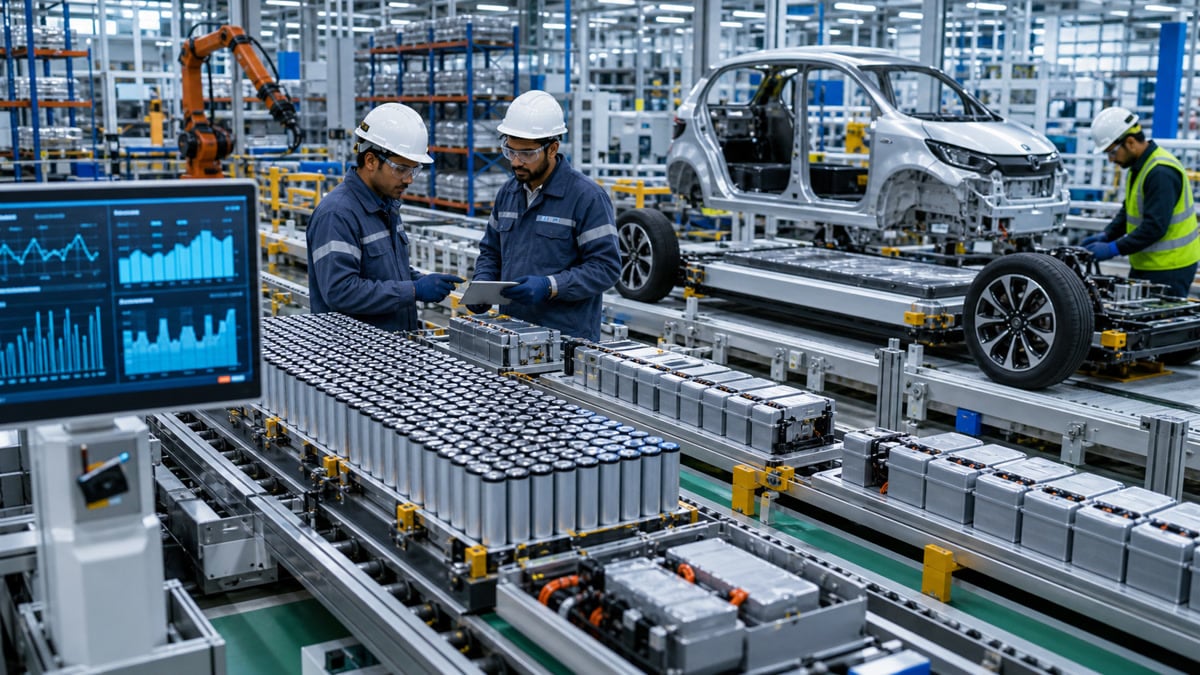
Editorial visual showing battery cell manufacturing and EV assembly as part of India's localisation push.What happened
Business Standard reported that JSW Group has finalised plans to set up a 30 gigawatt-hour lithium-ion cell plant with a joint venture partner, with investment of more than $1.3 billion. The reported plan is linked to JSW's new energy vehicle ambitions and its effort to localise key technology for future electric and hybrid vehicles.
The project is expected to be built in two phases. The first phase would create 10 GWh capacity with an investment of about $700-750 million, while the second phase would add another 20 GWh with about $600 million more. The report also said JSW is evaluating partner and location options, including Southeast Asia, while it builds an interim India-side plan for battery assembly and component manufacturing.
Why this matters for EV buyers and the auto market
Battery cells are the cost centre of an electric vehicle. India has made progress in EV assembly, battery pack assembly and charging networks, but cell manufacturing remains the hard part. Cells require deep technology access, large capital expenditure, supply of raw materials, long validation cycles and consistent quality control. If India wants electric cars, buses and two-wheelers to become more affordable, battery localisation has to move from announcements to scale.
For vehicle buyers, the impact will not be immediate. A planned cell plant does not reduce showroom prices tomorrow. But it can influence the next phase of EV pricing, battery warranty confidence, battery-as-a-service models and spare-part availability. If JSW succeeds in building cell capacity tied to its vehicle roadmap, it could reduce dependence on imported cells and give the company more control over battery chemistry, cost and supply reliability.
The supply-chain angle: why 30 GWh is significant
A 30 GWh cell plan is not a token pilot. It is large enough to support a meaningful new energy vehicle pipeline if executed on schedule. Business Standard reported that JSW is looking at lithium iron phosphate chemistry, which is widely used in cost-focused EVs and is generally considered suitable for hot operating conditions. That chemistry choice matters for India, where affordability, thermal performance and durability are central to consumer confidence.
The report also highlighted a practical reality: technology access is concentrated in countries such as China, South Korea and Japan. China remains a dominant force in lithium battery capacity and related technology, while technology-transfer restrictions can complicate localisation. That means JSW's plan is not only about money. It is about partner selection, chemistry choice, raw-material strategy, cell validation and the ability to build a dependable supply chain around the plant.
| Plan element | Reported detail | Why it matters |
|---|---|---|
| Cell capacity | 30 GWh in two phases. | Large enough to support a serious EV product roadmap rather than a small trial. |
| Investment | More than $1.3 billion across phase one and phase two. | Shows battery localisation is capital-intensive and needs long-term commitment. |
| Chemistry focus | Lithium iron phosphate batteries. | Can support cost-focused EVs and thermal suitability for Indian conditions. |
How this fits with India's battery policy
The Ministry of Heavy Industries has been administering the Production Linked Incentive scheme for Advanced Chemistry Cell battery storage, with an outlay of Rs 18,100 crore to create 50 GWh of domestic ACC manufacturing capacity. PIB has said 40 GWh has been awarded to four beneficiary firms, while the installed capacity reported under the scheme remained limited as of late 2025.
This is the core policy problem: India needs battery-cell manufacturing, but execution is slow because the sector is technically complex and investment-heavy. PIB has also noted that, apart from PLI beneficiaries, several manufacturers have announced cumulative battery capacity plans over the next five years. JSW's reported 30 GWh plan therefore comes at a moment when the country is trying to convert battery manufacturing commitments into real factories, trained labour, supply contracts and validated production output.
Why it matters for fuel transition
FuelPrice readers usually track petrol, diesel, CNG and toll costs, but EV battery localisation is directly connected to long-term fuel substitution. EV adoption is not driven only by charging stations or fuel-price pain. It also depends on the purchase price of EVs, battery reliability, replacement cost, financing and resale value. Local battery-cell capacity can influence each of these areas if it is backed by quality manufacturing and reliable supply.
For fleet operators, local cells and packs can improve confidence in uptime and service support. For car buyers, they can support lower entry prices or more flexible ownership products. For automakers, they reduce exposure to shipping delays, currency swings and sudden policy changes in supplier countries. For India's wider fuel economy, more competitive EVs can gradually reduce dependence on petrol and diesel in urban passenger mobility, ride-hailing and fleet use.
What changes now
The immediate change is strategic rather than consumer-facing. JSW is signalling that it does not want to remain dependent only on imported cells while building its new energy vehicle business. The reported interim plan involves importing cells from China while building battery assembly and component capabilities in India. That is a practical bridge: assemble and localise what is possible now, then move deeper into cell manufacturing as the JV, technology and plant roadmap mature.
Autocar India has also reported that JSW MG Motor India is targeting higher localisation across its lineup, while other industry reports have pointed to JSW Motors building a local ecosystem for its India auto push. The 30 GWh cell plan fits into that larger pattern: the vehicle business, battery assembly, supplier development and cell localisation are all being pulled into one long-term manufacturing strategy.
What to watch next
- Who JSW selects as the cell technology and joint venture partner.
- Whether the plant is located in India or in a Southeast Asian market linked to India through trade agreements.
- How quickly phase-one 10 GWh capacity moves from plan to construction and commissioning.
- Whether lithium iron phosphate chemistry becomes central to JSW's India EV product strategy.
- How JSW prices its first new energy vehicles when deliveries begin around late 2026 or early 2027.
Final takeaway
JSW's reported 30 GWh lithium-ion cell plan is a high-niche but important development because it tackles the battery bottleneck behind India's EV transition. Vehicle launches create attention, but battery-cell localisation determines cost, supply resilience and long-term competitiveness. If the plan moves from paper to production, it could strengthen India's EV manufacturing ecosystem and give buyers more confidence that future electric vehicles will be supported by a deeper domestic supply chain.
Sources: Business Standard, Press Information Bureau, Autocar India and Financial Express.