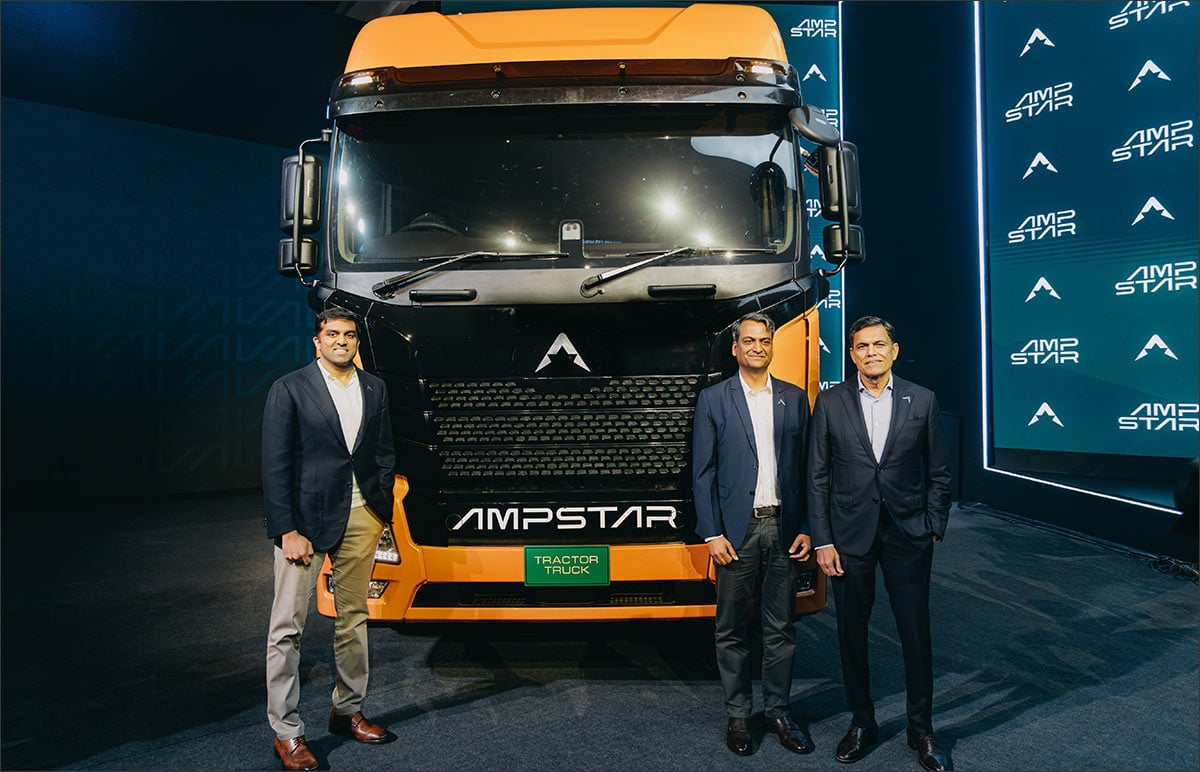
JSW Greentech has received its first commercial order for 100 AMPSTAR 4×2, 55-tonne electric tractor-trucks from JSW Cement. The fleet is planned for a roughly 330-km industrial freight corridor between Nandyal in Andhra Pradesh and Vijayanagar in Karnataka, with four battery-swapping stations intended to keep the trucks moving.
For Indian fleet operators, the significance is not a new retail truck price. It is a live test of whether a heavy electric vehicle, a Battery-as-a-Service model and dedicated energy infrastructure can work together on a long industrial route that currently depends on diesel.
Key takeaways
- The 28 Oct 2026 announcement marks AMPSTAR’s first commercial sale, according to Financial Express and a separate PTI report carried by The Economic Times.
- The 4×2 electric tractor-trucks will move clinker and slag on an approximately 330-km Nandyal–Vijayanagar corridor.
- JSW Eco-Mobility will provide batteries under a Battery-as-a-Service arrangement, with four planned swapping stations.
- JSW Greentech’s diesel and emissions savings are company estimates; the contract period and calculation method have not been disclosed.
What JSW Greentech has ordered
Financial Express and The Economic Times reported on 28 Oct 2026 that JSW Greentech had secured an order from JSW Cement for 100 AMPSTAR 4×2 electric prime movers rated at 55 tonnes. The order is for heavy-duty industrial haulage at JSW Cement’s Vijayanagar operations and is the first commercial sale under the AMPSTAR brand.
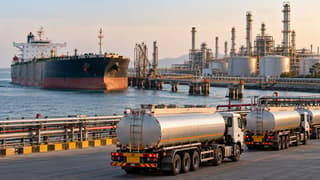
The trucks are intended to carry clinker and slag between Nandyal and Vijayanagar. The route is approximately 330 km, and the company has described expected cargo movement of about 1.25 lakh tonnes per month. That makes the project a fleet deployment rather than a demonstration vehicle: the operating result will depend on repeat trips, payload, uptime and the availability of replacement batteries.
Why the route matters
A 330-km one-way corridor implies roughly 660 km for a same-route return movement, before any empty running or diversions. That is why the project’s infrastructure plan matters as much as the truck itself. A vehicle can have sufficient headline power but still lose productivity if a battery is unavailable, a swap takes too long or a station cannot handle the fleet’s peak schedule.
How the battery-swapping model will work
JSW Eco-Mobility is expected to supply batteries under a Battery-as-a-Service arrangement, while Paradeep Parivahan is the logistics partner. The reported plan is to build four battery-swapping stations along the corridor. In this model, the fleet operator does not have to treat the battery as a one-time vehicle purchase; the commercial agreement instead links the truck operation with energy supply and support services.
Battery swapping can reduce waiting at a depot when the station has a charged battery ready and the process is designed for the vehicle. It does not, by itself, prove lower cost or higher utilisation. The public announcement does not state the battery capacity, certified loaded range, swap time, station throughput, energy tariff or the date when all four stations will be operational. Those details will be important for transporters comparing an electric tractor-truck with a diesel alternative.
For a wider view of public charging availability, readers can browse the state-wise EV station directory. The AMPSTAR project is different because its first corridor is based on dedicated battery swapping rather than relying only on public plug-in chargers.
What it could mean for diesel use and freight costs
JSW Greentech estimates that the operation could save approximately 4.5 crore litres of diesel and avoid around 6,250 tonnes of carbon dioxide over the contract period, figures reported by Financial Express and ET Auto. These are forward-looking company estimates, not measured results. The company has not disclosed the contract duration or the assumptions used to calculate diesel consumption, so they should not be treated as a guaranteed saving.
The practical comparison for a fleet is broader than the pump price. Operators would need to place the diesel route cost beside electricity or battery-service charges, driver and maintenance costs, payload, tyre use, financing, station access and the value of lost time. A route-specific estimate can start with the fuel cost calculator, while the latest diesel prices by location provide the dated input for a diesel baseline. Neither tool can establish the AMPSTAR project’s total cost until its commercial terms are published.
What has been confirmed—and what is still unknown
The 4×2 and 6×4 AMPSTAR tractor-truck platforms have received certification under the Central Motor Vehicle Rules from the Automotive Research Association of India, according to the PTI report carried by The Economic Times and Autocar Professional. That clears an important regulatory step for deployment on Indian roads, but certification is not the same as a public guarantee of range, uptime or operating cost.
JSW’s 22 Sep 2026 launch release said AMPSTAR vehicles would be built at a 90-acre greenfield facility in Chhatrapati Sambhajinagar, Maharashtra, with planned annual capacity of 15,000 electric buses and trucks. The launch release also described a broader full-stack offer covering vehicles, charging or energy support, financing and after-sales service. The 28 Oct order is the first visible test of that commercial model at scale.
- Not disclosed: the order value, per-truck price, contract length, deployment start date, battery capacity and loaded driving range.
- To watch: the final locations and throughput of the four swap stations, measured diesel displacement, truck availability and the cargo volume actually moved each month.
What this means for road users
The order does not change retail diesel prices, toll fees or private-car rules. Its immediate effect is limited to the JSW Cement freight operation. The wider relevance is that a high-utilisation industrial corridor will provide a real operating reference for electric heavy trucks, where energy planning and turnaround time matter more than a showroom specification.
If the deployment meets its schedule and keeps payload-moving time close to a diesel fleet, other cement, steel, mining and logistics operators may have a clearer basis for assessing electric freight. If the stations, battery supply or uptime fall short, the project will also show where the economics of heavy-duty electrification still need work. The next useful update will be evidence from operation, not another launch claim.
Sources
- Financial Express — “JSW Greentech bags first order for 100 electric trucks” — 28 Oct 2026
- The Economic Times/PTI — “JSW Greentech gets JSW Cement order to supply 100 Ampstar trucks” — 28 Oct 2026
- ET Auto — “JSW Greentech secures first order for 100 electric tractor-trucks” — 28 Oct 2026
- JSW Group — “JSW Group powers into Electric Commercial Mobility with AMPSTAR” — 22 Sep 2026