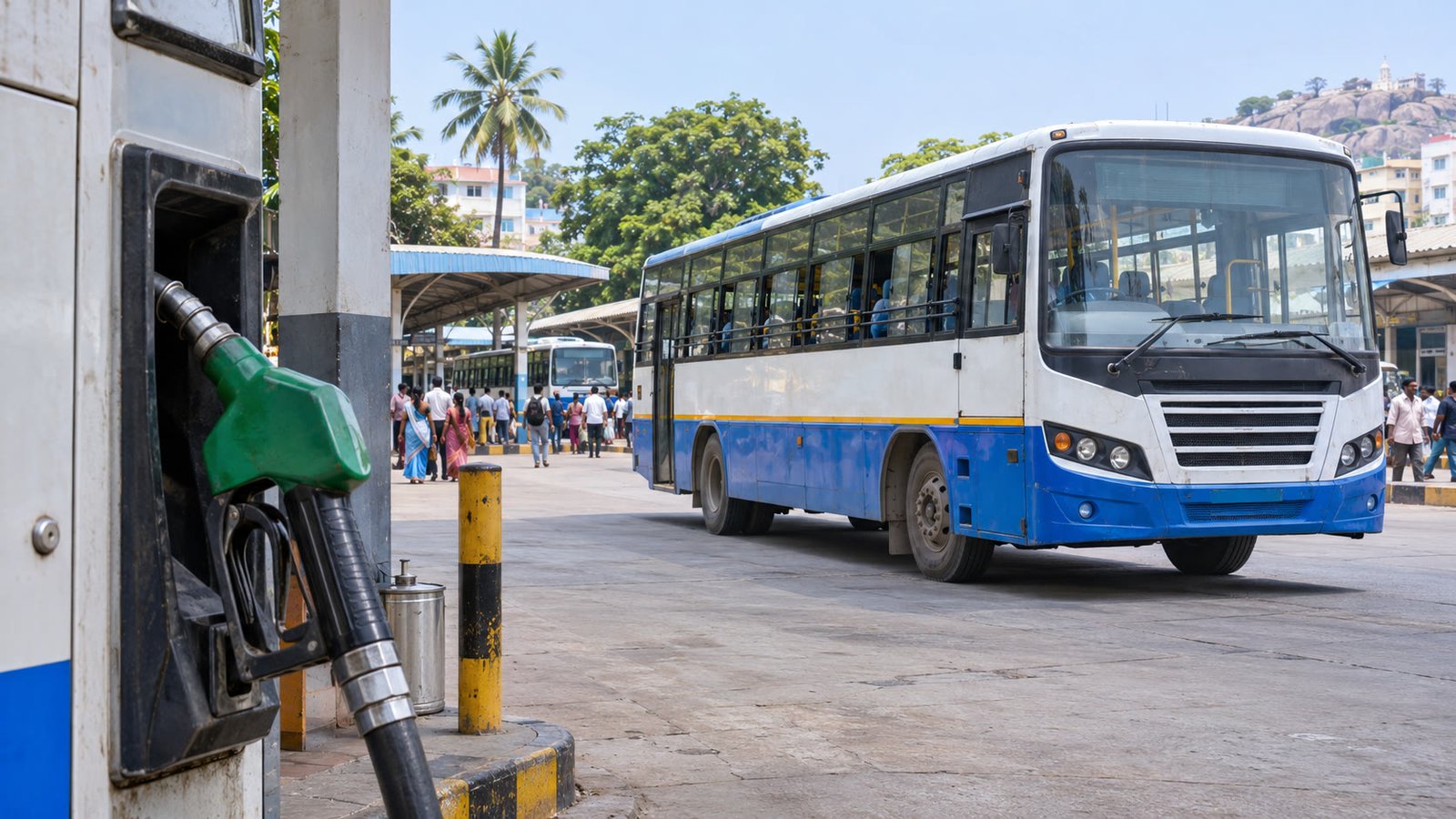
Karnataka has raised fares across its four state-run bus corporations from 5 November 2026, with an average increase of 23% for KSRTC, NWKRTC and KKRTC and 33–35% for BMTC. Chief Minister D K Shivakumar has said the state could reduce fares if the Union government lowers petrol and diesel prices, but that is a conditional statement and no rollback has been announced.
The revised charges took effect from midnight on 4 November, so passengers travelling on 5 November are the first to face the new rates. The change affects city, ordinary, express, long-distance and airport services, although the increase is calculated by stage and route rather than by applying one percentage to every ticket.
Key takeaways
- BMTC fares in Bengaluru have risen by an average of 33–35%.
- KSRTC, North Western Karnataka Road Transport Corporation (NWKRTC) and Kalyana Karnataka Road Transport Corporation (KKRTC) fares have risen by an average of 23%.
- BMTC ordinary-bus fares now range from ₹10 to ₹45 in the reported minimum-to-maximum examples, up from ₹6 to ₹35.
- The maximum increase on ordinary KSRTC fares is ₹9, while some stage-wise services have larger rupee changes.
- The Chief Minister’s fuel-linked rollback signal does not change the fare payable today.
What changed for bus passengers
The fare revision applies to all four state-run transport corporations. The Indian Express and a PTI report published by The Week said the average increase is about 23% for KSRTC and 33–35% for BMTC. The New Indian Express also reported the 23% and 33–35% split, while noting that the final calculation is stage-wise.
| Service | Reported change | Passenger impact |
|---|---|---|
| BMTC ordinary buses | ₹6 to ₹10 minimum; ₹35 to ₹45 maximum | Short and longer Bengaluru trips cost more, with the rise varying by stage. |
| BMTC Vajra services | Up to ₹15 more on longer journeys | Air-conditioned city routes also have revised stage fares. |
| KSRTC and other state RTCs | 23% average; ordinary KSRTC increase capped at ₹9 | Inter-city, rural and long-distance fares depend on the route and service type. |
| Airport services | Vayu Vajra maximum reported at ₹425, up from ₹405 | Airport trips from Bengaluru have a separate revised fare structure. |
These are reported examples, not a single statewide flat rate. The fare revision is calculated by stages, so the exact amount depends on the boarding point, destination, service category and distance. Daily and monthly pass rates are also expected to be revised by the respective corporations.
Why the state linked fares to fuel costs
Transport Minister Byrathi Suresh attributed the revision to higher diesel prices, employee costs, dearness allowance, spare parts and maintenance. He said diesel had risen by ₹10.47 per litre from 15 May to ₹98.13 per litre on 1 October 2026. The four corporations also reported large operating losses and outstanding fuel bills, making the fare decision a cost-recovery measure rather than a uniform fuel surcharge.
The fuel link matters beyond bus tickets. When diesel costs rise, public transport operators face pressure on scheduled services, maintenance and working capital. For private vehicle users comparing a bus journey with driving, the live fuel-price page gives the latest petrol, diesel and CNG rates. The fuel cost calculator can then estimate the fuel portion of a specific car or two-wheeler trip; tolls, parking and the number of passengers still need to be considered separately.
Who is affected
The immediate impact falls on passengers paying for BMTC, KSRTC, NWKRTC and KKRTC services, including commuters, students, inter-city travellers and people using airport buses. Because the revision is stage-wise, two routes with similar distances may not show the same rupee increase if they use different service categories.
The state has also said the Shakti scheme, under which eligible women travel free on non-luxury government buses, is separate from the fare revision. Ministers said the government reimburses the corporations for those tickets, although reimbursement timing has been part of the broader financial discussion. Luxury and some air-conditioned services follow their own fare treatment.
Could fares come down if fuel prices fall?
Speaking after the hike, Chief Minister D K Shivakumar said Karnataka would be prepared to reduce bus fares if the Union government reduced petrol and diesel prices. His statement sets out a possible future response, not an automatic formula. It does not specify how much fuel prices would need to fall, when a review would happen or how the reduction would be divided between routes and services.
For now, passengers should treat the revised fare as the applicable rate and check the operator’s latest stage chart or ticketing system before boarding, especially for airport, Vajra and long-distance services. If a fare reduction is later notified, it would be a separate state decision.
What to watch next
The next practical signal will be the updated daily and monthly pass schedules and any formal fare notification or route-wise chart issued by the transport corporations. The response of passenger demand, the corporations’ fuel dues and the direction of petrol and diesel prices will shape the debate over whether the current increase is temporary relief or a longer-term revision.
People planning a longer journey can also compare fuel, toll and time before choosing a route with the road-trip planner. That comparison will not change the bus fare, but it can show how the revised ticket compares with the total cost of driving.
Reader takeaway
Karnataka’s bus fare hike is already in force from 5 November 2026. Bengaluru passengers face the sharpest average increase, while the other three state-run corporations have a lower average rise but route-specific changes. The Chief Minister’s fuel-linked rollback signal is worth watching, but only a fresh government decision can reduce the fare.
Sources
- The Indian Express — Bus fares to become 35% costlier in Bengaluru, 23% across Karnataka — 4 Nov 2026
- The Week / PTI — Karnataka hikes bus fares ‘not to make profit but to save corporations’ says minister — 4 Nov 2026
- The New Indian Express — Will cut bus fares if Centre lowers fuel price: Karnataka CM DK Shivakumar — 5 Nov 2026