India’s Petroleum Ministry said on 7 Nov 2026 that 893 E20 petrol samples tested across 27 states and Union territories met the prescribed 19–21% ethanol range, rejecting Karnataka’s reported 26–31% readings at some outlets. The dispute is not closed: Karnataka Chief Minister D.K. Shivakumar said on 8 Nov that the state would present more documents on 9 Nov, so motorists should treat both sets of results as attributed claims until a jointly verifiable test is completed.
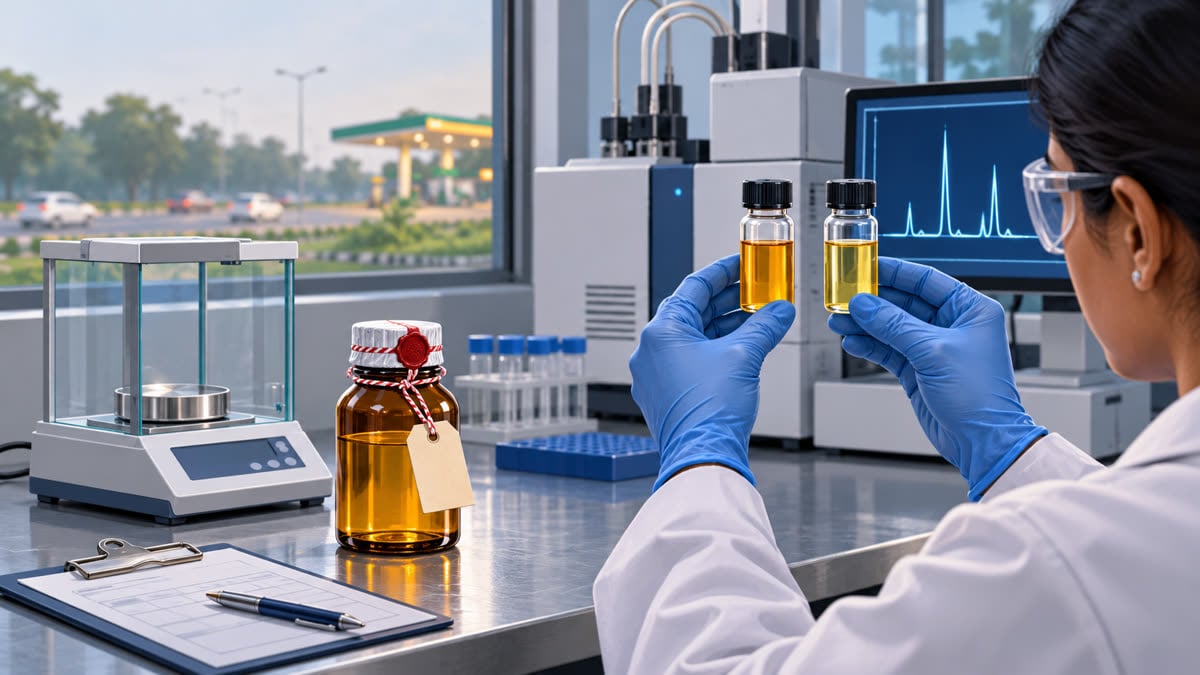
Illustrative image: a laboratory comparison of fuel samples; it is not a photograph of the reported tests.
Key takeaways
- The Ministry of Petroleum and Natural Gas says 893 E20 samples tested across 27 states and Union territories were within the 19–21% range under IS 17021.
- Its release says all 56 samples tested in Karnataka recorded 19–20% ethanol, with a reported average of 19.30%.
- Karnataka had reported higher readings from some outlets, including 31.2% in an IOCL sample and 30.5% in an HPCL sample, according to The Indian Express.
- Oil marketing companies have sought joint sampling and independent testing under the prescribed method; the conflicting results remain unresolved.
- The latest development is about fuel testing and verification. It does not announce a new petrol-price change.
What the Centre has confirmed
In a 7 Nov 2026 release, the Petroleum Ministry said the Oil Marketing Company and Centre for High Technology Quality Coordination Cell exercise tested 893 samples drawn from Indian Oil Corporation, Bharat Petroleum Corporation and Hindustan Petroleum Corporation depots and retail outlets. The release attributed 330 samples to IOCL, 280 to BPCL and 283 to HPCL, collected across 27 states and Union territories.
The ministry said all 893 samples were tested for ethanol content under IS 17021, Annex C, at refinery and OMC quality-control laboratories. Each result fell within the stated 19–21% range. The release also said all 56 samples tested in Karnataka met the specification, recording 19–20% ethanol and an average of 19.30%.
That is the Centre’s confirmed position from its own quality-monitoring exercise. It does not establish that every petrol sample in Karnataka has been tested, nor does it automatically disprove a separate sample set collected by the state. The two sides need comparable sampling, documented chain of custody and testing under the same standard before the results can be assessed on an equal basis.
Why the Karnataka and OMC results differ
Karnataka’s Food, Civil Supplies and Consumer Affairs Minister Rizwan Arshad had said that tests of samples from seven districts showed 31.2% ethanol in an IOCL sample and 30.5% in an HPCL sample, above the nominal E20 blend. The Indian Express reported those figures on 7 Nov 2026.
The OMCs, in a statement issued through the ministry, challenged the sampling and laboratory process. They said the later October 2026 exercise was reportedly carried out without OMC representatives, and that the certificates from a third-party laboratory did not provide enough detail about the prescribed gas-chromatography method, sample dilution or reference material. The ministry said the reported 26–31% figures therefore cannot yet be independently validated against IS 17021.
This is a material follow-up to FuelPrice’s earlier report on Karnataka’s 31.2% E20 claim. The new official response changes the status from a state-level allegation and OMC rebuttal to an unresolved dispute with competing test results in the public record.
What the dispute means for petrol users
For drivers, the immediate issue is not a different pump price. It is whether the fuel being tested meets the prescribed blend and how vehicle calibration affects consumption. The ministry’s current release refers to its earlier technical assessment: vehicles calibrated for E20 can see an approximate 1–2% mileage reduction, while some other vehicle categories may see 3–6%, depending on calibration.
That range should not be converted into a blanket loss for every car or two-wheeler. As an illustration, if a vehicle uses 100 litres over a fixed route, a 1–2% reduction in mileage would mean roughly 101–102 litres for the same use; a 3–6% reduction would mean roughly 103–106 litres. This is a simple example, not a forecast of any owner’s actual fuel bill. Drivers can enter their own distance and vehicle efficiency in the fuel cost calculator and then check the latest city rate through the live fuel-price pages.
The practical checks are vehicle-specific: read the owner’s manual or manufacturer guidance on ethanol compatibility, keep the fuel receipt and note the outlet and date if a quality complaint is made, and avoid treating an unverified social-media claim as proof of a nationwide problem. The current release itself says the evidence needs a transparent and jointly verifiable process.
What happens next
On 8 Nov 2026, Shivakumar said Karnataka had collected samples from 67 locations and that a minister would present documents and evidence on 9 Nov, according to The Economic Times. That is an expected next step, not a final finding. The state’s claims should remain attributed until the underlying sampling records and laboratory reports are made available for independent review.
The OMCs have asked for joint sampling and independent testing at authorised laboratories. That is the key process to watch: whether both sides use the same sampling procedure, retain counterpart samples, identify the outlet and batch, and publish enough method detail to reproduce the result. Until then, the Centre’s 893-sample exercise and Karnataka’s higher reported readings describe different evidence sets rather than a settled national conclusion.
Reader takeaway
The latest official position is that the E20 samples tested through the OMC and CHT exercise met the prescribed range, including the 56 Karnataka samples cited by the ministry. Karnataka is still pursuing a separate claim and has promised more documents. For vehicle owners, the sensible reading is to separate confirmed test results from disputed claims, use the vehicle’s documented fuel compatibility, and wait for jointly verifiable testing before drawing a conclusion about every petrol outlet or every vehicle.
Sources
- Press Information Bureau — “E20 Petrol Supplied by PSU Oil Marketing Companies Meets Prescribed Quality Standards; 893 Samples Across 27 States and UTs Found Compliant” — 7 Nov 2026
- The Indian Express — “31% ethanol in petrol? Oil companies challenge Karnataka government’s claims” — 7 Nov 2026
- Business Today — “E20 petrol row: Centre rejects Karnataka’s 31% ethanol claim, says all 893 samples passed quality tests” — 7 Nov 2026
- The Economic Times — “Karnataka ethanol row: DK Shivakumar alleges excessive blending, promises evidence and documents on Monday” — 8 Nov 2026