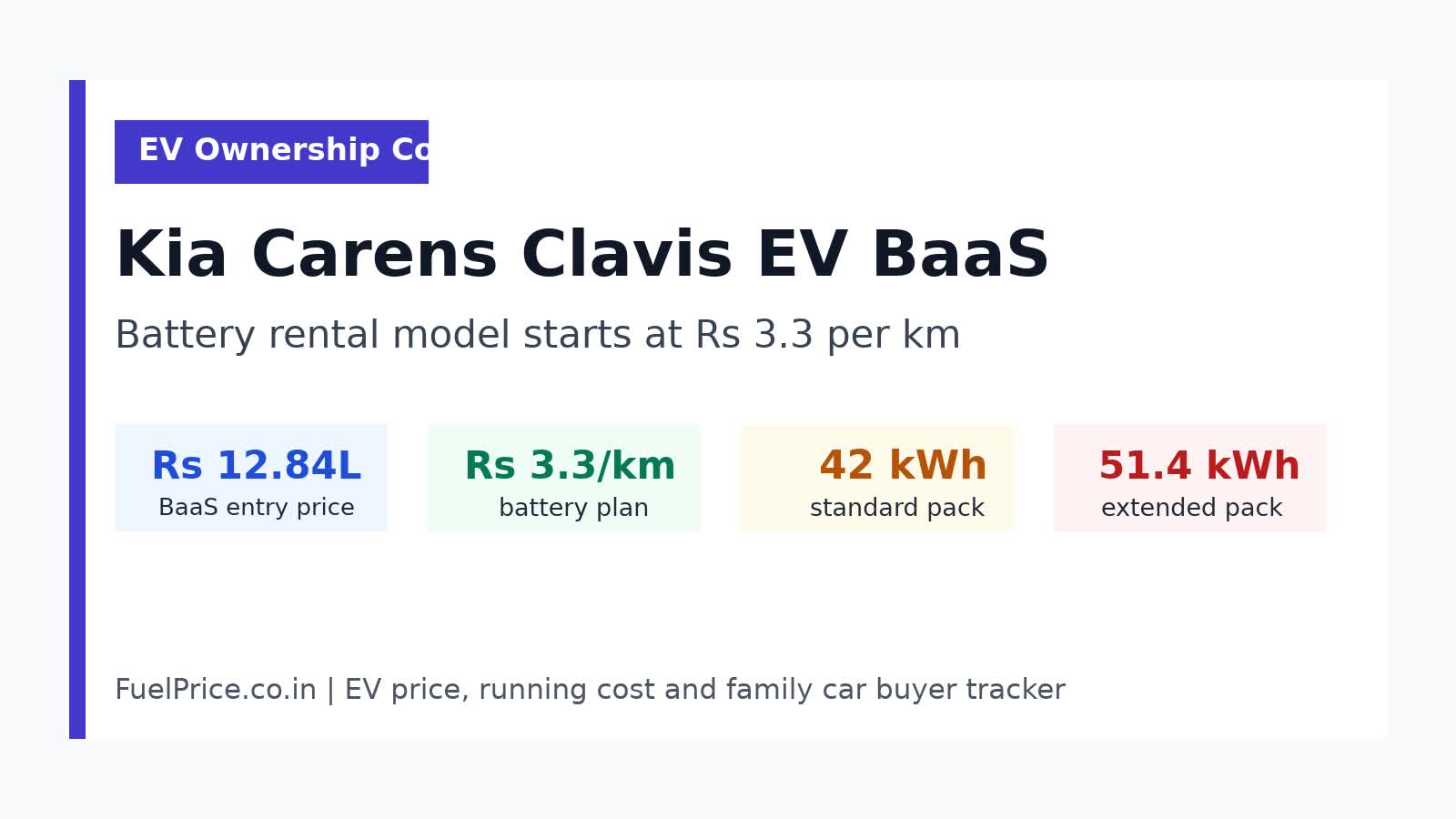
Quick brief: Kia India has introduced a Battery-as-a-Service finance model for the Carens Clavis EV. The Standard Range version can be accessed at a reported Rs 12.84 lakh chassis price plus a Rs 3.3 per km battery usage plan, compared with the regular ex-showroom price of Rs 17.99 lakh.
Kia Carens Clavis EV BaaS lowers the entry price, but buyers need to calculate battery cost against their monthly kilometres.This is a buyer-math story, not a simple discount story. BaaS lowers the initial acquisition cost by separating the battery cost from the vehicle chassis, but it adds a usage-linked battery repayment charge. For a family EV like the Carens Clavis EV, the best choice depends on monthly running, financing comfort and ownership horizon.
What changed
- BaaS launched: Kia India has introduced a Battery-as-a-Service finance model for the Carens Clavis EV.
- Usage charge: Multiple reports list the battery plan at Rs 3.3 per km.
- Lower entry price: Standard Range chassis price under BaaS is reported at Rs 12.84 lakh.
- Two battery options: The model is offered with 42 kWh and 51.4 kWh battery packs.
- Buyer impact: Lower upfront price helps first-time EV buyers, but high-mileage users must compare total cost carefully.
Price and battery plan explained
Under the BaaS route, the vehicle body and battery are treated differently in the finance structure. The buyer pays a lower chassis-linked price and then pays for the battery separately through a per-kilometre plan. This is useful for reducing the initial price shock, but it does not make the battery free.
| Variant | Regular ex-showroom price | BaaS chassis price | Battery plan |
|---|---|---|---|
| Standard Range | Rs 17.99 lakh | Rs 12.84 lakh | Rs 3.3 per km |
| Extended Range | Rs 21.99 lakh | Rs 15.94 lakh | Rs 3.3 per km |
Why this matters for EV buyers
EVs often look expensive because the battery cost is paid upfront. BaaS changes the purchase experience by reducing the entry price and spreading battery repayment over usage. That can make a seven-seat electric family vehicle easier to consider for buyers who cannot stretch to the full ex-showroom price immediately.
However, buyers should avoid comparing only the headline entry price. A person driving 500 km a month will face a very different battery bill from a person driving 2,000 km a month. The per-km charge must be added to monthly EMI, charging cost, insurance and service cost before deciding.
Running-cost check: when BaaS may work
- Low to moderate running: Buyers with predictable city usage may benefit from lower upfront cost.
- First EV purchase: Families unsure about long-term battery ownership may prefer separating the battery cost.
- Cash-flow priority: Buyers who want a lower initial outgo may consider BaaS even if total long-term cost needs close tracking.
- High monthly running: Fleet-like or very high-mileage users must calculate the per-km battery charge carefully.
Battery and range context
The Carens Clavis EV is reported with two battery options: 42 kWh and 51.4 kWh. Reported claimed ranges are around 404 km for the Standard pack and up to 490 km for the Extended Range version. Real-world range will depend on load, air-conditioning use, traffic, highway speed and charging habits.
For a seven-seat family EV, range consistency matters because the vehicle may be used with more passengers and luggage than a typical city hatchback. Buyers should test whether their weekly driving pattern fits the smaller battery or whether the larger pack is worth the higher chassis price.
How it compares with outright EV ownership
Outright purchase is easier to understand: the buyer pays the full vehicle price and owns the battery as part of the car. BaaS lowers the visible entry price but adds a separate cost stream. Neither route is automatically better. The right answer depends on how long the buyer plans to keep the car and how many kilometres the vehicle will run each month.
Buyer checklist before choosing BaaS
- Estimate monthly kilometres honestly before comparing BaaS and outright purchase.
- Ask for the complete battery agreement, including tenure, lock-in, transfer rules and early closure terms.
- Check whether resale transfer of the battery plan is clearly documented.
- Compare total monthly EMI plus battery charge plus home or public charging cost.
- Confirm warranty, insurance treatment and claim process for the battery separately.
Final takeaway
The Kia Carens Clavis EV BaaS plan makes one of the few seven-seat EV options in India look more accessible at the entry point. But the smarter decision is not based on Rs 12.84 lakh alone. Buyers should calculate monthly kilometres, per-km battery charge, charging cost and ownership tenure before deciding between BaaS and full-price EV ownership.
Sources checked
- CarDekho: Kia launches BaaS for Carens Clavis EV, May 13, 2026
- autoX: Kia launches Carens Clavis EV with battery rental scheme
- Autocar Professional: Kia India introduces BaaS model for Carens Clavis EV
- Team-BHP: Kia launches BaaS scheme for Carens Clavis EV at Rs 3.3/km
- Kia India: Carens Clavis EV official product page