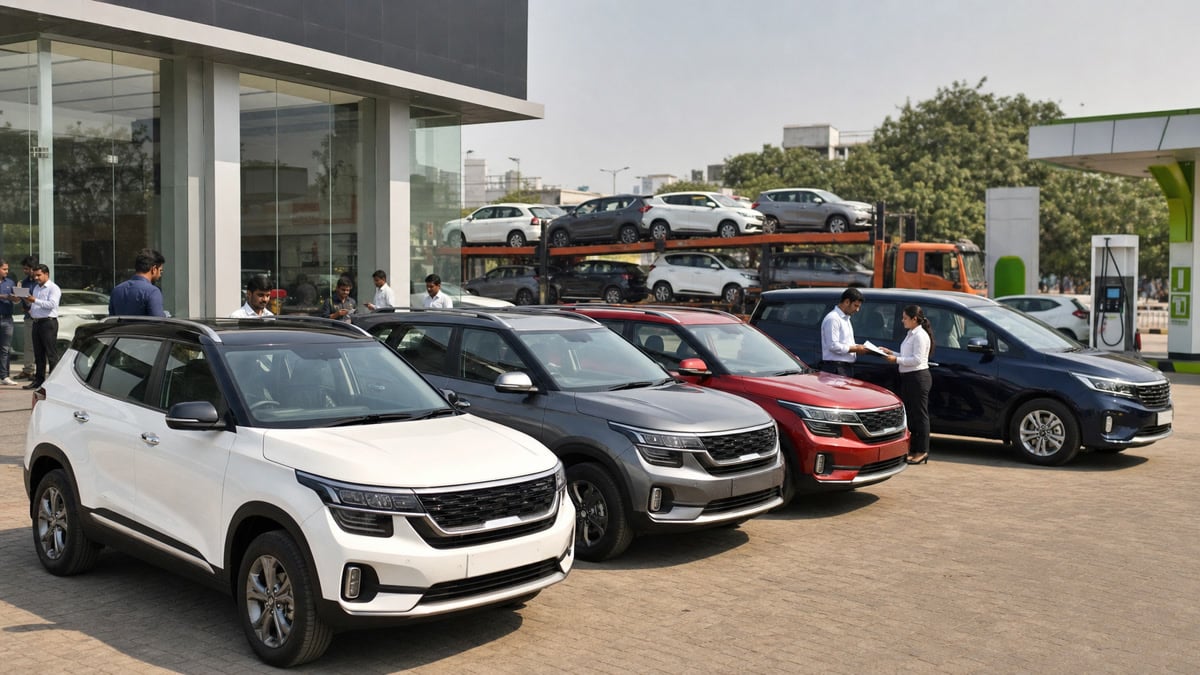
Kia India has delivered one of the sharper passenger-vehicle demand signals of early FY27: the company recorded its highest-ever May sales in India with wholesale dispatches of 27,586 units in May 2026. The number was up 23.6% year-on-year from 22,315 units in May 2025 and came with a broader message for buyers, dealers and the auto supply chain: demand remains concentrated around SUVs, automatic variants, family movers and new-energy affordability experiments.
Kia India's May 2026 dispatches show how SUVs, MPVs, automatic options and EV affordability programmes are shaping buyer demand.What happened
The latest sales update says Kia India dispatched 27,586 vehicles to dealerships in May 2026, its best May performance since entering the Indian market. The year-on-year jump matters because it comes after several months of strong passenger-vehicle activity and after the industry has been balancing price changes, fuel-cost sensitivity, financing costs and shifting consumer preference toward higher-riding vehicles.
The growth was not reported as a one-model spike. Multiple reports citing the company's sales update point to demand across the Seltos, Sonet, Carens Clavis, Clavis EV and MY26 Syros. That mix is important because it cuts across compact SUVs, midsize SUVs, three-row family vehicles and an EV-linked ownership proposition.
| Metric | May 2026 signal | Why it matters |
|---|---|---|
| Wholesale dispatches | 27,586 units | Highest-ever May volume for Kia India. |
| Year-on-year growth | 23.6% | Shows demand strength despite price and running-cost awareness. |
| January-May 2026 sales | 1,39,197 units | Up 14.6% from the same period in 2025, suggesting momentum beyond one month. |
Why this is more than a monthly sales number
For FuelPrice readers, the relevance is not only that one automaker sold more cars. The story is about what kind of cars are drawing buyers. Kia's May momentum appears to be led by SUVs and family vehicles, both of which usually have higher transaction values than entry hatchbacks. That points to a market where many buyers are still willing to pay for cabin space, seating flexibility, automatic gearboxes, safety features and premium equipment, even as fuel bills remain a regular ownership concern.
The Seltos remains central to that signal. Reports say the updated Seltos has been crossing the 10,000-unit monthly sales mark since its January 2026 update. That is significant because midsize SUVs sit at the intersection of city commuting, highway travel, family use and aspiration buying. They also influence fuel-demand quality: buyers choosing petrol, diesel, automatic and higher-feature variants shape both dealership revenue and long-term service, parts and fuel consumption patterns.
Buyer impact: more choice, but sharper cost comparison
A strong dispatch month normally improves availability at dealerships, but it can also mean popular trims continue to command attention. For buyers, the practical takeaway is to compare waiting periods, variant availability and real running costs before booking. Kia's lineup spans petrol, diesel, automatic, three-row and EV-linked options, so the right choice depends on actual use rather than headline demand.
- Urban users: Automatic petrol and diesel variants can improve convenience, but city mileage and traffic use should be part of the calculation.
- Highway and family users: SUVs and MPVs offer space and stability, but tyre, insurance, servicing and fuel costs can be higher than smaller cars.
- EV-curious buyers: The Clavis EV and Battery-as-a-Service angle lower the entry-barrier conversation, but monthly kilometres and charging access decide whether the economics work.
Dealer, logistics and auto-sector impact
For dealers, higher wholesales improve showroom energy and inventory rotation, but they also require careful stock planning. If demand is concentrated in specific automatic, diesel, EV or high-feature trims, dealerships need the right mix rather than only higher volume. For logistics providers, dispatch growth means more movement from factories and stockyards to dealerships, adding demand for vehicle carriers, last-mile dealer transport and pre-delivery inspection capacity.
For the wider auto industry, Kia's May number reinforces the premiumisation trend. Passenger-vehicle demand is not only about first-time entry models; it is increasingly shaped by customers upgrading to SUVs, connected features, safety packages, automatic transmissions and more flexible family vehicles. That can support supplier demand for electronics, powertrain components, interiors and safety systems, while also keeping competitive pressure high for Hyundai, Maruti Suzuki, Tata, Mahindra and Toyota in the SUV-heavy parts of the market.
What changes now
The immediate change is that Kia enters June with visible demand momentum and a stronger five-month sales base. The company's January-May 2026 volume of 1,39,197 units indicates that the May result was part of a broader year-to-date trend, not an isolated jump. That gives dealers more confidence heading into the next booking cycle, while buyers may see more focused offers on slower trims and firmer demand for popular variants.
What to watch next
The next checkpoints are retail registrations, variant-level waiting periods and whether demand stays broad-based after seasonal factors change. Fuel-price movements, financing rates, insurance costs and monsoon-driven buying patterns can all influence whether dispatch strength converts into sustained retail momentum. The EV angle also deserves attention: if Battery-as-a-Service improves affordability for family EV buyers, it could become a meaningful bridge between conventional MPVs and electric three-row mobility.
Final takeaway: Kia India's record May 2026 sales show that Indian passenger-vehicle demand remains resilient where products combine SUV appeal, family utility, automatic convenience and EV affordability experiments. For buyers, the smartest move is still to compare total ownership cost, not just showroom popularity.