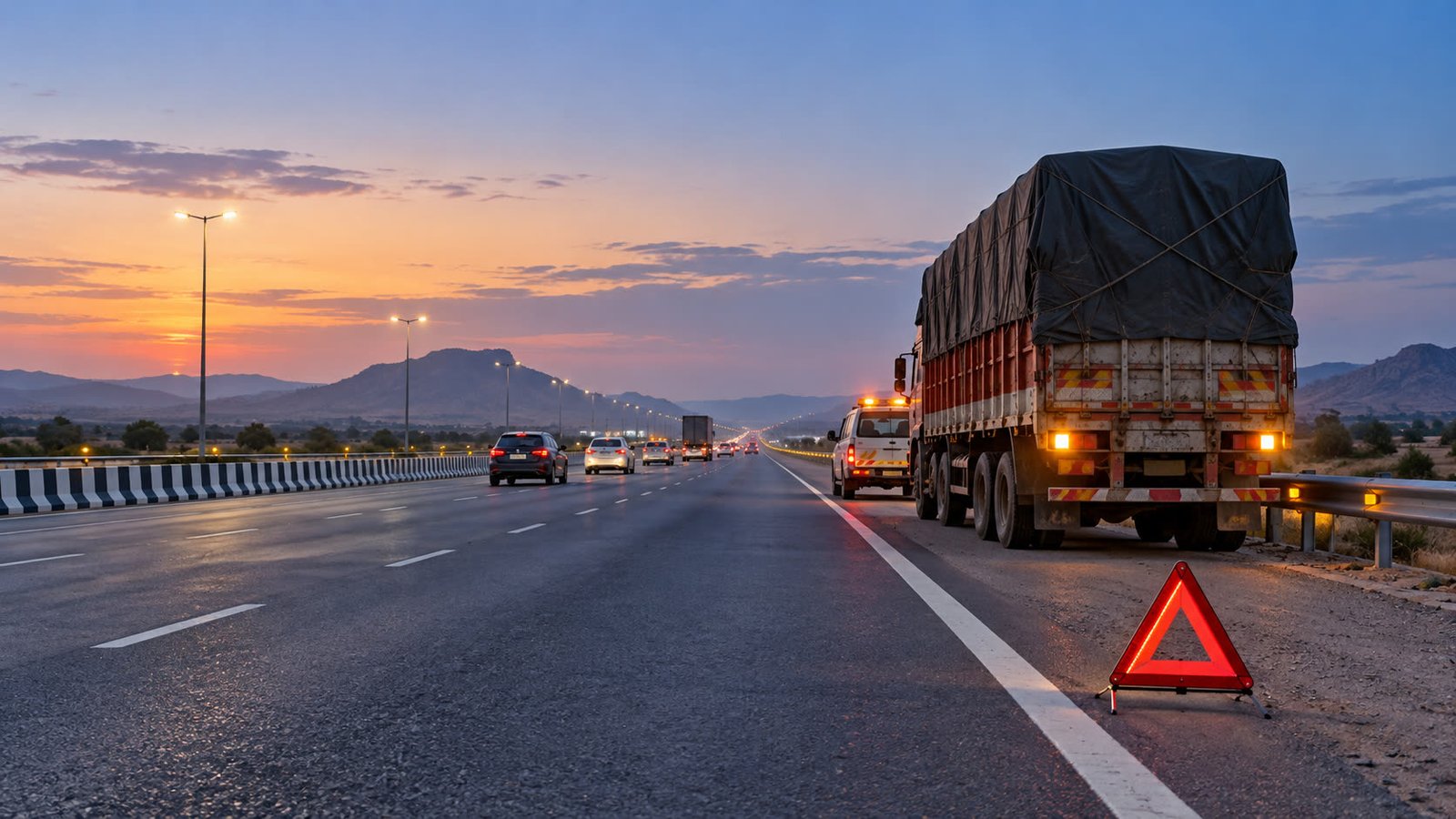
Two people were killed early on 9 Oct 2026 after a container truck hit a six-tyre trailer that had broken down and remained parked on the Delhi–Mumbai Expressway in Kota, Rajasthan. When passers-by and occupants of other vehicles stopped to help the trapped driver, another heavy vehicle struck the group from behind, turning a breakdown into a second crash.
The incident matters beyond this one route. On a high-speed expressway, a disabled vehicle, a rescue group and approaching traffic can create a fast-moving secondary hazard. For private motorists, bus operators and truck fleets, the practical lesson is to treat any roadside breakdown as a traffic-safety emergency: create distance, keep people away from live lanes and wait for recovery support where possible.
Key takeaways
- The crash happened early on 9 Oct 2026 on the Delhi–Mumbai Expressway in Kota district, near the Balapura–Gopalpura stretch.
- Police-based reports said a six-tyre open-body trailer had broken down and remained parked on the roadside for about two days.
- A container truck first hit the stationary trailer; a second heavy vehicle then hit the vehicles and people involved in the rescue attempt.
- Two people died. The injury count differs across reports: PTI said three people were injured, The Times of India said four, and Hindustan Times described more than four injured.
- The reports describe a safety incident, not a new toll fee or FASTag rule. Drivers should check live traffic before using the corridor.
What happened in Kota
The Times of India and PTI reported that a six-tyre open-body trailer travelling on the expressway had broken down and remained parked on the roadside for two days. A container truck approaching from the Delhi side then struck the rear of the stationary trailer. The impact trapped the moving truck's driver inside the cabin.
People who saw the first crash stopped to help. The accounts describe passers-by and occupants of a car and another truck gathering near the damaged vehicles. A further heavy vehicle then hit the scene from behind while the rescue attempt was under way. Two people who were helping were killed, according to police statements cited by The Times of India, Hindustan Times and PTI.
The reports do not agree on the injury total, and the difference should not be silently merged. PTI reported three injured people, The Times of India reported four, while Hindustan Times said more than four people were injured. All three accounts agree on the two deaths, the disabled trailer, the first collision and the second impact during the rescue attempt. Police used cranes to move the damaged vehicles, Hindustan Times reported.
Why a parked vehicle can cause a second crash
A breakdown on a normal road is already stressful, but an expressway leaves less time for approaching drivers to react. A stationary truck can be difficult to see around a curve, in low light or behind another large vehicle. Once people gather beside a damaged vehicle, the risk extends beyond the original occupants: a rescue group can be exposed to a vehicle that has not yet slowed down or changed lanes.
The Kota incident also shows why a shoulder should not be treated as a safe work area by default. A shoulder gives a disabled vehicle some separation from traffic, but it does not remove the risk of an errant vehicle, a narrow section, poor visibility or a second impact. Recovery crews and fleet managers should prioritise early warning, distance from the carriageway and professional assistance over roadside repairs in exposed locations.
What drivers should do near a breakdown
If a vehicle develops a fault, the first priority is to leave the live lane if that can be done safely. Switch on hazard lights, slow other traffic with visible warning equipment only when it is safe to place it, and keep passengers away from the moving carriageway. Do not stand behind a stopped truck or car, and do not form a group beside the vehicle while waiting for help.
Drivers approaching a stopped vehicle should reduce speed early, scan for people outside the vehicle and move to a farther lane only when the manoeuvre is safe and legal. A sudden lane change can create a second crash, so the aim is controlled separation rather than a last-second swerve. Night-time and dawn travel require extra caution because a vehicle's outline and people near it may be visible only for a short distance.
For truck, bus and taxi operators, the incident is a reminder to include breakdown protocols in route planning. The driver should know who to call, where the recovery vehicle can approach and how passengers or helpers will be kept behind a barrier or well away from traffic. Fleet savings from a quick roadside repair are not worth exposing people to a live expressway lane.
What this means for a planned trip
The reported crash occurred near toll plazas on the Delhi–Mumbai Expressway, so a collision or recovery operation can affect travel time even when the toll rate itself is unchanged. The reports reviewed for this article do not announce a continuing closure or a toll revision. Before departure, check the current route situation and allow time for incident-related slowing rather than relying only on the normal journey estimate.
For a long drive, the road-trip planner can help map the route and build in a realistic time buffer. This is especially useful for families and commercial drivers who have fixed arrival windows and may need to stop before entering an expressway.
Fuel and toll costs still matter when a delay changes the route or adds idling. Use the fuel cost calculator to model the planned distance, then check the relevant charges in the toll-charge calculator. These tools estimate the trip; the final cost can change if traffic diverts the vehicle, the driver takes a longer route or the vehicle spends more time idling.
The reader takeaway
The Kota crash is a reminder that the most dangerous moment may come after the first impact, when people stop in the hope of helping. If you approach a breakdown or crash scene, slow down early and give it as much room as conditions safely allow. If your own vehicle stops, get it away from the live lane, keep people out of traffic and seek trained recovery help instead of turning the shoulder into an improvised repair area.
Sources
- Hindustan Times, “Two killed, four injured in multi-vehicle pile-up on Delhi-Mumbai Expressway in Kota” — 9 Oct 2026
- The Times of India, “Kota expressway chain collision kills 2 rescuers, injures 4” — 9 Oct 2026
- ThePrint/PTI, “2 good samaritans killed, 3 injured while helping trapped truck driver on Delhi-Mumbai Expressway” — 9 Oct 2026