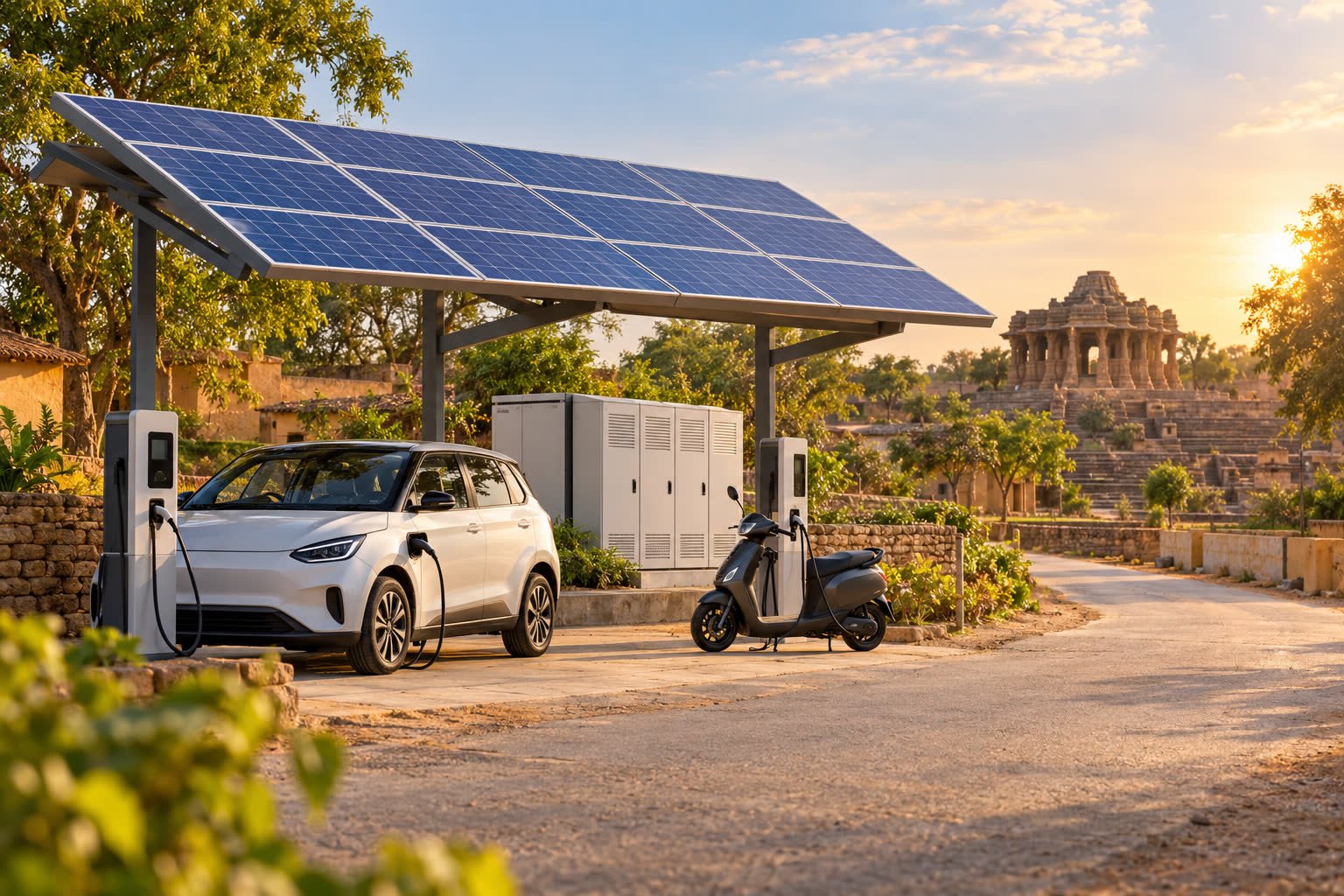
An ANI report published by ETEnergyWorld on 10 Oct 2026 says Gujarat's Modhera is extending its solar-village model into everyday EV use, with residents adopting electric vehicles and a solar-powered charging station near the Sun Temple. The significance for drivers is practical: the project links charging access with local renewable generation, but it does not mean every EV visit is free or that the same setup is available across India.
Key takeaways
- The latest report describes Solar Village Modhera 2.0 as a move from solar-powered homes and public infrastructure towards electric mobility.
- Modhera's official project record lists a 6 MW ground-mounted solar plant, a 15 MWh battery energy storage system and solar EV-charging stations.
- The charging station near the Sun Temple is reported to use electricity generated by the solar plant; its tariff, operating hours and live availability still need to be checked before a trip.
- The development is a local demonstration of solar generation, storage and transport working together, not a new national EV subsidy or charging mandate.
What is changing in Modhera
Modhera, in Gujarat's Mehsana district, is known for its solarisation project and the Sun Temple. ETEnergyWorld's 10 Oct report, based on an ANI dispatch, says the village is now extending that clean-energy model into transport. It describes residents adopting EVs and an EV charging station established near the temple, with the station's power supply coming from the ground-mounted solar plant.
The report quotes Dilip Kumar, a deputy engineer at Gujarat Urja Vikas Nigam Limited, saying the charging facility can help residents reduce petrol and diesel expenses and carbon emissions. That is a reported intended benefit, not a measured saving for every vehicle. The amount a driver pays will still depend on the station's tariff, the vehicle's energy consumption, the session length and whether the charger is accessible when the vehicle arrives.
For local residents, tourists and small commercial operators, the useful change is the possibility of charging close to a destination rather than treating EV use only as a city commute. For drivers passing through the area, the more important question is whether the charger is a dependable stop on the planned route.
What official records confirm
The Ministry of New and Renewable Energy's official Modhera project page says the scheme included a 6 MW grid-connected ground-mounted solar photovoltaic plant, a 15 MWh battery energy storage system and solar EV-charging stations. The same record says the project was completed and inaugurated on 9 October 2022.
The Prime Minister's Office account of the 9 October 2022 inauguration described Modhera as India's first 24-hour solar-powered village and said the solar system would serve household, agricultural and vehicle needs. Those primary records are important context: the core solar and storage assets are not being created for the first time in October 2026. The latest report is best read as an update on how that infrastructure is being used for mobility.
That distinction also keeps the story in proportion. A solar plant and a battery can support charging, but they do not by themselves confirm charger uptime, connector compatibility, public access rules, queue time or a zero-cost session. Those are separate service details that matter more to a driver making a time-sensitive journey.
Why the charging link matters to EV users
For an EV owner, the value of a rural charging site is measured by reliability as much as by its energy source. A driver planning a visit to Modhera needs a usable location, a compatible connector, a functioning payment route and enough time for the vehicle to charge. If any one of those is missing, the solar backing does not remove the need for a backup plan.
The development also shows why local charging directories matter. Readers can use the state-wise EV charging directory to identify charging options, then confirm the specific station's access conditions through the operator or local facility before setting out. A directory listing should be treated as a starting point for verification, not as a guarantee that a plug is available at a particular moment.
Drivers comparing an EV trip with a petrol or diesel vehicle can use the fuel cost calculator to establish a conventional-fuel baseline. The comparison should include the actual charging price, route length, waiting time and any detour, rather than assuming that solar generation automatically makes public charging free.
What to check before relying on a rural charger
- Live access: Confirm that the station is open to the public, its operating hours are current and the approach road is usable.
- Vehicle fit: Check the connector type, charging speed and whether the outlet supports the vehicle being driven. Solar support does not tell a driver which charging standard is installed.
- Payment and tariff: Look for the current price, payment method, minimum session rules and any parking or service charge. Do not infer a free session from the phrase “solar-powered”.
- Route resilience: Keep enough charge for the return leg or identify a second option. The road-trip planner can help map the journey around distance, stops and time rather than range alone.
What to watch next
Modhera's example will become more useful if the public operating details become clearer. The next meaningful evidence would be published charger hours and tariff information, reliable uptime data, information on the number and type of outlets, and signs that residents, visitors or local fleets are using the facility regularly.
The wider lesson for other towns is that EV adoption needs more than vehicle sales. Solar generation can reduce dependence on grid power at a charging site, while storage can help manage supply across the day, but the driver-facing experience still depends on maintenance, access and clear payment information. Those practical details determine whether a charging station supports a real trip or remains only an infrastructure announcement.
Reader takeaway
Modhera's latest mobility push is significant because it connects renewable generation, battery storage and road transport in one local system. For EV users, the sensible takeaway is to treat the site as a promising clean-energy charging example, then verify the charger, price, access and backup route before depending on it for a journey.
Sources
- ETEnergyWorld, “Gujarat's Modhera expands solar-powered living to green mobility,” 10 Oct 2026.
- Ministry of New and Renewable Energy, “Solarisation of Sun Temple Town of Modhera in Mehsana District, Gujarat,” project record citing completion on 9 Oct 2022.
- Prime Minister's Office, “PM lays foundation stone and dedicates to the nation various projects worth over Rs 3900 crore in Modhera, Mehsana, Gujarat,” 9 Oct 2022.