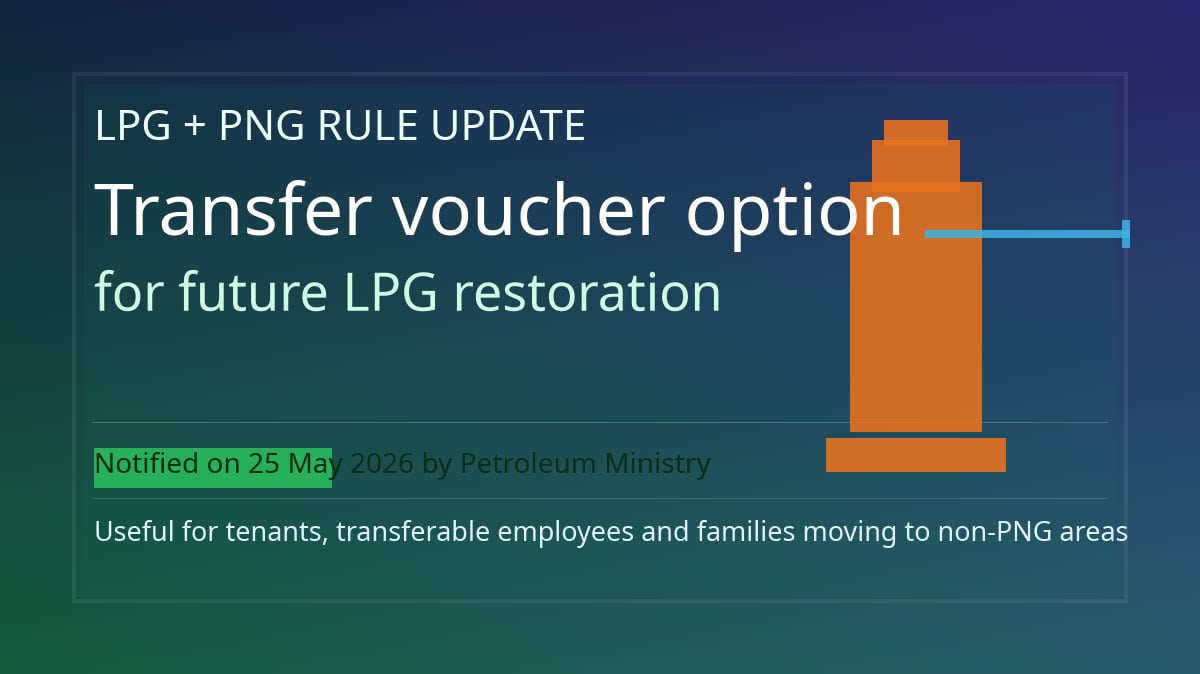
India has changed an important domestic cooking-gas rule on 25 May 2026: households shifting to piped natural gas can now choose a transfer voucher route instead of only closing the LPG connection permanently. The biggest practical number is the 30-day window for acting after a PNG connection is obtained.
This is a small-looking rule change with a direct household impact. It matters for tenants, transferable employees, migrant families, students, and anyone who may move from a PNG-covered city to a location where piped gas is not available.
The May 2026 amendment gives PNG users a documented path to restore LPG later in a non-PNG area, instead of treating the shift as a permanent exit from LPG.Quick Take
- What changed: PNG users now get a transfer voucher option for future LPG restoration.
- Action window: The rule points to a 30-day period after getting a PNG connection.
- Why it matters: It protects mobility for households that may later move to non-PNG areas.
- What it is not: It is not a fuel price cut and it does not allow duplicate active domestic gas usage.
What Changed In The LPG Rule
The Ministry of Petroleum and Natural Gas has notified an amendment to the LPG Control Order framework. The change addresses a practical issue created when a household shifts from a domestic LPG cylinder connection to PNG, or piped natural gas.
Earlier, the compliance direction was strict for PNG users because the system wanted to avoid duplicate domestic cooking-gas access. The new amendment keeps that discipline but adds flexibility. A consumer who obtains PNG can apply for termination of the domestic LPG connection or opt for a transfer voucher that can help restore LPG later, especially when the family shifts to a place where PNG is not available.
For FuelPrice readers, the key point is simple: the rule is about access continuity, not a change in cylinder price or PNG tariff.
Why This Matters For Indian Households
India is expanding city-gas networks, but PNG coverage is still uneven. Many consumers live in metro or large-city apartments with PNG today, then move to smaller towns, rented homes, job-transfer locations, or areas where PNG lines have not reached. For such users, a permanent LPG closure can become a problem later.
The transfer voucher route reduces that friction. It creates a cleaner paper trail for a household that has genuinely moved out of LPG because PNG is available, while still keeping a route to restore LPG when PNG is no longer accessible.
This matters most for people whose housing and job location change often. A family posted from Delhi NCR, Mumbai, Pune, Bengaluru, Hyderabad, Ahmedabad, or another PNG-covered market to a non-PNG town may not want to restart the entire LPG consumer journey from zero.
Who Benefits Most
- Transferable employees: Families moving between cities can keep documentation ready for future LPG restoration.
- Tenants: Rented homes often change from PNG to non-PNG depending on locality and building infrastructure.
- Migrant workers and students: Short-term city residents may not stay in one fuel ecosystem permanently.
- Families shifting from apartments to independent houses: PNG access can change within the same city.
- Consumers in expanding city-gas markets: The rule supports smoother transition as PNG networks grow, without trapping users if they move out.
LPG vs PNG: What Consumers Should Understand
LPG and PNG both serve cooking-fuel needs, but the user experience is different. LPG is cylinder-based and portable across many locations through distributor networks. PNG is pipeline-based and convenient where the network exists, but the connection is tied to the specific premises.
| Point | LPG Cylinder | PNG Connection | Why The Rule Change Helps |
|---|---|---|---|
| Availability | Wide distributor network | Limited to pipeline-served areas | Transfer voucher supports movement to non-PNG areas |
| User mobility | Easier to shift with documentation | Premises-specific | Mobile households get a cleaner future restoration path |
| Compliance risk | Active domestic connection must follow rules | PNG users should not keep duplicate active benefit | The voucher route keeps the process documented |
What Users Should Do Now
If you already have PNG or are about to switch from LPG to PNG, do not treat the rule as automatic restoration. Consumers should still follow the distributor or oil-marketing-company process.
- Confirm whether your premises has an active PNG connection in the same consumer household name or address.
- Contact your LPG distributor within the required window if termination or transfer voucher action is needed.
- Keep connection documents, identity proof, address proof, and PNG connection details ready.
- If you expect to move soon, ask specifically about the transfer voucher process instead of closing the LPG record without future-use documentation.
- Do not assume that an inactive LPG connection can be restored instantly without verification at the new location.
Fuel Ecosystem Angle
This amendment also reflects how India is managing the transition between cylinder distribution and city-gas infrastructure. PNG expansion can reduce dependence on cylinder logistics in dense urban pockets, but LPG remains essential for portability, backup access, rural areas, smaller towns, and locations where city-gas pipelines are not available.
For oil marketing companies and city-gas distributors, the rule supports cleaner consumer mapping. It reduces the chance of dual active domestic cooking-gas access while avoiding unnecessary hardship for users who move. That balance is important because cooking fuel is not a luxury purchase; it is a basic household utility.
Market And Policy Takeaway
This is not a headline that changes petrol, diesel, or LPG retail prices today. Its importance is in the operating system behind household fuel access. As city-gas networks expand, rules must handle real-life mobility: job transfers, renting, temporary migration, and uneven pipeline coverage.
For consumers, the best reading is practical: if PNG is available now but your future address may not have it, the transfer voucher is the document to understand. It may prevent avoidable friction when you need LPG again.
Final Verdict
The LPG-PNG transfer voucher amendment is a consumer-friendly compliance fix. It keeps the anti-duplication discipline of the LPG system intact, but gives genuine mobile households a fair route back to LPG in non-PNG areas. The next thing to watch is how oil marketing companies and distributors communicate the exact process at the local level.