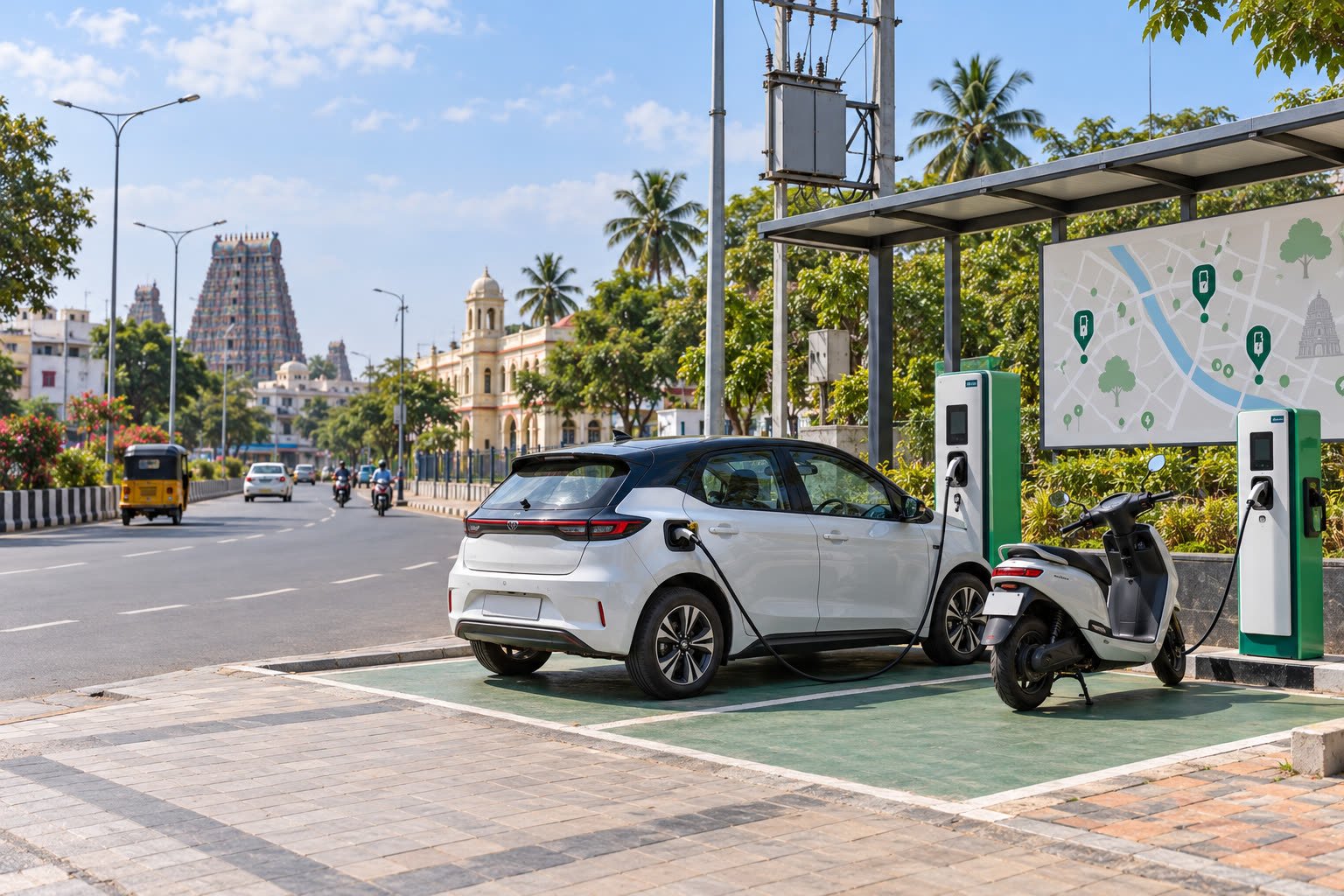
Madurai will prepare a five-year City Electric Vehicle (EV) Implementation Plan to map suitable charging locations and assess the electricity-grid work needed as EV use grows. The move matters to EV owners and people planning long trips because it signals a structured charging build-out, but it does not yet announce a charger count, tariff or completion date.
Key takeaways
- Madurai city corporation is preparing a five-year EV implementation plan, according to reports published on 2 Nov 2026 by The New Indian Express and The Times of India.
- The plan will examine charging locations, land, infrastructure requirements and the impact of higher EV adoption on the electricity grid.
- A city-level EV Cell is coordinating departments and stakeholders; reports place Madurai among six Tamil Nadu cities identified for coordinated EV initiatives.
- For now, this is a planning step rather than proof that a new charger is operational on any particular route.
What Madurai's plan includes
The New Indian Express reported that Madurai will use the five-year plan to identify suitable locations for charging stations, assess grid impact and prioritise projects with clear timelines and departmental responsibilities. The report said a city corporation workshop discussed land for chargers, infrastructure requirements, the EV Cell's role and the data needed to prepare the plan.
The Times of India separately reported that the municipal EV Cell is preparing a five-year plan to forecast EV adoption, identify charging-station requirements and assess the electricity grid. Taken together, the two reports point to a city-planning exercise that is meant to connect expected demand with land, power and implementation responsibilities before a larger rollout.
This is not yet a charger rollout
The distinction is important for current drivers. The reported development does not provide a list of new stations, a charger count, an operator, a tariff or a commissioning schedule. On the information available on 2 Nov 2026, the plan should therefore be treated as an expected infrastructure roadmap, not as a confirmed expansion that has already changed charging availability in Madurai.
Existing EV owners still need current, station-level information before they set out. The FuelPrice EV station directory can help with the first check, but drivers should also confirm connector compatibility, charging speed, operating hours, payment or booking requirements and whether a backup station is available along the route.
What it means for EV trips and operators
For an EV driver, better city planning could eventually make urban and inter-city travel more predictable. That benefit will arrive only after the plan is converted into named sites, approvals, power connections, operating arrangements and reliable public information. Until then, a trip plan should be based on chargers that are already listed and working, not on a future station inferred from the announcement.
Before a longer journey, use the FuelPrice road-trip planner to review the route and likely stops, then keep a practical buffer for a busy or unavailable charger. Drivers comparing an EV trip with a petrol or diesel vehicle can also use the fuel-cost calculator to separate the energy-cost question from the still-developing public-charging question.
The operator and property implications are also significant. A suitable site needs more than parking space: it may require a power connection, safe vehicle movement, permissions, equipment maintenance and a clear way to manage demand. A city-level plan that brings transport, electricity, traffic and planning stakeholders into the same process can make those dependencies visible before money is committed. That is the practical value of the planning stage; it is not a promise that every proposed site will be built.
Why the grid question matters
Charging infrastructure is an electricity and land-use project as well as a mobility service. Tamil Nadu's Public Charging Infrastructure Guidelines, jointly developed by state agencies with technical support from ITDP India, cover spatial site identification, charging-demand assessment, public-private collaboration, and technical and safety standards. Those areas closely match the questions reported for Madurai's implementation plan.
The Bureau of Energy Efficiency's national e-mobility resource page also lists Ministry of Power charging guidelines, Central Electricity Authority safety requirements and state-policy resources. These provide the wider compliance background, while Madurai's city plan is intended to work out the local locations, demand and responsibilities. The national and state material should not be read as a notification that new Madurai stations are already funded or live.
Madurai's place in Tamil Nadu's EV policy
Both reports say Madurai is one of six cities identified under the Tamil Nadu Electric Vehicles Policy 2023 for coordinated EV initiatives. The city-level EV Cell, which the reports say was constituted in February 2026, includes representatives from transport, electricity, traffic, pollution-control, planning, education and public-transport bodies.
That structure gives the story a wider significance than a single charging point. It creates a route for local authorities to combine registration and travel patterns with land availability and grid planning. For residents, however, the useful test will be whether that coordination produces a public list of sites, realistic delivery milestones and operating information that can be checked before a trip.
What to watch next
- Publication of the City EV Implementation Plan, including target locations, charger types and demand assumptions.
- Identification of public land and the approvals or clearances needed for each site.
- Any Tamil Nadu Power Distribution Corporation process or grid-upgrade schedule tied to charging demand.
- Operator selection, service uptime, payment arrangements and the tariff information shown to drivers.
- A live, public station list with commissioning dates rather than only a broad infrastructure target.
Reader takeaway
Madurai's five-year EV plan is a useful signal that charging expansion is being treated as a city infrastructure task involving land, power and multiple departments. It is not an immediate change to the charger network. EV owners should continue checking current station availability and planning a backup, while buyers and fleet operators should wait for exact sites, operators, commissioning dates and tariff details before treating the plan as delivered infrastructure.
Sources
- The New Indian Express — “Madurai to prepare 5-year roadmap for EV charging infra” (2 Nov 2026)
- The Times of India — “EV battery training opens job, business opportunities for Madurai ITI students” (2 Nov 2026)
- ITDP India — “Tamil Nadu Public Charging Infrastructure Guidelines” (accessed 2 Nov 2026)
- Bureau of Energy Efficiency — “E Mobility” (accessed 2 Nov 2026)