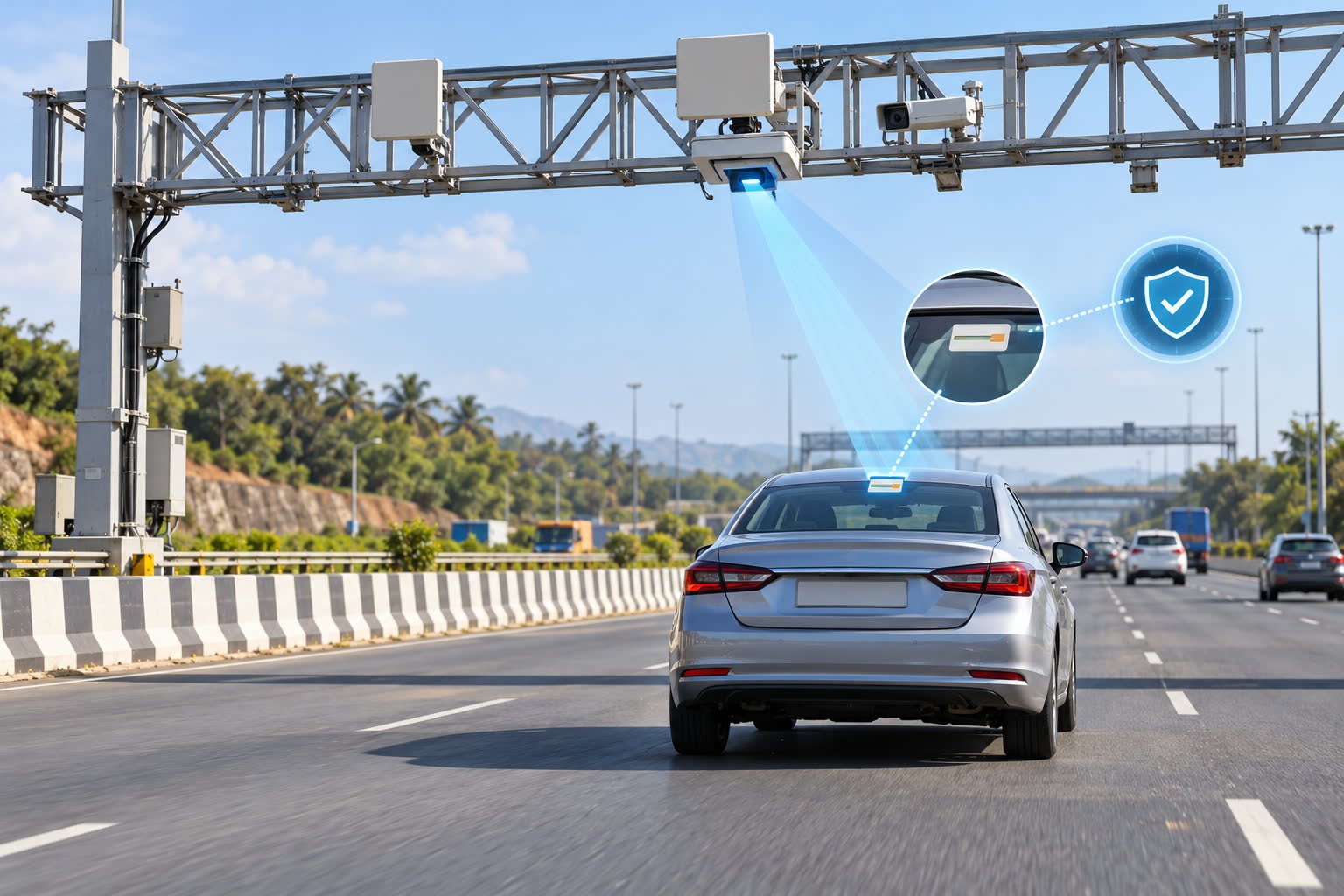
According to a 1 Nov 2026 report by Mint, the Ministry of Road Transport and Highways (MoRTH) and the Defence Ministry are discussing a digital way to recognise eligible private vehicles used for official defence duties as multi-lane free-flow (MLFF) tolling expands. The options include a FASTag annual pass reimbursed by the Defence Ministry or a differentiated tag that records movement without deducting toll, but neither option has been notified.
Key takeaways
- The proposal is still under discussion; it is not a new blanket toll exemption for all serving personnel or private cars.
- Mint reported that vehicles using MLFF stretches have faced automated toll notices when an existing exemption cannot be verified digitally.
- MoRTH's 22 Jul 2026 release describes MLFF as a combination of ANPR, AI analytics and RFID-based FASTag collection.
- The existing FASTag Annual Pass costs ₹3,075 for 2026–27 and covers 200 fee-plaza crossings or one year, whichever comes first, for eligible non-commercial cars, jeeps and vans.
What MoRTH is trying to solve
At a conventional toll plaza, an eligible person can present the required identity or duty document and the operator can verify the exemption before allowing the vehicle through. MLFF removes that physical checkpoint. Overhead cameras and readers identify a vehicle while it continues moving, and the toll system then either deducts the applicable fee or records an unpaid passage.
Mint reported on 1 Nov 2026 that the problem has surfaced on highway stretches where MLFF is already operating: private vehicles used by armed-forces personnel have reportedly received e-challans even when the occupants relied on the existing exemption process. The report said MoRTH has started discussions with the Defence Ministry, but the ministries had not finalised who would bear the cost or how the vehicle would be recognised.
That distinction matters for readers. The development is about making an existing eligibility decision work inside a digital tolling system. It is not confirmation that every private vehicle owned by a serving defence employee will become toll-free.
How the MLFF rollout changes the process
In its 22 Jul 2026 release, MoRTH said the MLFF model uses automatic number-plate recognition (ANPR) with AI analytics alongside RFID-based FASTag technology. The stated aim is to let vehicles pass without stopping, slowing down or remaining in a toll-plaza lane. In that release, the ministry said MLFF had been awarded at 17 fee plazas, five had gone live and bids had been invited for 104 more. Those figures describe the position reported on 22 Jul 2026, not a promise that the entire network was already barrier-free.
The current issue could become more important as the system expands. Mint reported on 1 Nov 2026 that India's national-highway network has about 1,150 toll plazas and that the government expects MLFF to cover the network by the end of FY28. The report said fewer than 10 plazas then had MLFF and bids had been invited for more than 100, making an exemption database and an appeals process part of the rollout rather than a minor back-office detail.
What the rules mean today
The baseline is narrower than a simple “defence personnel do not pay toll” message suggests. The Times of India reported on 1 Jun 2026 that vehicles used for official purposes by defence personnel are among the categories with exemptions and that “Exempted FASTags” are issued through IHMCL for vehicles that are legally exempt.
An Indian Express report published on 20 Feb 2020, based on an NHAI response to an RTI application, said a personal vehicle used for private or off-duty travel does not qualify under the clarification it received. That report also recorded a legal disagreement about the interpretation of the Indian Tolls (Army and Air Force) Act, 1901. The practical takeaway is that eligibility, purpose of travel and the required pass or documentation matter; a service identity card alone should not be treated as proof of a new universal exemption.
Until MoRTH or NHAI publishes a fresh notification, the reported mechanism should be treated as proposed. Drivers should not change their FASTag settings or stop paying a toll on the assumption that a special tag is already available.
What could change for drivers and operators
For eligible defence journeys
A validated exemption record linked to a FASTag could remove the need for a manual intervention at an MLFF location. It could also prevent an eligible passage from being treated as unpaid and routed into an e-challan process. The final design still has to specify which vehicles qualify, how official use is established, how often records are checked and how an incorrectly charged passage is reversed.
For ordinary private motorists
There is no reported change to ordinary toll rates or to the existing Annual Pass terms. A driver planning a highway journey can use the toll-charge calculator to estimate the route cost, while keeping the FASTag active, correctly fitted and funded for roads outside any pass coverage. The proposed defence mechanism does not make other private vehicles exempt.
For fleet and transport operators
MLFF may reduce queues and idling at locations where it works reliably, but it also makes accurate vehicle-to-account matching more important. Operators should retain toll messages and trip records when a passage is disputed. MoRTH's 22 Jul release listed the National Highways 24×7 helpline 1033, issuer-bank helplines and the RajmargYatra app among the available complaint channels. A route manager can also compare timing and stops with the road-trip planner when checking whether a tolling issue affected a scheduled run.
The cost and privacy questions
The reimbursement route would use the existing annual-pass framework. The 2026–27 fee is ₹3,075 per eligible non-commercial car, jeep or van for up to 200 fee-plaza crossings or one year, whichever comes first, according to MoRTH's July release. That gives the Defence Ministry or another department a visible per-vehicle cost, but the final bill would depend on the number of vehicles that qualify and whether the department reimburses passes or pays for a separate system.
A differentiated FASTag could avoid charging at the point of passage, but it would need reliable eligibility data, periodic validation and safeguards against misuse. Mint reported that discussions have also considered how movement data for official vehicles should be handled for security reasons. For private vehicles, the harder question is linking a vehicle that may be privately owned to a particular official journey without creating a permanent record that is broader than necessary.
What to watch next
- A MoRTH, NHAI or Defence Ministry notification naming the eligible vehicle and journey categories.
- The application, verification and renewal process for an exempted or differentiated FASTag.
- Whether existing e-challans can be reviewed or cancelled when an eligible passage was captured before digital recognition was available.
- The cost-reimbursement decision and the data-retention rules for ANPR and FASTag records.
Reader takeaway: the proposed digital fix is meant to prevent a manual toll exemption from failing inside MLFF technology. It is not in force yet, so ordinary drivers should continue to follow the current toll and FASTag rules and watch for an official notification. Related updates are available in the latest FuelPrice news archive.
Sources
- Mint — Centre plans toll exemption via FASTags for armed forces’ private vehicles — 1 Nov 2026
- Press Information Bureau / MoRTH — FASTAG Based Toll Collection and Digital Tolling System — 22 Jul 2026
- The Times of India — List of vehicles exempted from NH toll may soon be pruned — 1 Jun 2026
- The Indian Express — Toll exemption to defence personnel only if they are travelling on duty, says NHAI — 20 Feb 2020