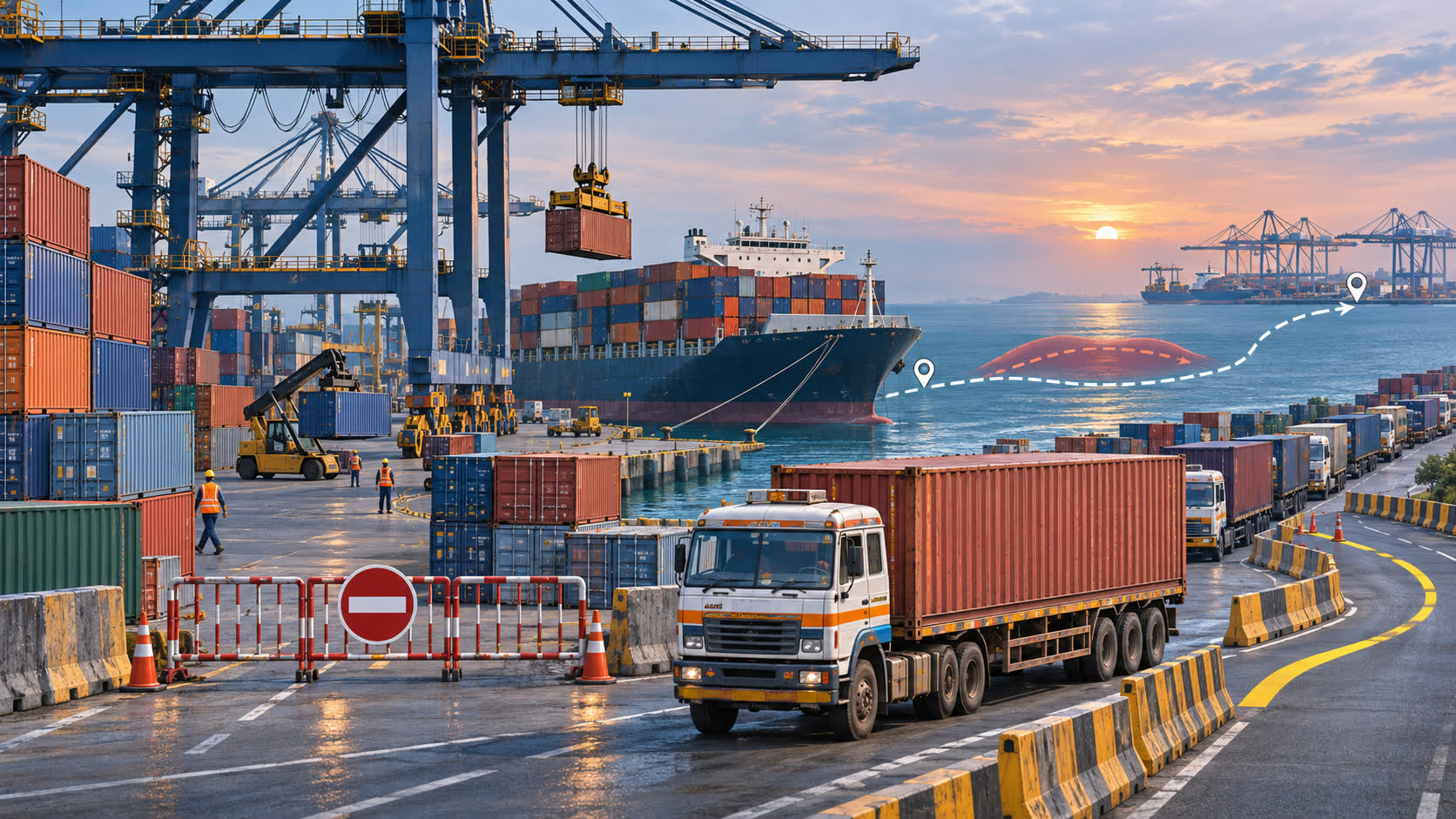
Maersk’s 18 Nov 2026 Middle East operational update flags route restrictions, congestion and added costs for cargo moving through the Gulf, including India-linked shipments. The Loadstar reported on 17 Nov that spot quotes from Nhava Sheva to Khor Fakkan had reached about US$7,500 for a 40-foot container, while empty-container returns could add another charge.
Key takeaways
- Maersk says congestion at Khor Fakkan is causing longer clearance times, truck queues and changes to some final destinations.
- Its 18 Nov update lists a US$1,200 drop-off charge for a 40-foot container returned at the Sajaa dry port in the UAE.
- The same update lists emergency freight rates of US$1,800 for a 20-foot dry container, US$3,000 for a 40-foot dry container and US$3,800 for reefer, special or dangerous-goods containers on affected cargo.
- The Loadstar’s 17 Nov report put a JNPA–Khor Fakkan spot quote at about US$7,500 per 40-foot box, up from US$6,500–7,000 in the second half of October.
- These are shipment-specific carrier and market figures, not a new Indian fuel or toll charge. The final bill depends on route, cargo type, contract and handling arrangements.
What Maersk’s latest update changes
Maersk’s “Middle East Operational Update 55”, dated 18 Nov 2026, says the situation remains fluid and that service measures can change. The notice temporarily pauses some landside bookings, including selected movements from the UAE and Qatar via Jeddah or Oman, from Jeddah to the UAE, Oman or Qatar, and from Salalah or Sohar to several Gulf destinations.
For ocean cargo, acceptance depends on the equipment and destination. The notice says some reefer bookings to or from Iraq, Kuwait, Qatar, Bahrain, parts of Saudi Arabia, Jordan and the UAE are suspended, with stated exceptions. Dry cargo remains accepted on several routes, but Maersk lists restrictions for Iraq and for export containers at Dammam and Jubail. This means a booking that was available for one cargo type may not be available for another.
The most immediate operational issue is at Khor Fakkan. Maersk says vessel congestion, limited berthing, high yard use, road congestion and extended truck waiting times are delaying clearance. Some containers booked for Khor Fakkan may instead be discharged at Fujairah or Jebel Ali and then moved by a bonded land route, depending on the shipment and whether a feeder can transit the Strait of Hormuz.
Charges listed in the 18 Nov carrier notice
Maersk’s own update lists the following amounts for affected cargo and routes. They should be read as the carrier’s current published charges, not as a universal price for every India–Gulf shipment.
| Item | Published amount | Scope |
|---|---|---|
| Emergency freight | US$1,800 per 20-foot dry container | Affected cargo loading from or destined for listed Gulf markets; Maersk update, 18 Nov 2026 |
| Emergency freight | US$3,000 per 40-foot dry container | Affected cargo and routes covered by the notice; Maersk update, 18 Nov 2026 |
| Emergency freight | US$3,800 per reefer, special or dangerous-goods container | Affected cargo categories covered by the notice; Maersk update, 18 Nov 2026 |
| Hormuz transit fee | US$1,000 per container | Additional amount when the vessel transits the Strait of Hormuz; Maersk update, 18 Nov 2026 |
| Empty return at Sajaa | US$1,200 for a 40-foot container | UAE drop-off charge listed as effective from 6 Nov 2026; Maersk update, 18 Nov 2026, and The Loadstar, 17 Nov 2026 |
Maersk says the Hormuz transit amount is on top of the emergency freight rate. It also says the charges can be adjusted as conditions change and that additional storage, handling, clearance, terminal or inland-transport costs may apply. The carrier’s notice therefore gives a useful checklist of possible cost lines, but it is not a final invoice.
Why India-linked cargo is under pressure
The Loadstar reported on 17 Nov 2026 that space from JNPA, also known as Nhava Sheva, and Mundra to Khor Fakkan, Fujairah and Sohar had become tighter and less predictable. It cited a CMA CGM spot quote of about US$7,500 for a 40-foot booking from JNPA to Khor Fakkan, compared with US$6,500–7,000 in the second half of October. It also reported a quote of about US$6,500 from JNPA to Sohar, described as nearly double the level available at the end of September.
Those figures are market reports for particular bookings, not a rate card that applies to every exporter. The final amount can change with the carrier, sailing, equipment availability, cargo requirements, destination and whether the booking includes inland movement. The same report said Maersk’s empty-return charge to the Sajaa dry port could reach US$1,200 for a 40-foot container; Maersk’s 18 Nov update lists the same amount for that drop-off location.
What it means for Indian transporters and businesses
For an Indian exporter or importer, the risk is not limited to the ocean quote. A changed final port can add a bonded road movement, a different collection point or extra time before the container reaches the consignee. That can affect delivery schedules for goods moving onward from the Gulf, even when the Indian leg from the factory to the port is unchanged.
Indian fleet and logistics operators should also separate the ocean charge from the road leg. A rerouted container may involve more truck waiting time, a longer trip, additional tolls or a new fuel requirement. Businesses planning a revised inland movement can use the toll-charge calculator to model the road component and the fuel-cost calculator to estimate diesel use. For domestic delivery planning after a port change, the live fuel-price tool can help keep the fuel assumption current.
What to check before accepting a revised route
- Ask the carrier or forwarder to identify the exact final port, inland destination and return depot for the container.
- Request a written split between the base ocean rate, emergency freight, the Hormuz amount, empty-return charge, landbridge movement, storage, terminal handling and local haulage.
- Confirm whether the cargo classification is dry, reefer, special, dangerous goods or out-of-gauge, because Maersk’s acceptance rules and published amounts differ by category.
- Check the validity date of the quote and whether the booking is subject to available capacity. Maersk says its measures may change as the regional situation develops.
- Keep the original booking, revised routing notice and final invoice together. That makes it easier to compare the quoted route with the route actually used.
What to watch next
The next practical signal will be whether congestion at Khor Fakkan and Fujairah eases enough for container collection and onward trucking to return to normal. Maersk says affected customers will receive shipment-specific details, while The Loadstar’s reporting indicates that India–Gulf capacity and spot pricing remain under pressure.
Reader takeaway: India-linked Gulf cargo is facing a combination of tighter space, rerouting and extra handling costs. Treat the published figures as dated reference points, then verify the complete route and charge breakdown for the specific container before calculating the shipment’s landed cost.