Union minister Nitin Gadkari has urged Maharashtra to consider an electric-vehicle charging rate of ₹5 per unit (kWh) between 8 am and 6 pm, with ₹8–₹10 per kWh after 6 pm. Reports by Autocar Professional on 30 Oct 2026 and The Times of India on 31 Oct 2026 describe this as a proposal, not an active statewide tariff, so EV drivers should not assume that every public charger will immediately bill at the suggested rates.
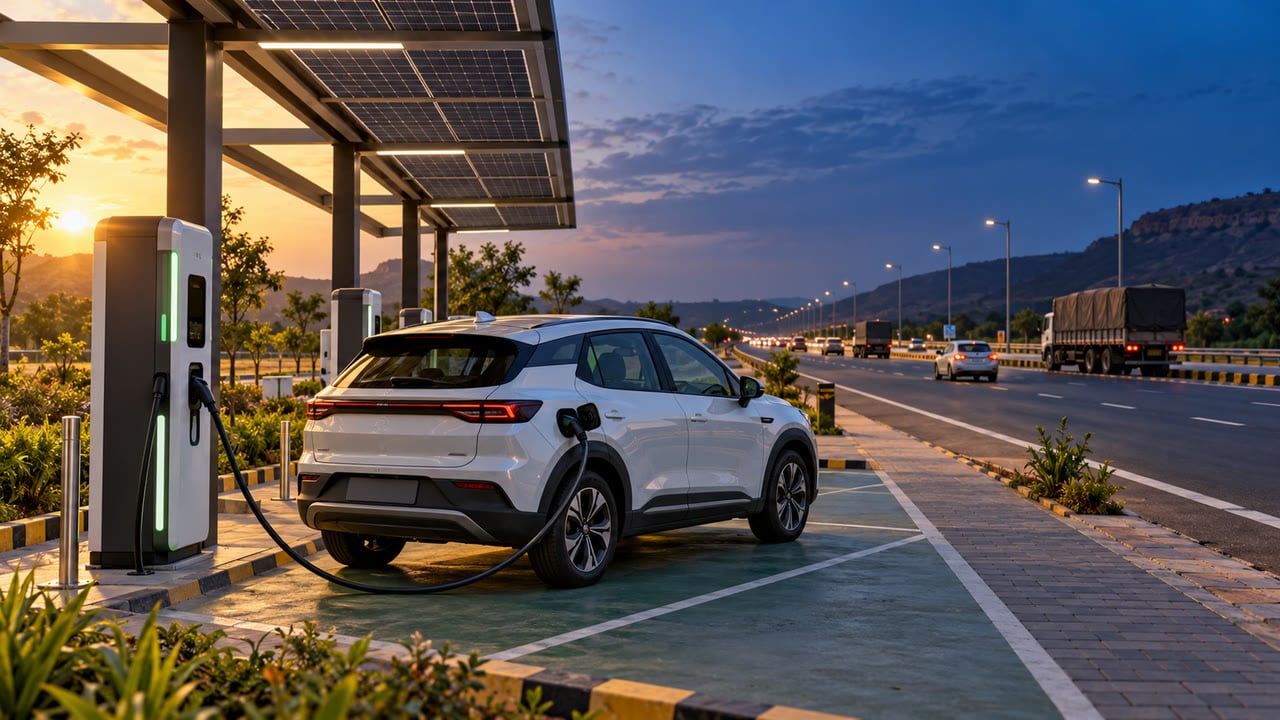
Illustrative image: a generic highway EV charging stop showing a day-to-evening charging context; it is not a photograph of a specific Maharashtra location.
Key takeaways
- Gadkari asked Maharashtra to consider ₹5 per kWh for EV charging from 8 am to 6 pm.
- He suggested ₹8–₹10 per kWh after 6 pm and asked for lower rates at charging points on national highways.
- Fadnavis said the state would bring in processes to reduce charging costs, but the reports do not cite a new tariff order or effective date.
- The ₹22 per kWh figure was cited by Gadkari for the highway charging points he referred to; it is not a universal price for every EV station in Maharashtra.
- Station operators can still add taxes, parking, idle-time or service charges, so the price shown in the operator app remains important.
What Gadkari proposed
Gadkari made the request at an event in Pune on 30 Oct 2026, where six EKA Mobility manufacturing facilities were inaugurated. According to the two reports, he asked Maharashtra Chief Minister Devendra Fadnavis to consider a daytime public-charging rate of ₹5 per kWh from 8 am to 6 pm. The reported evening suggestion was ₹8–₹10 per kWh after 6 pm.
Gadkari also said he had asked the Union Power Ministry to look at the rate at EV charging points on national highways. He referred to ₹22 per kWh as the current rate at the highway facilities under discussion. That wording matters: the report describes a rate cited at those facilities, not a single retail price that applies to all public, workplace or home charging in the state.
Fadnavis said Maharashtra would introduce processes to lower EV charging fees and improve the charging ecosystem. Neither report cites a notification bringing the proposed rates into force. Until a competent authority issues the relevant order and operators update their tariffs, the suggestion should be treated as expected policy, not a confirmed price change.
Why the proposal matters to EV drivers
Public fast charging is an important part of the cost of an electric-car road trip, especially for people who cannot charge at home or who travel between cities. A lower energy rate would reduce the energy portion of a charging session and could make long-distance EV use easier to budget. It would not, by itself, guarantee a lower final bill if a station adds parking, platform, convenience or idle-time fees.
For an illustrative 40 kWh top-up, applying the proposed ₹5 per kWh rate gives an energy-only cost of ₹200. Applying the reported ₹22 per kWh highway rate to the same assumed top-up gives ₹880, a difference of ₹680. This is a simple example based on the reported figures, not a quote for any particular vehicle or station; the battery may accept a different amount of energy and the final invoice can include other charges.
Drivers planning a route can use the state-wise EV charging directory to identify possible stops, then confirm the live price and connector details in the operator's app before departure.
Who would be affected
- Private EV owners: Maharashtra residents and visitors using public chargers could see lower energy costs if the proposal is formally adopted and passed through to customers.
- Highway travellers: The request specifically covers charging points along national highways, where a lower energy rate could matter on inter-city trips.
- Electric fleets: Buses, delivery vehicles and other high-use fleets would be more exposed to public charging prices because they may need frequent or high-capacity sessions.
- Home-charging users: The proposal does not automatically change a household electricity bill or the price charged by a private charger installed at home.
- EV buyers: This is a charging-cost proposal, not a purchase subsidy, registration-fee waiver or guarantee that an electric vehicle will have a lower total cost of ownership.
The effect will also vary by charger type and commercial model. A slow charger at a destination, a high-power highway charger and a fleet depot do not necessarily have the same connection, utilisation or operating costs. A state-level announcement may therefore take time to translate into a uniform customer price.
What Maharashtra's EV policy says
The Government of Maharashtra's Electric Vehicle Policy 2025, issued through a government resolution dated 23 May 2025, says the concessional tariff for EV charging and battery-swapping stations is governed by Maharashtra Electricity Regulatory Commission Order No. 217 of 2024 dated 28 March 2025, or by future MERC orders. The policy also assigns multiple departments responsibilities for charging-infrastructure implementation.
That framework explains why a ministerial request and a customer-facing tariff are different stages. A formal state or regulatory process would need to clarify which chargers are covered, whether the rate applies to energy only or to the complete customer bill, how the time window is measured, and how operators must display the charge. As of 31 Oct 2026, the reports provide no effective date for the proposed ₹5 per kWh rate.
Until that position changes, EV owners comparing a trip should use the price shown for the specific station rather than a proposed state rate. The fuel-cost calculator can also help compare an EV charging assumption with a petrol or diesel trip, provided the assumptions are kept separate from a station's final bill.
What drivers can check now
- Station price: Confirm the current per-kWh rate in the operator app or at the charger before starting a session.
- Extra fees: Look for parking, idle-time, booking, convenience and applicable tax components.
- Charging window: Check whether the station actually offers time-based pricing and whether the proposed 8 am to 6 pm window is recognised there.
- Connector and power: Match the charger connector and output with the vehicle's capability; a cheaper rate is not useful if the station cannot support the trip's timing.
- Route backup: Keep an alternative stop in the plan in case a charger is occupied, unavailable or operating at a different price.
For a longer journey, the road-trip planner can help place charging and rest stops against the route. That is particularly useful for drivers who are comparing an energy-only estimate with the time cost of a public charging stop.
What to watch next
The next meaningful development would be a state notification, a MERC-related tariff decision or an operator announcement that converts the suggestion into a customer-facing price. EV users should also watch whether the Union Power Ministry responds separately for highway charging points, because a Maharashtra state process and a national-highway charging policy may not cover exactly the same stations.
Until then, the proposal is best understood as a signal that charging price is becoming a policy issue for EV adoption and road travel. For drivers comparing an EV with a conventional vehicle, live petrol and diesel rates are available through the fuel-prices page, while charging prices still need to be checked station by station.
Frequently asked questions
Is the ₹5 per kWh EV charging rate active in Maharashtra?
No. The 30 Oct and 31 Oct 2026 reports describe it as Gadkari's request or suggestion. They do not cite a notification with an effective date, so drivers should continue using the price displayed by the relevant charging operator.
Will the proposal apply to every EV charger?
That is not yet clear. The request referred to Maharashtra charging points and to facilities on national highways, while the state's policy and regulatory framework covers different types of charging infrastructure. Any final order would need to define the stations, time window and charges included.