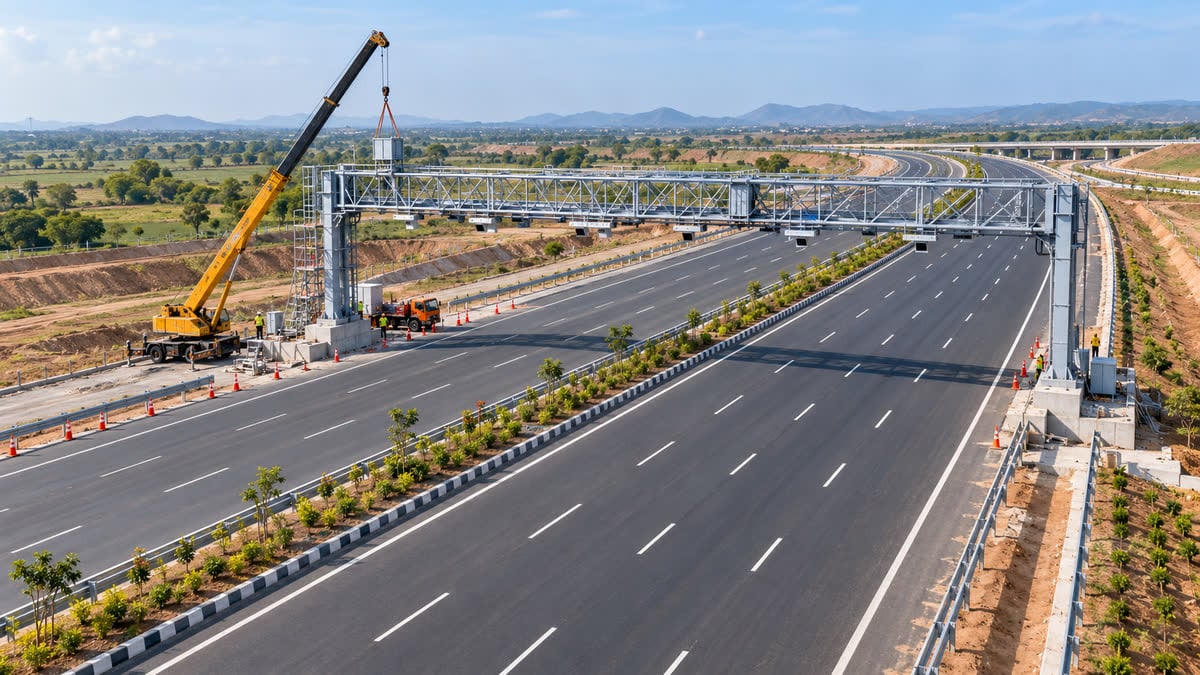
NHAI is standardising barrier-less Multi-Lane Free Flow (MLFF) toll design for new and under-construction national highways, according to a 30 Oct 2026 report by The Indian Express. For drivers, this points to smoother passage through future toll zones rather than an immediate toll-rate change: overhead FASTag and camera systems will identify moving vehicles, while a failed payment can still create an e-notice.
Key takeaways
- The latest NHAI guidance standardises the layout and equipment needed for barrier-less MLFF tolling on new highway projects.
- Vehicles can be identified in motion through a combination of FASTag-linked RFID readers and Automatic Number Plate Recognition (ANPR) cameras.
- The design change does not itself announce a new toll amount or a universal date for every existing plaza to become barrier-less.
- A failed FASTag payment can lead to an e-notice. Official NHAI guidance allows the normal user fee when the notice is paid within 72 hours; after that, the unpaid fee can be twice the applicable toll.
What NHAI’s new MLFF design means
Traditional toll plazas depend on marked lanes, booths and boom barriers. MLFF changes the collection point into an overhead detection zone. The current report says NHAI has fixed a standardised layout for the barrier-less system so that new and under-construction highways do not need to be designed around long peak-hour queues at a conventional plaza.
The technology is not a new form of road pricing. The toll remains a user fee under the applicable highway notification; the change is how the vehicle is detected and how the payment is processed. The Ministry of Road Transport and Highways has already described MLFF provisions as part of its guidelines for upcoming high-speed, access-controlled National Highways. That official release says the relevant project layouts should make room for MLFF implementation.
That distinction matters for trip planning. The new design direction does not publish a revised fee schedule, change a vehicle category or make every existing toll plaza barrier-less overnight. A driver should treat a toll amount as changed only when NHAI or the relevant authority issues a separate fee notice with an effective date.
How a barrier-less toll crossing works
An MLFF gantry uses high-performance RFID readers to read the FASTag and ANPR cameras to identify the vehicle registration number. The system then attempts to deduct the applicable user fee while the vehicle continues through the zone. There is no cash booth at the point where the moving vehicle is read, and the driver does not need to stop solely to make the FASTag transaction.
The NHAI guidance reported by The Indian Express also calls for a backup gantry, advance signs warning road users that a barrier-less plaza is ahead and adequate lighting around the equipment. Those details are practical safety measures: drivers need to know that they are approaching a detection zone, and the cameras and readers need a clear, well-lit view of vehicles and plates.
MLFF does not mean toll-free travel. It also does not remove the need to follow speed limits, lane markings and highway signs. A free-flow toll zone is designed to remove the stop at the fee point, not to authorise a vehicle to accelerate through an unfamiliar section.
What FASTag users should check before a trip
The easiest way to avoid an avoidable payment problem is to check the tag before joining a long route. NHAI’s rollout guidance asks road users to maintain sufficient FASTag balance and keep the tag active and correctly affixed to the vehicle windscreen. The tag should also be linked to the vehicle that is being driven; a mismatch can make a transaction harder to validate.
- Check the balance and recent transaction status in the issuer’s app or portal.
- Confirm that the FASTag is active, properly fixed on the windscreen and linked to the correct registration number.
- Keep the number plate readable and follow any advance signs in an MLFF zone.
- If a toll deduction is missing after a crossing, look for an e-notice instead of assuming the trip was free.
For a planned journey, the toll-charge calculator can help estimate the route’s user-fee component. Keep that estimate separate from the vehicle’s fuel cost, which can be checked with the fuel cost calculator. A shorter queue may reduce idling time, but it does not guarantee a particular rupee saving because traffic, route choice and driving conditions still vary.
What happens when a FASTag payment fails
Under the national highway payment framework, an unpaid user fee is created when electronic toll infrastructure records a vehicle’s passage but the applicable fee is not received. NHAI says an e-notice can include the vehicle details, the date and location of the passage and the amount due. It may be delivered through electronic channels and made available through the designated notice system.
The payment window is important. The official NHAI rules say that payment within 72 hours of the e-notice keeps the charge at the original applicable user fee. If the unpaid amount is not cleared within that window, the amount payable can become twice the applicable toll. The rules also provide a way to submit a representation when a vehicle owner believes a notice is incorrect.
For drivers, the practical lesson is to check the notice promptly, verify the vehicle and passage details and keep the payment confirmation. A screenshot of a balance or a successful deduction may help with a later complaint, but it is not a substitute for checking the official notice record.
Where the rollout stands
MLFF is already operating at selected National Highway fee plazas. In its rollout communication, the government referred to installations at Choryasi in Gujarat, Mundka in Delhi, Daulatpura in Rajasthan and Gharaunda on the Panipat–Jalandhar section of NH-44. These examples show that the technology is moving from a pilot-style deployment towards a wider operating model, but they do not mean that every toll plaza on those corridors has the same design.
The new design guidance is most relevant to project authorities, concessionaires and highway users who will travel on future corridors. A project may still have construction, commissioning, testing and public-notice steps before an MLFF gantry becomes operational. Drivers should rely on the signs and official notices at the specific route rather than infer a rollout date from the national policy direction.
What changes now for drivers and fleet operators
For a private driver, the immediate action is simple: keep the FASTag usable and monitor deductions after a barrier-less crossing. For a fleet operator, the shift has a wider cost implication. A route model should separate the posted toll from the possible value of less waiting, while also accounting for failed transactions, e-notice handling, tag administration and the need to reconcile each vehicle’s passage with its account.
The system could reduce queue-related delay and idling where it is correctly installed and maintained. That is an expected operating benefit, not a guaranteed saving for every trip. The useful comparison is therefore a dated toll estimate plus a realistic fuel and time assumption, rather than a promise that MLFF will lower the total cost of every journey.
What is confirmed—and what is not
- Confirmed: NHAI is moving new highway design towards barrier-less MLFF, using FASTag-linked RFID and ANPR-based vehicle identification.
- Confirmed: a failed electronic toll transaction can lead to an e-notice and the national rules set a 72-hour window for the original user fee.
- Not confirmed by this update: a new toll rate, a blanket conversion date for existing plazas or a specific go-live date for every project under construction.
Sources
- The Indian Express — “Barrier-less system to reduce toll lanes in new highways” — 30 Oct 2026
- Press Information Bureau/MoRTH — “NHAI Guidelines to Strengthen Technology Integration and Sustainability in Development of High-Speed National Highway Corridors” — 24 Sep 2026
- Press Information Bureau/MoRTH — “NHAI Rolls Out Multi-Lane Free Flow (MLFF) Tolling at Gharaunda Toll Plaza on NH-44” — 25 Jun 2026
- NHAI — “National Highways Fee Rules, 2026 Amended to Strengthen Toll Compliance and Digital Enforcement” — 18 Mar 2026