Mahindra Last Mile Mobility (MLMML) and Uber announced on 16 Nov 2026 that they will support the adoption of 5,000 Mahindra electric three-wheelers on Uber’s platform over the next 12 months. The EV Auto Advantage programme is intended to improve access to financing and other adoption support for drivers, especially in markets where electric-vehicle penetration is still low.
The important qualification is that this is a target announced under a memorandum of understanding (MoU), not a statement that 5,000 vehicles have already been ordered, delivered or assigned to drivers. The companies have not yet published a city-by-city rollout, lender list, interest rate, down payment, trade-in value, vehicle-wise allocation or delivery timetable.
Key takeaways
- Mahindra and Uber will support 5,000 electric three-wheelers over a 12-month period.
- The programme focuses on financing and other adoption enablers for drivers on the Uber platform.
- Low-EV-penetration markets are the stated priority, but participating cities are not yet named.
- No rupee saving, loan rate, trade-in amount or minimum driver income has been promised.
- Drivers and fleet operators will need charging, service, battery and total-cost details before comparing an electric auto with a petrol or CNG vehicle.
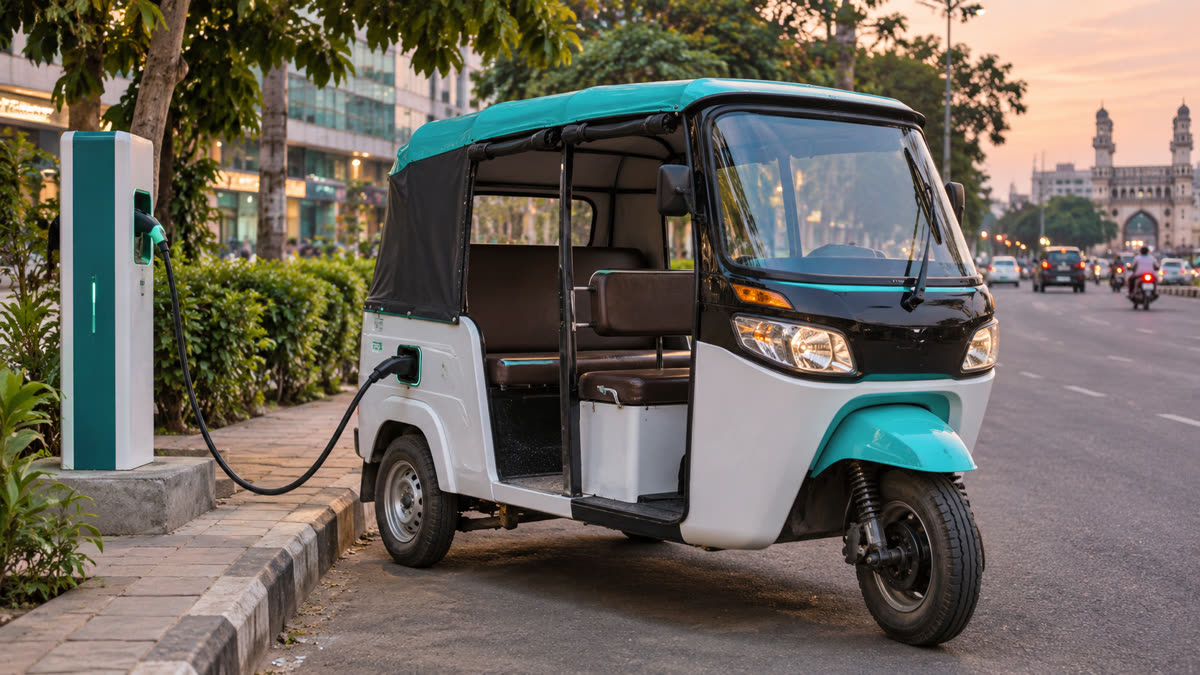
Illustrative image: an electric three-wheeler at an urban charging point. It is not a photograph of the announced deployment.
What Mahindra and Uber announced
Mahindra’s official release said MLMML and Uber made the announcement in Mumbai on 16 Nov 2026. The MoU places the plan under the EV Auto Advantage programme and sets a goal of supporting 5,000 Mahindra electric autos over the following 12 months. The stated purpose is to reduce the financial and practical barriers that can prevent a commercial driver from switching from an internal-combustion vehicle to an electric one.
The release describes financing and other adoption enablers, but it does not set out a standard loan product or a universal purchase price. Financial Express and Autocar Professional also reported the 5,000-vehicle target and the focus on improving financing access. Mint reported that trade-in incentives and financial support are part of the proposed driver package. Those reports are useful context, but the precise value and eligibility conditions still depend on the final programme terms.
What the plan could change for drivers
For an auto driver, the most relevant part of the announcement is access rather than a new vehicle specification. A commercial EV decision depends on the full operating cycle: the vehicle’s usable range with passengers or cargo, charging time, electricity tariff, battery warranty, service response and the cost of finance. None of those inputs can be turned into a verified monthly saving from the 5,000-vehicle headline alone.
Financing support may reduce the upfront barrier for some drivers, while a trade-in facility could make it easier to replace an older auto. But an MoU does not guarantee approval, a particular interest rate or a lower total cost. Actual offers, if and when released, may vary by driver profile, vehicle variant, city, lender, insurance arrangement and the condition of the vehicle being exchanged.
The programme may also affect passengers indirectly if more electric autos become available on the Uber platform. However, neither company has promised a minimum number of trips, a fare change, a guaranteed utilisation level or a particular earnings outcome. The confirmed development is the planned support mechanism, not a guarantee of income for drivers or a change to every passenger’s ride options.
Confirmed facts and open questions
Confirmed in the 16 Nov announcement
- The target is support for 5,000 Mahindra electric three-wheelers on Uber’s platform over 12 months.
- The arrangement is an MoU between Mahindra Last Mile Mobility and Uber.
- The EV Auto Advantage programme will work on financing and other adoption enablers.
- The focus includes markets where EV penetration is relatively low.
- Mahindra said MLMML has more than 4 lakh commercial EVs on Indian roads, covering passenger and cargo applications.
Details drivers still need
- Which cities and Uber service categories will be included first.
- Which Mahindra electric-auto models, battery options and payload configurations will be available.
- Whether the support will be a loan arrangement, lease, trade-in benefit, cash incentive or a combination of these.
- The interest rate, processing fee, insurance cost, down payment, tenure and maintenance terms.
- Where drivers can charge, how long a normal commercial charge will take and how service downtime will be handled.
Why charging and running cost matter
Electric autos can shift a driver’s cost pattern from repeated fuel purchases to electricity, finance and battery-related costs. That does not automatically make every route cheaper. A vehicle that runs long shifts may need a reliable charging plan, while a driver with limited parking access may depend on public charging and its availability or tariff.
Drivers comparing an electric auto with a conventional vehicle can first establish the petrol or diesel baseline using the FuelPrice fuel cost calculator. The result is only one part of the comparison: electricity rates, charging losses, scheduled maintenance, tyre wear, financing and battery coverage also need to be checked against the actual duty cycle.
Charging access is especially important in the low-penetration markets named in the announcement. The state-wise EV station directory can help identify the existing public-charging network, but a directory listing is not a guarantee of connector compatibility, availability, queue time or commercial pricing. Those details should be confirmed locally when the programme opens for enrolment.
What to watch next
The next meaningful update should be a formal rollout note with participating cities, eligible driver categories, vehicle variants and the exact financial package. A clear schedule would also show whether the 5,000 figure is a maximum support target, a phased deployment goal or a commitment tied to verified driver demand.
For fleet operators, the useful comparison will be total cost per working kilometre and vehicle uptime, not just the headline financing benefit. That calculation should include the expected daily distance, passenger or cargo load, charging time, service coverage, insurance, battery warranty and resale or trade-in treatment. For individual drivers, the same information will show whether the offer fits a particular route and working pattern.
Bottom line
The Mahindra-Uber partnership is a new channel for electric-auto adoption, with a stated target of supporting 5,000 vehicles over the next 12 months. It could make access to finance, trade-in support and platform-based work easier for some drivers, but the announcement does not yet provide the terms needed to calculate a real saving or a guaranteed income outcome. Until city and programme-level details are released, the confirmed story is the support target and the financing intent—not a finished offer available on identical terms to every driver.
Sources
- Mahindra — Mahindra Last Mile Mobility and Uber Partner to Accelerate 3W EV Adoption Across India — 16 Nov 2026
- Mint — 5,000 electric autos in 12 months: Uber launches EV Auto Advantage with Mahindra to scale up green fleet — 16 Nov 2026
- Financial Express — Mahindra, Uber to deploy of 5,000 electric three-wheelers in 12 months — 16 Nov 2026
- Autocar Professional — Mahindra, Uber Target 5,000 Electric Three-Wheeler Deployments — 16 Nov 2026
This article is for general information only and is not financial, insurance or legal advice.