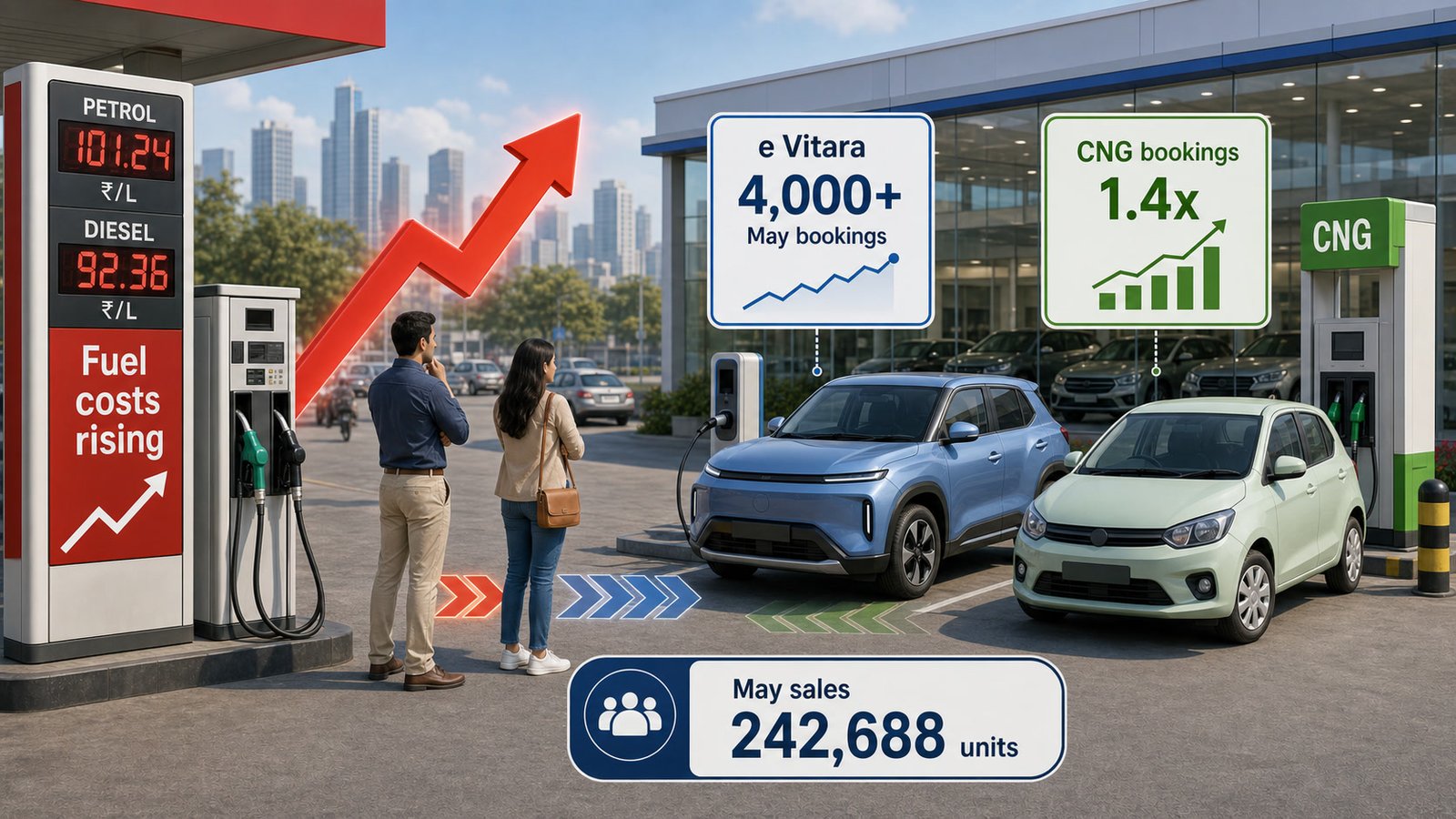
India's fuel-cost pressure is now showing up directly in showroom behaviour. Maruti Suzuki's first electric SUV, the e Vitara, received more than 4,000 bookings in May 2026, while bookings for the company's CNG models rose to about 1.4 times the earlier run-rate after recent petrol and diesel price hikes. The signal is important because it comes from the country's largest carmaker, not from a niche EV start-up or a single-city fleet operator.
The broader sales base is also large enough to matter. Maruti Suzuki's official May 2026 release says the company sold 242,688 units during the month, its highest-ever monthly volume. Domestic sales reached 193,535 units, while exports stood at 41,914 units. Within that record month, the fuel-choice story is sharper: buyers who might have delayed a purchase because of higher running costs are instead comparing petrol, CNG and electric options more actively.
What Changed In May
According to reports citing Maruti Suzuki senior executive officer for marketing and sales Partho Banerjee, fuel prices rose by around Rs 8 per litre over an 11-day span, hurting the sentiment of price-sensitive small-car buyers. But the same pressure appears to have made lower running-cost choices more attractive. The e Vitara's May bookings were reported at more than 4,000, nearly double the previous month, while CNG bookings rose sharply despite CNG itself becoming costlier in several cities.
This is not just a headline about demand. It is a test of whether buyers now evaluate cars on total cost of ownership rather than only ex-showroom price. For a private commuter, the monthly fuel bill can decide whether a petrol hatchback remains affordable. For high-usage families, cab-like users and small businesses, the calculation becomes even more direct: every litre or kilogram saved changes the payback period.
| Data point | Reported figure | Why it matters |
|---|---|---|
| Maruti total sales, May 2026 | 242,688 units | Record monthly base makes the fuel-shift signal more meaningful. |
| e Vitara bookings | More than 4,000 in May | Shows EV interest rising when petrol and diesel costs move up. |
| CNG booking run-rate | About 1.4 times earlier pace | Confirms CNG remains a practical running-cost hedge for many buyers. |
| e Vitara production constraint | Around 2,000 units a month reported | Demand can convert into sales only if supply improves. |
Why Buyers Are Moving Toward CNG And EVs
The immediate trigger is fuel inflation. When petrol and diesel prices move quickly, entry-level and compact-car buyers feel the change faster because their budgets are already tight. A petrol car may still be cheaper to buy, but its monthly cost can rise sharply if the owner has a long commute. CNG, despite refuelling queues and lower boot space in some models, can still offer a lower running cost per kilometre for heavy users. That explains why Maruti's CNG order flow has strengthened even after CNG price increases.
The e Vitara story is different but connected. EV buyers are not only comparing fuel bills; they are also looking at charging access, battery subscription or upfront pricing, range, resale confidence and warranty support. More than 4,000 bookings in a single month show that Maruti's long-awaited EV entry has found attention at the right time. However, reports also point to production being limited at around 2,000 units a month for now, with many units intended for export. That means waiting periods and allocation strategy could decide how quickly the booking momentum turns into Indian retail deliveries.
Impact On Fuel Users And The Auto Market
For fuel users, the message is straightforward: the cheapest sticker price may not be the cheapest ownership choice. A petrol hatchback, a factory-fit CNG variant and an EV can all suit different usage patterns. City commuters with predictable routes and home or workplace charging may see the e Vitara and similar EVs as a stronger case. High-mileage buyers without dependable charging may still prefer factory-fit CNG because the operating-cost advantage is easier to understand and the refuelling network is already familiar in many cities.
For Maruti, the opportunity is also a constraint-management problem. Stronger CNG bookings require enough factory-fit kit supply, trained dealer service capacity and model mix discipline. Strong EV bookings require battery supply, charging ecosystem confidence and enough domestic allocation. If demand runs ahead of supply for too long, customers may either postpone purchases or move to rival brands with faster delivery timelines.
The development also matters for petrol and diesel demand. One month of bookings does not change national fuel consumption by itself, but it shows how quickly consumers react when pump prices move. If fuel-price volatility stays high, CNG and EV penetration in passenger vehicles could accelerate faster than earlier forecasts, especially in urban and semi-urban markets where refuelling or charging options are improving.
What To Watch Next
- Whether Maruti can raise e Vitara output and domestic allocation after the reported August-September capacity improvement window.
- Whether CNG kit suppliers can scale without increasing waiting periods for popular hatchbacks and compact cars.
- Whether CNG pump queues and price increases reduce the appeal of CNG in high-demand cities.
- Whether petrol and diesel prices remain elevated enough to keep alternative-fuel bookings above normal levels.
- Whether rival carmakers respond with faster EV launches, more CNG variants or sharper hybrid pricing.
The reader takeaway is clear: the Maruti numbers are not only a sales milestone. They are evidence that fuel-price anxiety is changing buyer behaviour in real time. CNG remains the practical low-running-cost bridge for many buyers, while EVs are gaining attention where charging access and supply can support the purchase. The next few months will show whether this is a short-term reaction to fuel hikes or the start of a stronger structural shift away from petrol-only buying decisions.
Sources: Maruti Suzuki official May 2026 sales release; Autocar Professional; Autocar India; Business Standard; HT Auto; Financial Express.