Maruti Suzuki is expected to unveil India's first E100-compatible passenger vehicle on June 5, turning pure-ethanol mobility from a policy target into a practical consumer question. The model name has not been officially confirmed, but the move is important because it brings 100 percent ethanol fuel into the mainstream car market rather than keeping it limited to prototypes and policy discussions.
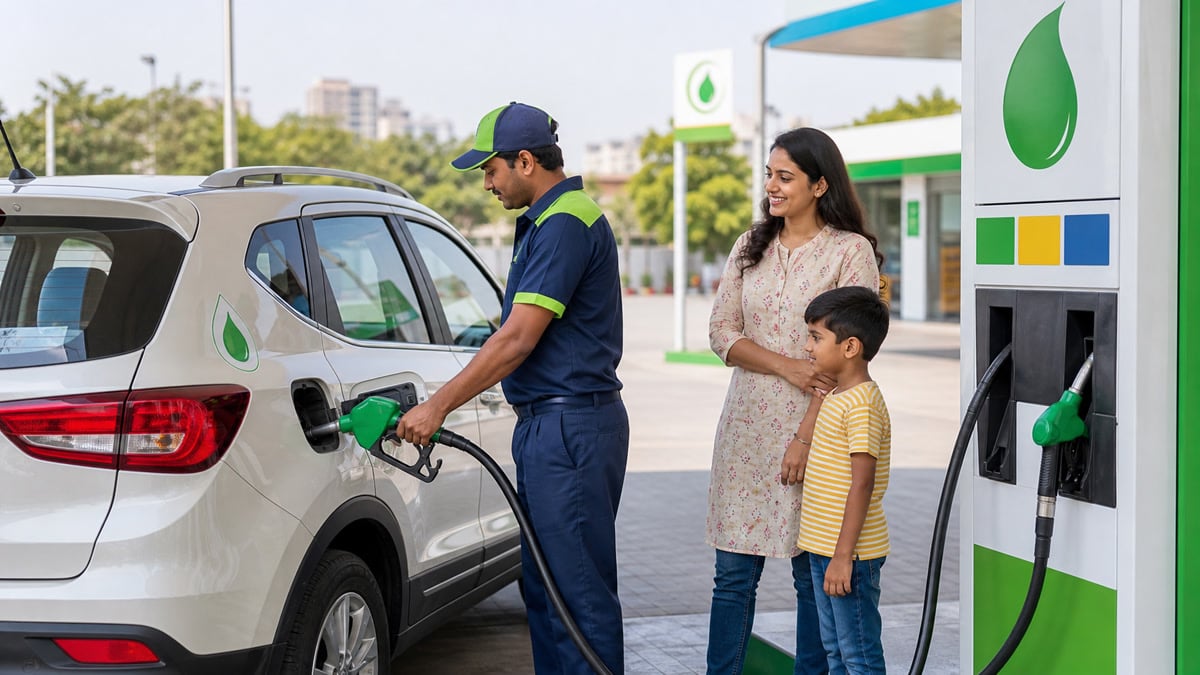
Editorial representation of an E100-compatible passenger vehicle refuelling at an ethanol-ready fuel station.What happened
Business Standard reported that Union Road Transport and Highways Minister Nitin Gadkari announced Maruti Suzuki would launch India's first E100-compatible vehicle on June 5, World Environment Day. India Today and Autocar India had earlier reported the same timeline, noting that Maruti Suzuki has not confirmed the exact model but that previous flex-fuel prototypes of the WagonR and Fronx make them likely reference points.
The timing matters. India has already moved rapidly on E20 petrol, where petrol contains 20 percent ethanol. E100 is a different step. It is effectively pure ethanol and needs a vehicle designed to handle high ethanol content, different combustion characteristics, fuel-system compatibility and real-world drivability challenges such as cold starts and calibration.
Why this is not just another car showcase
For most car buyers, alternative fuels are judged on three points: purchase cost, running cost and convenience. An E100-compatible car could offer lower fuel bills if ethanol is priced well below petrol, but the benefit is not automatic. Ethanol carries lower energy density than petrol, so a car may consume more litres to travel the same distance. The per-kilometre saving depends on how much cheaper ethanol is at the pump and how efficiently the engine is calibrated.
Business Standard's report cited industry expectations that E100 could reduce per-kilometre fuel expenses meaningfully if ethanol pricing remains favourable. That is the biggest attraction for daily commuters, ride-hailing users and high-mileage households. But the same report also underlined the larger test: fuel availability, storage readiness, logistics and consumer confidence after the launch event.
What changes from E20 to E100?
| Area | E20 petrol | E100-compatible vehicle |
|---|---|---|
| Fuel blend | 20 percent ethanol blended with petrol. | Designed to run on nearly pure ethanol, with fuel-system and engine calibration changes. |
| Consumer concern | Compatibility and mileage impact for existing petrol vehicles. | Pump access, ethanol price gap, per-km economics and long-term service support. |
| Infrastructure need | Works through the current petrol retail network. | Needs dedicated handling, storage and dispensing readiness for high-ethanol fuel. |
The fuel-station question
The bigger challenge is not only whether Maruti Suzuki can make a compatible vehicle. The real test is where owners will refuel it. High-ethanol fuel needs a retail ecosystem that can handle ethanol's moisture absorption and corrosion-related requirements. Fuel stations may need dedicated storage, compatible pipes, suitable dispensing equipment and supply-chain planning.
This is why E100 adoption is likely to begin through targeted corridors, selected pumps or pilot markets rather than instant nationwide availability. Brazil's flex-fuel experience shows that vehicle readiness and fuel availability must rise together. If buyers are forced to search for an E100 pump, the technology becomes a future-ready badge. If E100 becomes easy to access and cheaper per kilometre, it becomes a real alternative to petrol for some users.
Why Maruti Suzuki matters in this transition
Maruti Suzuki is India's largest passenger-vehicle maker and has a deep base among budget-conscious buyers. Its involvement gives E100 more weight than a niche concept car would. The company had officially showcased a WagonR flex-fuel prototype in December 2022, designed for ethanol-petrol blends from E20 to E85. At the time, Maruti Suzuki said the prototype had an upgraded engine and ethanol-compatible components, and projected a major greenhouse-gas reduction when operated on E85 compared with a conventional petrol WagonR.
An E100-ready passenger vehicle would push the technology further. It would also place pressure on the wider industry to clarify whether flex-fuel cars can become part of India's mainstream fuel strategy alongside CNG, hybrids and EVs. For consumers who are not ready for EV charging or high upfront EV prices, flex fuel could offer another pathway if the running-cost equation works.
How this affects fuel users and automakers
For fuel users, the promise is cheaper running cost and lower exposure to global crude oil prices. Ethanol is domestically produced, which gives policymakers an energy-security argument and also links the fuel economy to rural incomes and agriculture. For automakers, flex-fuel vehicles allow continued use of internal-combustion platforms while reducing petrol dependence.
However, buyers should not assume E100 is automatically cheaper in real use. The fuel price, mileage drop, maintenance requirements and resale perception all matter. A car that can run on E100 needs clear communication around what happens when E100 is unavailable, whether it can run on other blends, how warranty conditions apply and how service centres will handle high-ethanol fuel systems.
What to watch next
- Which Maruti Suzuki model is finally shown on June 5.
- Whether the vehicle is a production-ready launch, pilot rollout or technology showcase.
- How E100 fuel will be priced against petrol and E20 petrol.
- Which cities or fuel outlets will support E100 dispensing first.
- Whether other automakers follow with their own E100-compatible passenger vehicles.
Final takeaway
Maruti Suzuki's expected E100 vehicle debut is a milestone for India's ethanol roadmap, but its success will depend less on the launch stage and more on the pump network. For buyers, the headline benefit is potential running-cost savings. The practical test is fuel access, transparent pricing and confidence that a pure-ethanol car can be serviced and used conveniently. If those pieces come together, E100 could become a serious bridge between today's petrol market and India's wider clean-fuel transition.
Sources: Business Standard, India Today, Autocar India, Maruti Suzuki, PIB and Mint.