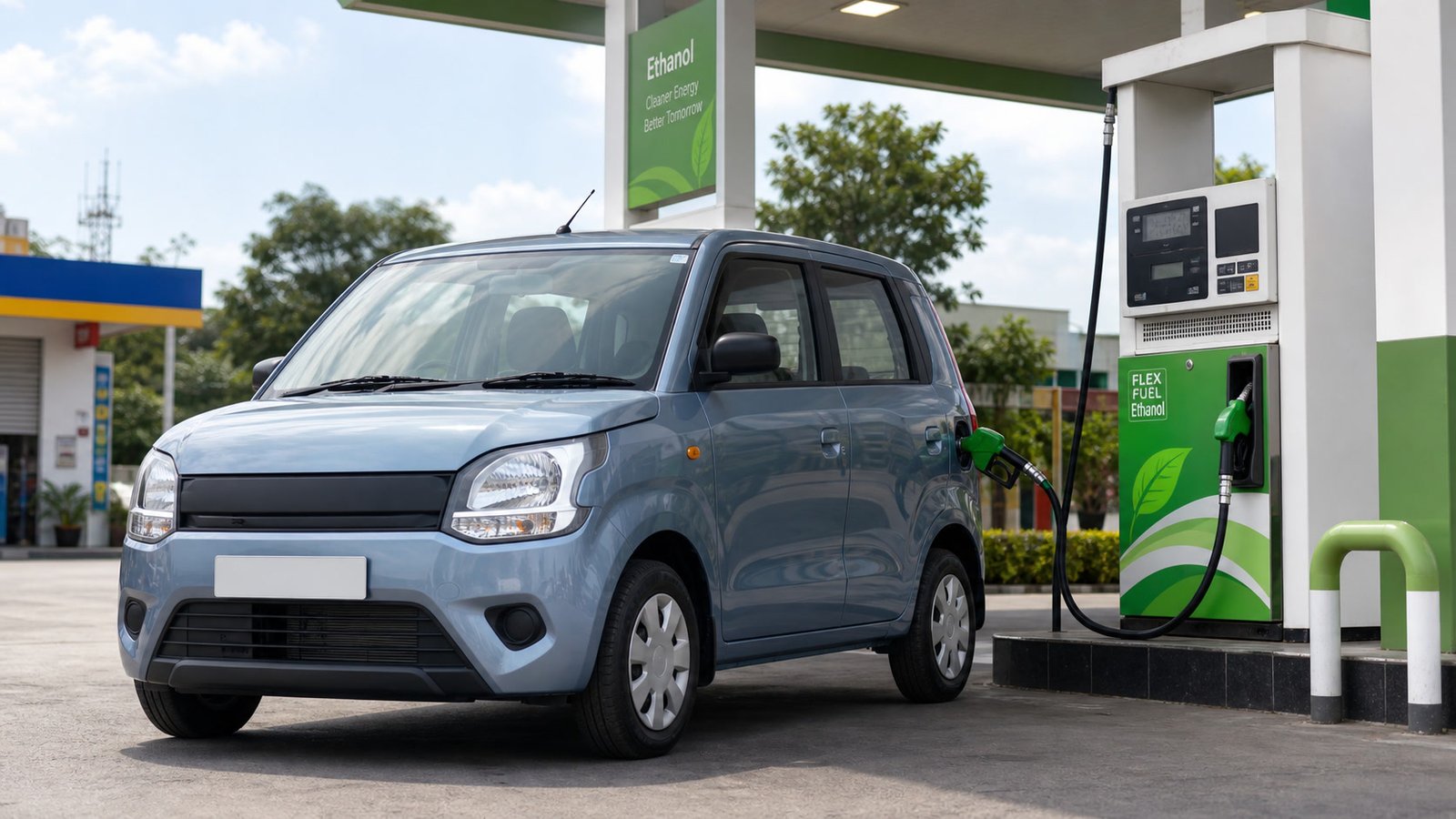
Maruti Suzuki has now put a concrete price on the WagonR Flex Fuel, and the number tells you almost as much as the car itself. At Rs 7.24 lakh ex-showroom, the model is not being sold as a cheap shortcut to lower running costs. Instead, it is being presented as a showroom-ready sign that India's ethanol transition is moving beyond policy documents and into real products that buyers can actually book, compare and eventually drive.
That matters because the WagonR Flex Fuel is more than another WagonR variant. It is being positioned as India's first mass-market passenger vehicle capable of running on higher ethanol blends, which puts it directly inside the country's fuel-policy conversation. For FuelPrice readers, the launch is important not only because of the car's price tag, but because it shows where India wants its next fuel chapter to go: away from a single petrol-only future and toward a system that can absorb more ethanol at the pump.
The headline price is also revealing. ET reports that the WagonR Bioflex is Rs 86,000 more expensive than the top-end petrol WagonR. That premium is the real-world cost of flex-fuel hardware, calibration and compatibility work. In plain terms, Maruti is signalling that the technology is ready enough to be sold, but still new enough that buyers will pay extra for it today.
Why this launch matters beyond one hatchback
India has spent years expanding ethanol blending in petrol. The next phase is more ambitious: allowing vehicles to make use of blends that go beyond the current mainstream level. That is why the WagonR Flex Fuel is notable. It turns a broad policy direction into a visible consumer product. Once a flex-fuel badge appears on a popular hatchback, the market can no longer treat ethanol adoption as a distant pilot project.
At the same time, the launch does not magically solve the fuel equation. Flex-fuel vehicles are only useful if the fuel network can match them. TOI recently reported that the government wants around 500 ethanol dispensing stations, or E100 pumps, by December 2026 and 5,000 by 2027. That network target is crucial, because a vehicle built for higher ethanol blends becomes genuinely useful only when drivers can actually find those blends where they live, travel and refuel.
The government's recent policy signals add to the story. Higher-ethanol fuel grades and E100 are no longer being discussed as fringe ideas. They are being linked to standards, pump rollout and vehicle readiness. That policy backdrop is exactly what makes the WagonR Flex Fuel launch commercially interesting. Maruti is not just offering a new trim; it is testing how quickly buyers will respond when fuel diversification begins to look tangible.
| Key point | What the market should read into it | Why it matters |
|---|---|---|
| Price: Rs 7.24 lakh ex-showroom | Flex-fuel tech is real, but not yet cheap | Buyers must compare the upfront premium against fuel use and availability |
| Premium: Rs 86,000 over the top-end petrol WagonR | Alternative-fuel hardware still carries a cost | This premium will shape adoption speed |
| Higher ethanol blend capability | The car is designed around a broader fuel future | It can help India reduce dependence on imported petrol over time |
| E100 rollout targets: 500 pumps by Dec 2026, 5,000 by 2027 | The infrastructure plan is still catching up | Fuel availability will decide how useful the vehicle is in daily life |
What flex-fuel means for the buyer
Flex-fuel is attractive because it gives the car more than one fuel pathway. In practical terms, the engine and fuel system are calibrated to operate on petrol and on ethanol-rich blends, instead of being tied to one fixed petrol formulation. That makes the vehicle more adaptable if ethanol availability expands and if higher blends become cheaper or more common at retail pumps.
But the consumer maths is not as simple as looking at the sticker price. Ethanol has lower energy density than petrol, so mileage and running-cost behaviour can change depending on the blend and the vehicle calibration. That means buyers should think in terms of cost per kilometre, not merely the price per litre at the pump. A blend can be cheaper per litre and still not deliver a dramatic ownership saving if consumption rises.
That is why the WagonR Flex Fuel should be judged on a few practical questions, not just the launch headline:
- Can the driver find the right fuel blend in their city or travel corridor?
- How does the car behave in real-world mileage compared with a petrol WagonR?
- Will service networks and warranty guidance be clear enough for regular use?
- Does the premium over the petrol version make sense for the buyer's daily commute and fuel access?
Those questions matter because flex-fuel ownership is only meaningful when product, price and pump availability line up. Without that alignment, the vehicle becomes a technology showcase rather than a mass-market solution.
Why the policy backdrop is getting stronger
The bigger reason this launch deserves attention is that India is simultaneously building the policy and infrastructure case for higher ethanol use. TOI recently reported that Petroleum Minister Hardeep Singh Puri wants around 500 E100 dispensing stations by the end of 2026 and about 5,000 by 2027. That is the missing piece for any flex-fuel story: the vehicle can only be useful if the country has a fuel map that supports it.
TOI has also explained that flex-fuel vehicles can run on multiple fuel grades, typically including ethanol-heavy blends such as E85 or even E100 where supported. That is why the WagonR launch is important. It shows automakers are preparing for a market where higher-ethanol fuels are not just a compliance measure, but a retail choice for consumers and fleet operators.
From a FuelPrice perspective, the macro implication is simple. If flex-fuel products scale and E100 pump availability expands, India can reduce some reliance on imported fossil fuel, support domestic ethanol supply chains and give the auto market another tool to manage fuel-cost pressure. That is not an instant shift. It is a gradual one. But the WagonR makes that shift visible.
Who stands to gain first
Early adopters will probably be the first to benefit. These are buyers who already live in cities where ethanol availability is improving, fleet owners looking for a policy-aligned vehicle, and users who want to bet on a future with more fuel diversity. Automakers also gain because the WagonR Flex Fuel gives them a reference point for future ethanol-capable passenger cars. Fuel suppliers and ethanol producers gain too, because the launch strengthens the case for a larger retail network.
For everyday buyers, however, the advice is more cautious. Flex-fuel is promising, but it is not yet a universal answer. If your usual route does not have reliable access to higher ethanol blends, the practical value of the car is reduced. In that sense, the WagonR Flex Fuel launch is both a consumer product and a test of the country's readiness.
What to watch next
The next few months will show whether this remains a one-off showcase or becomes the start of a broader rollout. Watch for three things: whether Maruti and rivals bring more flex-fuel models to market, whether E100 dispensing actually expands in the cities named by the government, and whether the real-world cost-per-kilometre case becomes persuasive enough for private buyers.
The key takeaway is that this is a policy-to-product moment. The WagonR Flex Fuel is not important because it is cheap; it is important because it proves ethanol mobility is now moving from slides and speeches into a real showroom price. If the fuel network follows, this could be the beginning of a much wider shift in India's automotive fuel mix. If it does not, the car will still matter, but mostly as an early signpost rather than a mass-market transition.
Sources: Times of India June 15, 2026 launch report, Economic Times June 15, 2026 price report, Times of India June 5, 2026 ethanol-pump rollout report, Times of India flex-fuel explainer.