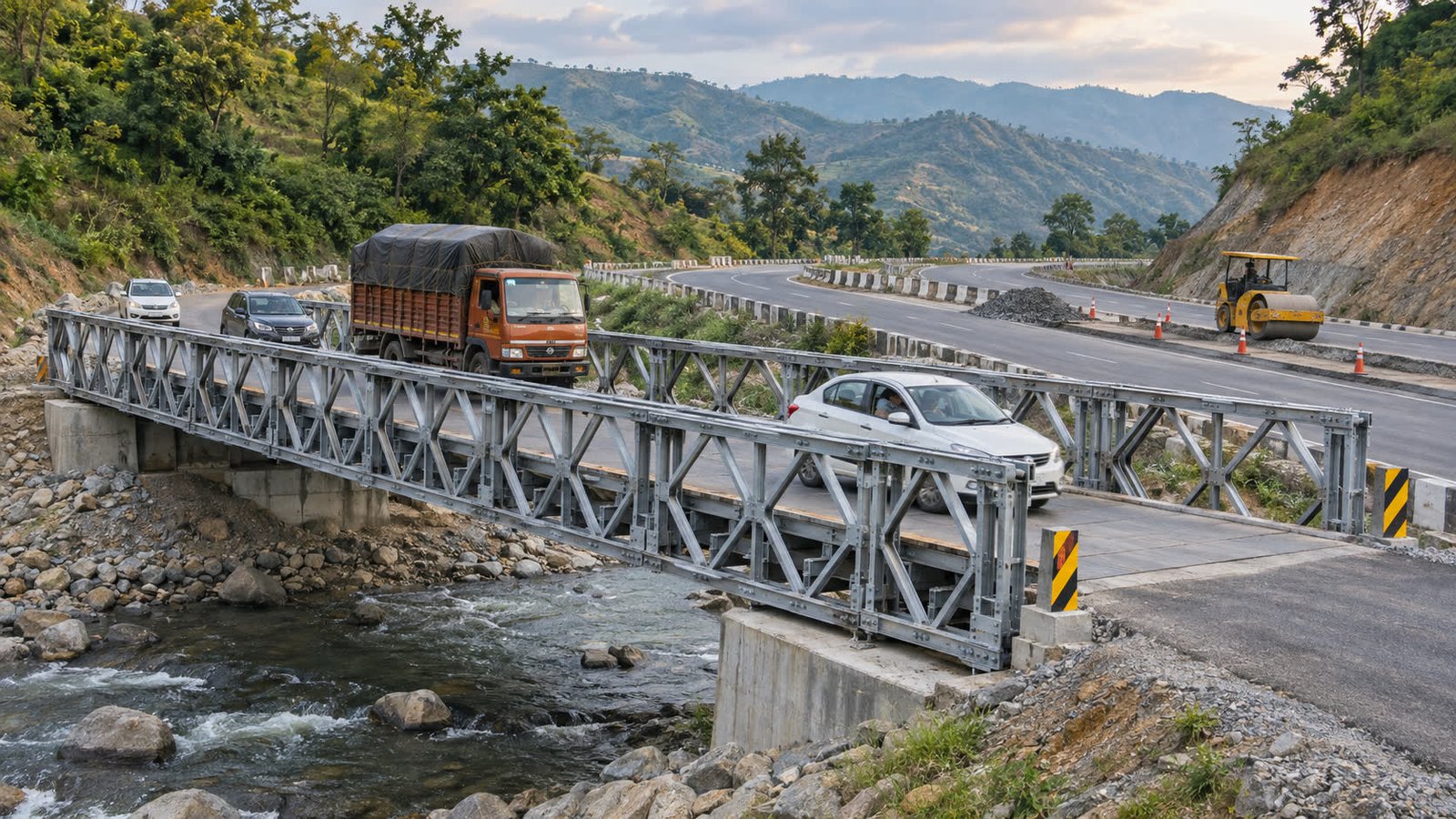
The Tribune and Dainik Jagran reported on 5–6 Nov 2026 that NHAI has installed a new Bailey bridge over the Manuni rivulet at Matour on the Pathankot–Mandi National Highway. The replacement is intended to restore a safer, more dependable crossing at a busy Kangra bottleneck and reduce disruption for cars, buses, trucks and other route users.
Key takeaways
- A new double-storey Bailey bridge has been placed at Matour over the Manuni rivulet on the Pathankot–Mandi highway.
- The two reports describe a bridge about 80 feet long and roughly 3.75 metres wide; installation took about three hours.
- The old structure had deteriorated and was reported to have a 16-tonne load-bearing capacity. Multi-axle traffic is expected to use the replacement subject to site controls.
- Traffic was diverted through Jamanabad, Abdullapur and Kangra during the overnight work. Neither report announces a new toll fee or FASTag rule.
What changed at Matour
The reported change is a bridge replacement, not a new tolling policy. NHAI installed a modular steel Bailey bridge over the Manuni rivulet at Matour, a point on the Pathankot–Mandi route used by local traffic and longer-distance vehicles travelling through the Kangra area.
The Tribune said the new bridge replaces an unsafe existing structure whose plates had been damaged by heavy-vehicle movement. Dainik Jagran separately reported that the old bridge had a load limit of 16 tonnes and that the new structure would allow multi-axle vehicles to cross. Those details matter to freight operators because a restriction at a river crossing can turn a short highway movement into a longer diversion, with extra fuel, time and scheduling cost.
How the overnight installation was carried out
According to the two reports, traffic was stopped at about 11:15 pm on Wednesday, 4 Nov 2026, and the installation began around 11:20 pm. Heavy cranes and machinery positioned the approximately 80-foot-long, 3.75-metre-wide, double-storey bridge, with the main operation taking about three hours. Workers then continued tightening the bridge’s nuts and bolts while the structure was set in place.
The bridge was brought from Kolkata. The reported cost was about ₹85 lakh for the bridge and a further ₹15 lakh for installation. These are project figures reported by both outlets, not a charge to motorists and not a change in the toll payable on the highway.
What this means for drivers and transporters
For private drivers, the immediate benefit is a more predictable crossing on a route that can carry local, tourist and commercial traffic towards the wider Kangra region. For transporters, the more important point is the reported return of a structure designed to handle heavier traffic than the old 16-tonne bridge. The actual movement of vehicles will still depend on the load classification displayed at the site and instructions from highway personnel.
Dainik Jagran reported that vehicles were sent through the Jamanabad–Abdullapur–Kangra route while the bridge was being installed and that movement over the new bridge was to begin after the setting work. Because the installation was completed overnight, the disruption window should be shorter than a prolonged closure, but drivers should not assume that traffic controls have disappeared at every approach.
Fuel, time and toll implications
A diversion changes the cost of a trip even when the toll amount does not change. An extra approach loop, a slower work zone or a temporary one-way arrangement can add fuel use and travel time, especially for loaded commercial vehicles. Route users can compare the available alignment and estimated journey time in the road-trip planner before leaving.
For a private car or two-wheeler, the useful comparison is the total trip cost rather than fuel alone. The fuel-cost calculator can help estimate the effect of additional kilometres once the current route conditions are known. Operators who need the full road cost can also check the toll-charge calculator. The two reports do not state that the bridge opening changes a fee plaza rate, a local pass or FASTag eligibility.
What route users should check now
- Follow the latest signs, barricades and instructions from traffic staff at Matour and the Jamanabad Road approach.
- Allow extra time if travelling soon after the installation, because bolt-tightening, surface work or controlled vehicle movement may continue.
- Heavy-vehicle and multi-axle operators should check the posted load classification before committing to the crossing.
- If a diversion is active, compare the added distance and fuel requirement before choosing the route; do not rely on an older navigation estimate.
- Keep the trip plan flexible for night travel, when temporary closures or one-way controls can be introduced for safety.
What to watch next
The next practical signal is not another announced toll rule but the stability of traffic movement across the new bridge. Drivers will want to see whether all vehicle classes can use it as reported, whether any lane or speed controls remain, and how quickly the permanent bridge work or site finishing is completed. The available reports do not give a final timetable for those follow-up details.
For now, the reader takeaway is straightforward: Matour has a newly installed crossing on the Pathankot–Mandi highway, but route conditions should still be checked close to departure. The bridge is a reported infrastructure intervention aimed at removing a weak point in the road network; it is not a nationwide FASTag change or a new toll charge.
FAQs
Where is the new Bailey bridge?
It is at Matour over the Manuni rivulet on the Pathankot–Mandi National Highway in Himachal Pradesh’s Kangra area.
Can multi-axle vehicles use it?
Dainik Jagran reported that the replacement would allow multi-axle vehicles to cross, while the old bridge had a reported 16-tonne load limit. Drivers must follow the load classification and controls displayed at the site.
Has the toll changed?
No toll revision is reported in the two reports used for this update. The story concerns bridge access and traffic management, not a FASTag or fee notification.