Mercedes-Benz will launch the 2026 S-Class facelift in India on 15 June 2026, and the important FuelPrice angle is not only luxury, screens or design. The larger story is the arrival of the S 450e plug-in hybrid, a version that brings a sizeable rechargeable battery, a petrol engine and a claimed electric-only range of up to 100 km under ideal conditions.
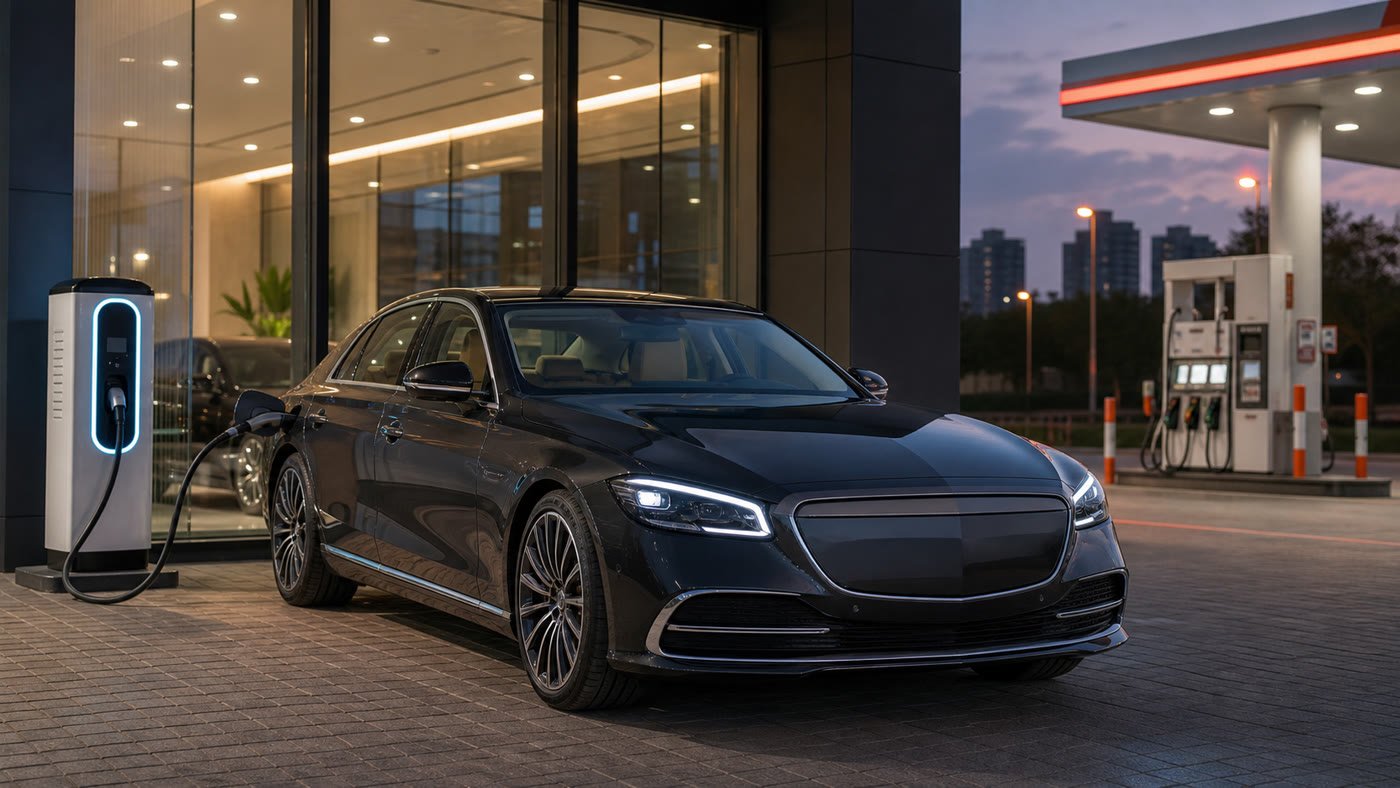
Representative editorial image: the S 450e launch highlights a premium plug-in hybrid use case where city driving can be electric and long-distance use still has petrol backup.What is launching?
The updated S-Class is Mercedes-Benz's flagship luxury sedan, and Indian auto reports say the facelift will arrive first with the S 450e plug-in hybrid powertrain. The model combines a 3.0-litre turbo-petrol inline-six engine with an electric motor, producing around 435 hp and 680 Nm. A 22 kWh battery pack is expected to support up to 100 km of pure-electric driving in ideal test conditions.
That makes this launch more relevant than a normal luxury-car refresh. Plug-in hybrid vehicles sit between conventional petrol or diesel cars and full EVs. They can be charged from an external source and driven on electricity for shorter daily routes, but they also carry an internal-combustion engine for longer trips. For S-Class buyers, the appeal is clear: quiet electric chauffeur-driven city use without giving up petrol-backed highway range.
Why the fuel-cost angle matters
India's luxury-car buyer may not be as price-sensitive as a mass-market hatchback buyer, but running-cost logic still matters for corporate fleets, business families, premium hotels and high-mileage chauffeur use. A 100 km claimed EV-only range means many daily office, airport and city routes could be completed without using petrol, provided the vehicle is charged regularly.
The key phrase is "provided the vehicle is charged regularly." A plug-in hybrid is only efficient when the owner treats charging as part of the routine. If the car is not plugged in, the battery advantage is reduced and the vehicle has to carry the weight of both a battery system and a petrol powertrain. In real-world terms, the S 450e could be very efficient for users with home, office or hotel charging, but less meaningful for users who depend only on fuel stations.
What changes for luxury buyers?
The S-Class has traditionally been bought for comfort, status, rear-seat space and technology. The PHEV variant adds another decision point: energy use. A buyer can now compare a diesel S-Class, a petrol S-Class, a full EV such as the EQS, and a plug-in hybrid flagship. Each option solves a different problem.
A diesel remains strong for long highway duty and predictable fuel stops. A petrol is smoother and simpler for buyers who do not want charging dependency. A full EV removes tailpipe fuel use but needs charging discipline and route planning. The S 450e gives a middle route: electric running for city use, petrol support for longer routes, and a luxury cabin that does not ask buyers to fully change their travel habits immediately.
| S 450e factor | FuelPrice reader impact |
|---|---|
| 22 kWh battery | Large enough to make regular city electric driving realistic if charging is available. |
| Up to 100 km claimed EV range | Can cover many premium urban routes without petrol under favourable conditions. |
| 3.0-litre petrol engine | Keeps long-distance confidence where charging access is limited or inconvenient. |
| Expected Rs 2 crore-plus segment | Technology showcase first; mass-market influence will be indirect through future hybrid strategies. |
Why this is bigger than one sedan
Luxury launches often preview technologies before they become broader market conversations. In India, plug-in hybrids are still niche compared with petrol, diesel, strong hybrid and battery EV options. The S 450e will not change mass-market fuel consumption on its own, but it can help normalise the idea that buyers may want electric-only city driving without committing fully to a battery EV.
That matters because India's charging ecosystem is still uneven. Large cities, premium residential complexes, offices, malls and hotels are improving charging access, but inter-city charging remains inconsistent on many routes. PHEVs can use that partial infrastructure effectively. They do not need a charger for every journey, yet they reward every charging opportunity by reducing petrol use.
What to watch next
The launch-day details will decide how strong the value proposition is. Mercedes-Benz is expected to disclose final India pricing, equipment, variant order, charging capability, warranty terms and whether petrol and diesel versions will follow immediately or later. Buyers should also watch real-world electric range, charging time and fuel efficiency once Indian road tests begin.
For fleet operators and chauffeur-driven users, installation of dependable AC charging at home, office or hotel parking could be as important as the car itself. Without that, the PHEV advantage becomes harder to unlock. With it, the S 450e can turn daily premium city travel into a mostly electric experience while keeping petrol as a safety net.
Final takeaway
The Mercedes-Benz S 450e is a niche luxury launch, but it carries a useful signal for India's fuel and mobility market. The car shows how premium buyers may bridge the gap between EV ambition and charging anxiety. If the claimed electric range, charging convenience and final price align, the S-Class PHEV could become a high-end example of how plug-in hybrids can reduce daily petrol use without forcing every owner into a full-EV lifestyle.