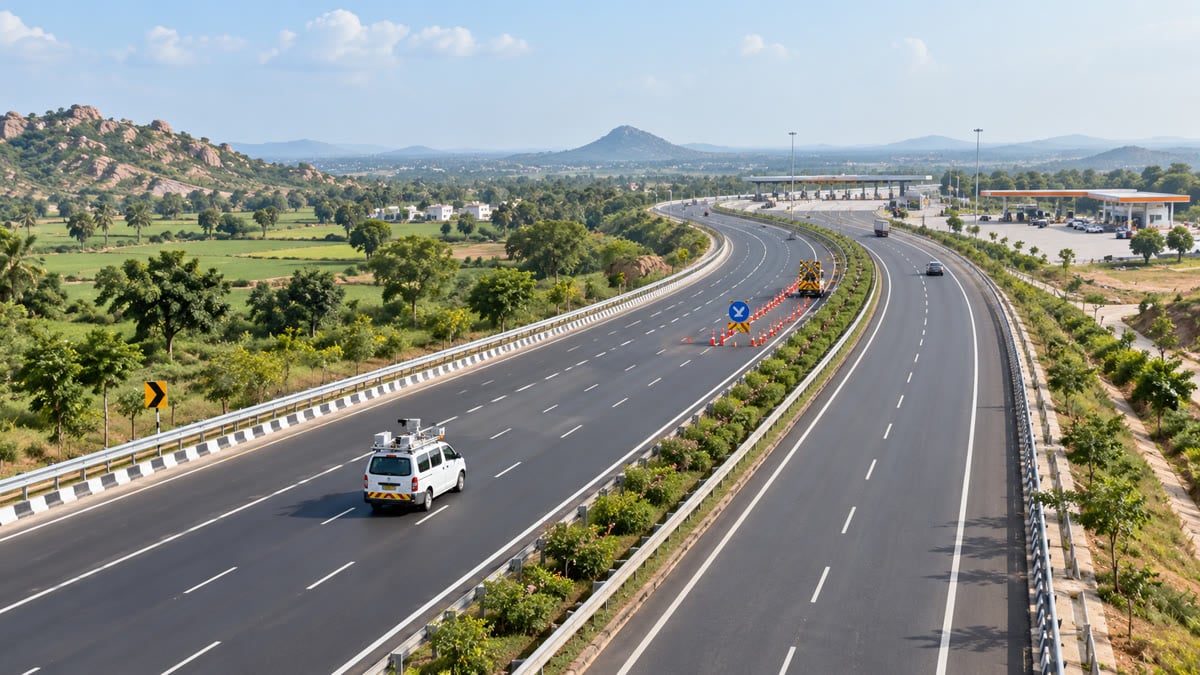
A fresh Ministry of Road Transport and Highways (MoRTH) circular reported on 29 and 30 Oct 2026 sets out plans to rate national highway corridors on efficiency, safety and user experience. For drivers, that brings road condition, congestion, accident risk, toll-plaza performance and roadside facilities into one performance picture, but the reports do not announce a new toll fee.
Key takeaways
- MoRTH will use separate criteria for access-controlled expressways and designated high-speed corridors versus normal national highways.
- The reported matrix covers peak congestion, level of service, pavement condition, toll-plaza performance, wayside amenities and road-user experience.
- Safety measures include accidents per 10 km per year, accident severity, fatalities and project failures that cause closures or diversions.
- The framework is a performance-assessment exercise. It does not itself change the toll charged on a route or impose a new requirement on private drivers.
- Published scores and the first set of corridor-level actions will matter more to road users than the announcement alone.
What MoRTH is changing
Business Standard reported on 29 Oct 2026 that the ministry plans to rank national highway corridors to identify deficiencies and prioritise improvement measures. The report said the approach will distinguish between access-controlled expressways, designated high-speed corridors and normal national highways, rather than judging every road by one common yardstick.
The Economic Times reported on 30 Oct 2026 that the framework groups the assessment into highway efficiency, highway safety and user experience. Under efficiency, the ministry is looking at peak congestion, level of service, the pavement condition index (PCI), toll-plaza ratings, carriageway-width uniformity and the availability of automated teller machines at 20-km intervals. These are not just construction measures: they describe how reliably a driver can move through and use a corridor.
The safety side is intended to look beyond the existence of crash barriers or signs. The reported criteria include the number of accidents per 10 km per year, accident severity, fatalities and project failures that lead to road closures or diversions. In practical terms, a corridor that is fast in light traffic but repeatedly closes after incidents would have a weakness that a simple travel-time measure could miss.
What it means for drivers and fleets
Road quality should become easier to compare
Drivers usually experience highway quality as a mix of potholes, rough patches, faded markings, bottlenecks and missing services. A corridor-rating system can put those issues into a common review process and help authorities identify which stretch needs attention first. That could improve maintenance planning, but it is not a promise that every pothole will be repaired immediately or that a particular route will receive a top rating.
The useful change for fleet operators is consistency. A transporter planning repeated runs needs to account for travel-time reliability, incident response and route closures, not only the nominal distance. If the rating results are published at corridor or toll-plaza-cell level, operators may get a better basis for comparing two routes and scheduling vehicles.
Toll experience is part of the benchmark
The inclusion of toll-plaza performance matters because paying a user fee and receiving a predictable crossing experience are related but separate questions. A rating can examine delay, facility condition and user service even when the underlying toll rate stays unchanged. The reports do not state that the new assessment will reduce or increase any fee.
For an upcoming inter-city trip, the road-trip planner can help organise the route and driving time. The actual user fee should still be checked separately through the toll-charge calculator, because a performance score is not a replacement for the current fee schedule.
Fuel savings are possible only as a knock-on effect
Less congestion and shorter queues can reduce idling and make a trip more predictable, but MoRTH has not provided a route-level estimate of minutes or litres saved in the reports reviewed for this article. Drivers should therefore treat any fuel benefit as a possible result of better maintenance and traffic management, not as a guaranteed saving. A route comparison can be paired with the fuel cost calculator using the vehicle’s own mileage and the dated fuel price selected.
How the rating model may work
The official NHAI public notice dated 24 Mar 2021 provides background on the highway-rating method already published by the authority. It described a 100-mark model with 45 marks for highway efficiency, 35 for highway safety and 20 for user services. NHAI said that model used 39 parameters and had covered more than 19,000 km of completed four- and six-lane national highways and expressways at that time.
The same NHAI notice said the influence length under each toll plaza was to be rated twice a year, preferably in October and April. It also described the rating as a way to identify inefficient or unsafe cells, prioritise interventions and improve accountability among the agencies involved in highway development and maintenance. That older official methodology is useful context; it should not be read as a published score for any specific route under the fresh 2026 circular.
The latest reports do not give a public start date for the next rating cycle or list the first corridors that will receive published scores. The next meaningful test will be whether the ministry or NHAI releases the ratings, explains the weak parameters and links them to repair, safety or toll-service actions.
What changes now—and what does not
- What changes: highway agencies and concessionaires face a clearer set of measures by which corridor performance can be reviewed, including conditions that drivers notice directly.
- What does not: there is no reported change to the toll amount, FASTag validity or a driver’s legal duties merely because the rating framework has been announced.
- What to watch: the first scorecards, the treatment of accident-prone and poor-pavement sections, and whether toll-plaza service findings lead to visible improvements.
Reader takeaway
This is a road-service accountability measure rather than an immediate toll or fuel-price change. Before a long drive, use the current route, toll and fuel tools for the cost you can verify today; then treat future MoRTH or NHAI ratings as an additional signal about road quality, safety and travel-time reliability.
Sources
- Business Standard — Govt plans to rate national highway corridors on safety, road quality — 29 Oct 2026
- The Economic Times — National highways face report card test: Govt to assess potholes, road safety, congestion, toll plazas and user experience — 30 Oct 2026
- National Highways Authority of India — Public Notice: Audit of Highway Rating — 24 Mar 2021