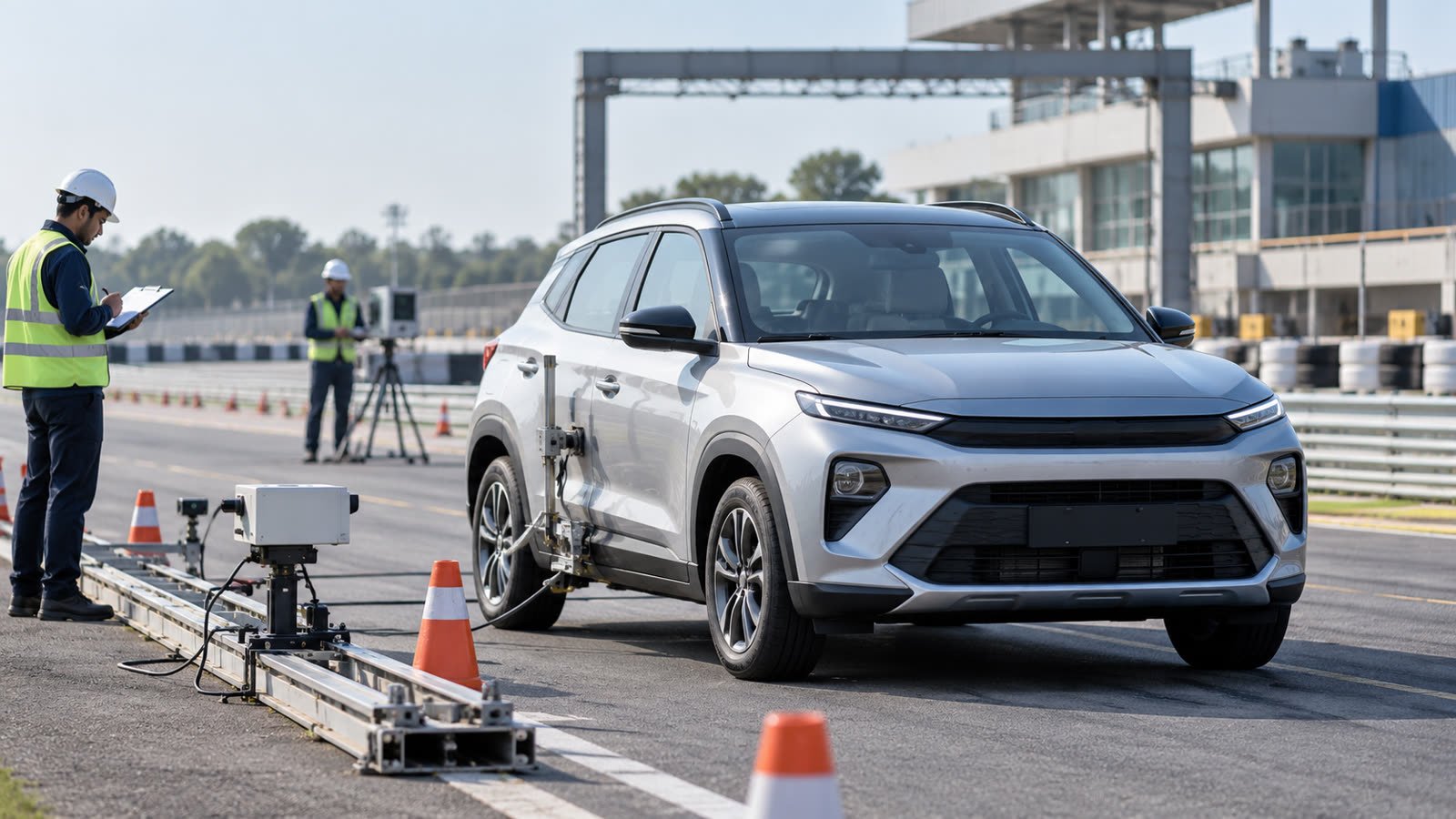
MoRTH has notified updated vehicle-safety requirements covering crash protection, pedestrian protection, immobilisers and event data recorders, with the first major deadlines beginning on 1 Oct 2027. The notification is aimed at vehicles entering the relevant approval and manufacturing phases; it is not a blanket instruction for cars already on Indian roads to be retrofitted.
Key takeaways
- Notification S.O. 5723(E) is dated 19 Oct 2026 and was published in the Gazette of India on 21 Oct 2026.
- Revised head-on, offset-frontal and lateral-collision standards are scheduled for new models from 1 Oct 2027 and all applicable models from 1 Oct 2028.
- Revised pedestrian-protection requirements start with new models from 1 Oct 2028; the FlexPLI test tool is listed for mandatory use from 1 Oct 2032.
- Rear-impact protection for the fuel system and electric powertrain is set for all applicable models from 1 Apr 2029. Event Data Recorders under AIS-192 are listed from 1 Oct 2029.
What MoRTH has notified
The Ministry of Road Transport and Highways has further amended its vehicle-safety notification through S.O. 5723(E), issued under the Motor Vehicles Act and the Central Motor Vehicles Rules. The order updates implementation dates and standards for steering and occupant protection, pedestrian protection, vehicle security, foot-control layout and crash data recording.
For buyers, the important distinction is between a new model and an all-model deadline. The notification sets compliance points for the vehicles and models covered by each entry. It does not say that every older car already registered in India must be taken back to a workshop for the new crash tests or equipment.
New vehicle-safety timeline
| Effective date | Requirement in the notification | What it means |
|---|---|---|
| 1 Oct 2027 | AIS-096 Rev. 1 head-on collision, AIS-098 Rev. 1 offset-frontal collision and AIS-099 Rev. 1 lateral-collision standards for new models; AIS-076 immobiliser fitment for M1 vehicles | New applicable models must be approved against the updated crash and security requirements. |
| 1 Apr 2028 | AIS-035 Rev. 1 for the arrangement and operation of foot controls on new M1 models | New passenger-car designs will have an updated control-layout requirement. |
| 1 Oct 2028 | AIS-096 Rev. 1, AIS-098 Rev. 1 and AIS-099 Rev. 1 for all applicable models; AIS-100 Rev. 1 pedestrian and vulnerable-road-user protection for new models | The revised occupant-protection phase expands beyond new models, while pedestrian protection starts with new models. |
| 1 Apr 2029 | AIS-101 Rev. 1 protection of the fuel system and electric powertrain in a rear impact for all models | The entry is relevant to both petrol or diesel vehicles and vehicles with an electric powertrain. |
| 1 Oct 2029 | AIS-201 frontal-collision restraint-system requirements for new models and AIS-192 Event Data Recorder approval | New models face the revised restraint focus, while the notification gives a separate date for EDR approval. |
| 1 Oct 2031 and 1 Oct 2032 | AIS-201 for all models from 1 Oct 2031; mandatory use of the FlexPLI test tool under AIS-100 Rev. 1 from 1 Oct 2032 | Later phases extend restraint-system coverage and standardise the pedestrian-leg impact test tool. |
Source: MoRTH notification S.O. 5723(E), dated 19 Oct 2026. In the notification, “all models” is a production/model-approval phase; it is not worded as a retrofit requirement for vehicles already registered.
Why the change matters to drivers and buyers
The updated AIS entries are technical approval standards, so the direct change will first be felt by vehicle manufacturers, suppliers and testing agencies. They will have to validate affected models against revised crash, restraint, pedestrian and security requirements before the relevant deadlines. A buyer may see the result as a change in body structure, restraint calibration, pedestrian-impact performance, immobiliser equipment or the way crash data is stored, but the exact equipment will remain variant- and model-specific.
The rear-impact entry is particularly relevant to the growing range of electric vehicles because it expressly refers to the safety of the electric powertrain as well as the fuel system. It does not mean that every EV on the road must be modified from 1 Apr 2029; it sets the standard for applicable models covered by the implementation phase.
The EDR requirement also needs careful reading. An Event Data Recorder is a crash-data device covered by AIS-192; its presence can support technical reconstruction after a serious collision, but the notification is an approval requirement and does not itself create a new driver reporting process or a claims rule.
What to check before buying a vehicle
When comparing a car or other vehicle around a regulatory transition, check the exact model year, variant and approval information rather than assuming that a headline feature applies across the range. A manufacturer’s technical sheet should identify safety equipment and any applicable certification; a dealer advertisement or a generic “future-ready” label is not a substitute for that information.
- Separate the vehicle’s current safety equipment from the future compliance dates in the notification.
- Ask whether the model is being sold under an existing approval or a new-model approval, especially around the 1 Oct 2027 and 1 Oct 2028 phases.
- For an EV, review the manufacturer’s information on electric-powertrain protection and repair support in addition to range and charging figures.
- Compare the equipment list with an independent crash-rating result where one is available; regulatory compliance and a consumer crash rating are related but not identical.
These checks are useful alongside ownership-cost planning. A buyer can estimate a vehicle’s fuel use with the fuel cost calculator, while an EV owner planning longer journeys can review the state-wise EV charging directory. For a mixed fuel-and-charging itinerary, the road-trip planner can help map the route before comparing models.
What happens next
The immediate change is regulatory: the dates now give manufacturers and approval agencies a formal schedule to prepare for. The notification does not announce a new showroom price, registration fee or buyer fee. Vehicle specifications, testing disclosures and model approvals are the practical areas to watch as the first 2027 deadline approaches.
Reader takeaway: the MoRTH update raises the future safety baseline for applicable vehicle models, but it is not a same-day retrofit order. For a purchase, focus on the exact model’s certified equipment and approval status, then treat the phased dates as a guide to how upcoming launches may differ from today’s models.
Sources
- Ministry of Road Transport and Highways, “S.O. 5723(E): Further amendment to vehicle-safety requirements” — 19 Oct 2026
- Gazette Tracker, “Amendment in CMVR, 1989” — 21 Oct 2026
- Press Information Bureau, “Mandatory Safety Devices for Heavy Commercial Vehicles” — 12 Feb 2026
- Society of Indian Automobile Manufacturers, “Safety Regulations” — accessed 22 Oct 2026
- MoRTH, “Draft AIS-192: Event Data Recorder Requirements” — Aug 2024