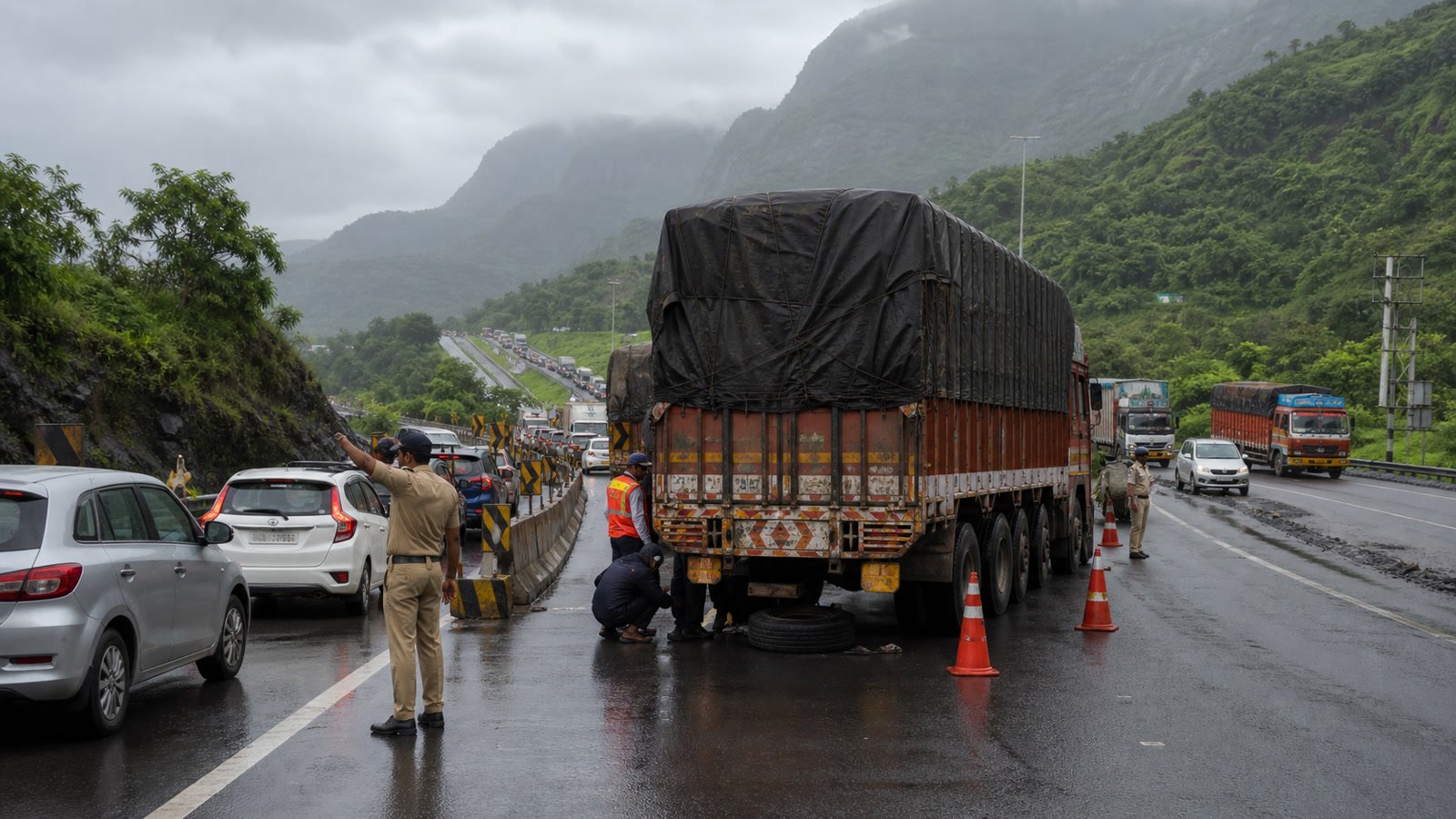
A truck breakdown near Igatpuri turned into a nearly five-hour traffic disruption on the Mumbai-Agra Highway on Friday, June 12, according to a Times of India report. The truck reportedly came to a halt near Munde village around 4:30 am after a tyre burst. Because construction work had narrowed movement between the Gonde and Igatpuri stretch to one lane on each side, the breakdown quickly created a bottleneck. Traffic flow was reported to have normalised only around 9:30 am after the vehicle was removed.
For many readers, this may look like a routine highway jam. For FuelPrice users, it is more than that. A single heavy vehicle stopping at the wrong point can change the economics of a trip for truck operators, private car users, taxi drivers, bus operators and delivery fleets. The direct cost is not only the time lost. Vehicles stuck in slow movement burn extra fuel, drivers miss planned rest or loading windows, and transporters may need to absorb schedule penalties or dispatch changes.
What Happened Near Igatpuri
The disruption took place on the Mumbai-Agra Highway, a key north-south road corridor for Maharashtra users and freight movement beyond the state. TOI reported that the truck had a tyre burst near Munde village in the Igatpuri area. Under normal circumstances, a disabled truck can often be moved aside quickly if the shoulder is clear and recovery support arrives early. In this case, the highway stretch was already constrained because of ongoing roadwork, leaving only one lane available in each direction.
That detail matters. A breakdown on a wide, free-flowing highway is an inconvenience. A breakdown on a narrowed ghat section can become a corridor-level disruption. Heavy vehicles need more room to manoeuvre, and recovery equipment may take longer to reach if traffic has already backed up. The report said a crane was not immediately available, which added to the delay. By the time the vehicle was cleared, morning traffic had already been affected for several hours.
Why A Breakdown Becomes A Fuel Cost
Highway fuel planning usually focuses on pump prices, route length and toll charges. Incidents like this show another cost layer: low-speed running and idling. Cars, buses and trucks are most efficient when they run steadily. In a queue, drivers accelerate, brake, wait, move a few metres and repeat the cycle. Air-conditioning, lights, wipers and cabin systems may remain on. A truck carrying time-sensitive cargo may also run auxiliary equipment for longer than planned.
The impact is especially relevant on a wet or hilly highway. Ghat-road sections already require careful gear selection and braking discipline. If traffic crawls after a stoppage, heavy vehicles can consume more fuel while climbing, restarting and holding position on gradients. Even when the pump price does not change, the effective trip cost rises because the vehicle uses more fuel per kilometre and loses productive time.
| Affected user | Likely impact | Practical check |
|---|---|---|
| Truck operators | Delay, diesel wastage in queues, missed delivery slots. | Build extra fuel and time buffer on narrowed ghat-road stretches. |
| Private car users | Longer travel time, higher petrol or diesel use, fatigue. | Check live traffic before starting and refuel before long highway drives. |
| Bus and taxi operators | Passenger delays and schedule bunching. | Warn passengers early and avoid unsafe speed recovery after clearance. |
| Local traffic teams | Lane control and recovery-equipment pressure. | Fast crane access is critical when roadwork has narrowed capacity. |
The Roadwork Factor
The most important operational lesson is not that a tyre burst happened. Tyre failures are common enough on Indian highways, especially for vehicles that cover long distances and carry heavy loads. The bigger issue is how quickly a normal breakdown can become a major delay when it occurs on a section where road capacity is already reduced. One lane in each direction leaves little margin for emergency recovery, overtaking or traffic diversion.
For fleet managers, that means construction updates should be treated as part of route planning. If a route has active lane restrictions, dispatch teams should consider the time of day, expected truck density, available fuel stops, recovery support and alternate routes. Drivers should also be told where to stop safely if they detect vibration, tyre damage or braking issues before entering a constrained stretch.
Monsoon Timing Makes The Risk Sharper
The timing adds another layer. The India Meteorological Department's national forecast bulletin continues to track rain and thunderstorm activity across several regions during the June monsoon period. On wet highways, visibility can fall quickly, road shoulders can become harder to use, and response vehicles may take longer to reach a disabled truck. Even without heavy rain at the exact breakdown spot, monsoon conditions make route uncertainty higher across western India.
Vehicle owners should treat this as a maintenance warning as much as a traffic alert. Tyre pressure, tread depth, spare tyre readiness, wheel nuts, lights, wipers and reflective triangles matter more during the rainy season. A preventable breakdown is not just a personal inconvenience; on a narrowed highway, it can impose fuel and time costs on everyone behind the vehicle.
What Changes Now
Nothing in this incident changes fuel prices directly. But it changes the practical cost of using the corridor on days when roadwork, monsoon conditions and heavy-vehicle movement overlap. For daily commuters, the message is to check live traffic before using the Igatpuri side of the highway. For truckers and fleet owners, the message is to build a margin for stoppages and ensure tyre checks before entering ghat sections.
Highway agencies and contractors also have a clear takeaway: where roadwork narrows a critical corridor, recovery planning becomes as important as construction progress. A crane, tow vehicle and trained lane-control crew can reduce the total fuel burned in queues, cut secondary-crash risk and restore movement faster.
The reader takeaway is simple: a fuel bill is shaped by more than the price displayed at the pump. On freight-heavy highways, lane restrictions and vehicle breakdowns can turn one tyre failure into hours of extra diesel and petrol consumption across the queue. Anyone using the Mumbai-Agra Highway near Igatpuri should plan with traffic, weather and vehicle condition in mind.
Sources: Times of India Igatpuri highway disruption report, IMD All India Weather Forecast Bulletin.