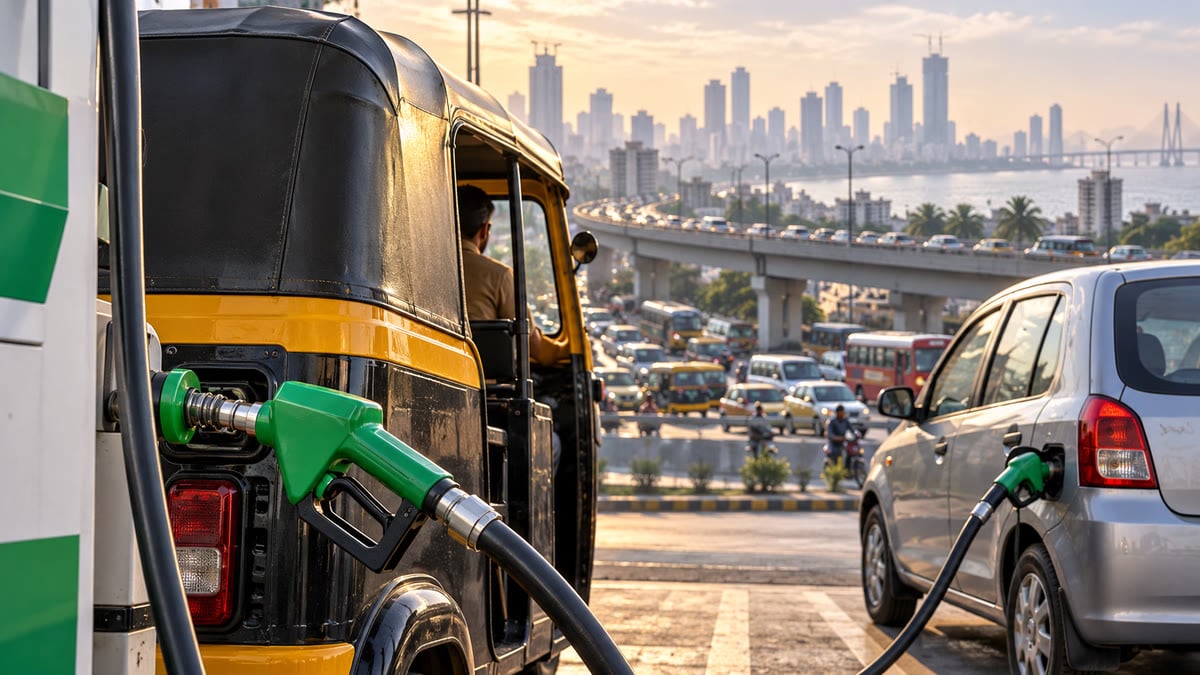
Mahanagar Gas Limited (MGL) has raised the retail price of compressed natural gas (CNG) by ₹1 per kg across Mumbai and adjoining areas. The new rate is ₹90 per kg from 1 November 2026, so every CNG-powered car, auto-rickshaw, taxi or fleet vehicle using MGL-supplied gas will pay more for the same quantity of fuel.
The revision was announced on 31 October and takes effect from midnight on 31 October, making the new price applicable from 1 November. MGL has attributed the move to higher gas procurement costs. The price change is confirmed through the company statement reported independently by The Indian Express and Hindustan Times; the explanation for the cost pressure remains MGL's attributed account.
Key takeaways
- MGL CNG in Mumbai and adjoining areas rises by ₹1 per kg.
- The revised retail rate is ₹90 per kg from 1 November 2026.
- The change affects private motorists, auto-rickshaws, taxis and other vehicles using MGL-supplied CNG.
- MGL cited higher input-gas costs, including imported regasified liquefied natural gas, or RLNG.
- The announcement is a fuel-price revision, not a new fare order for autos or taxis.
What changes from 1 November
The important number for drivers is the unit price: ₹90 for each kilogram of CNG purchased in Mumbai and the adjoining areas covered by MGL. The ₹1 increase is applied to the quantity dispensed, not as a flat charge per vehicle or per visit. A driver buying more kilograms will therefore see a larger rupee increase on the receipt, while the exact effect on a monthly budget depends on how much CNG the vehicle consumes.
That distinction matters for both personal and commercial vehicles. A private car owner can track the additional cost by adding up kilograms purchased after the new rate begins. An auto-rickshaw, taxi or fleet operator needs to apply the same ₹1-per-kg change to actual consumption across shifts or routes. This gives a more useful measure of the change than simply comparing the pump price with an older monthly bill.
The revised rate applies to CNG supplied by MGL in its operating areas. It should not be treated as a national CNG price or copied to another city, because rates depend on the local gas distributor and the applicable supply and tax structure.
Who is affected
The immediate effect is on drivers who refuel with MGL-supplied CNG in Mumbai and nearby areas. The Indian Express reported that the affected base includes auto-rickshaws, taxis, private vehicles and public-transport vehicles operated by state authorities and municipal corporations. Hindustan Times also reported higher operating pressure for autorickshaw and taxi operators, as well as private motorists who rely on CNG.
For commercial drivers, the fuel change becomes part of the operating cost of every trip. It does not by itself change a meter fare or permit an increase in passenger charges. Any revision to auto or taxi fares would be a separate decision by the relevant authority. Hindustan Times reported that union representatives see repeated CNG increases as a reason for possible fare pressure, but that is a reported concern rather than a confirmed fare revision.
Why MGL raised the price
According to MGL's statement as reported by The Indian Express, the wider West Asia crisis has pushed up the cost of domestically produced gas and imported RLNG, whose prices are linked to international benchmarks. The company also pointed to a reduction in domestic-gas allocation and greater dependence on higher-cost sources.
Hindustan Times separately reported MGL's explanation that rising international gas prices increased its procurement costs, including the cost of imported RLNG. MGL said the revision would partially offset the higher input cost and help maintain continued CNG supply. Those are the company's reasons for the decision; they should be kept separate from the confirmed retail-price change itself.
The latest increase follows another recent revision in the Mumbai region. Both reports describe the move as part of a series of recent increases, which is why the effect is more significant for users who buy CNG regularly even though the individual revision is ₹1 per kg.
How drivers can measure the added cost
- Check the station display and receipt from the first refill made at the new rate.
- Record the kilograms purchased rather than only the total rupee amount.
- Multiply the total kilograms used in a week or month by ₹1 to isolate the extra fuel cost from this revision.
- Use the latest CNG prices across Indian cities when a journey crosses into another distributor's area.
- For a personal route or a work route, enter the vehicle's real efficiency and distance in the fuel cost calculator rather than relying on a generic mileage assumption.
Drivers planning a longer journey can also use the road-trip planner to separate fuel planning from tolls and route distance. The key is to keep the local CNG rate and the vehicle's actual consumption together; either figure on its own can give a misleading trip estimate.
What to watch next
The next useful signals are further MGL price revisions, changes in the cost of imported RLNG and any separate decision on auto or taxi fares. The current reports do not announce a fare revision or a new nationwide CNG rule. For drivers, the practical update is narrower but immediate: from 1 November, each kilogram of MGL CNG in the affected Mumbai-area network costs ₹1 more.
Reader takeaway
Mumbai-area CNG users should update their running-cost records for the ₹90-per-kg rate from 1 November 2026. The increase is easy to calculate because it is tied to kilograms consumed: every kilogram purchased at the new rate adds ₹1 compared with the previous price. Private motorists can track the change in their monthly fuel budget, while commercial operators can add it to route-level operating costs and wait for any separately announced fare decision.