Netradyne's partnership with National Highways for Electric Vehicles (NHEV) adds a new digital layer to India's e-highway plan: AI-led fleet visibility, driver behaviour analytics, predictive risk detection and corridor-level monitoring for commercial electric vehicles.
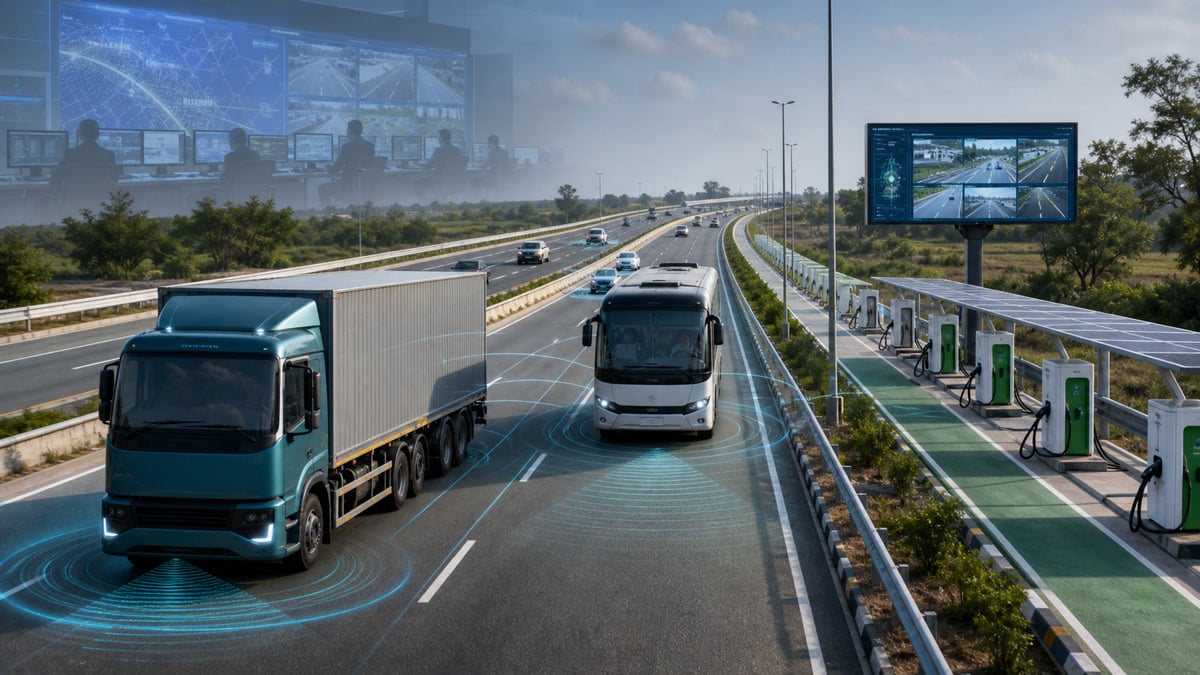
Editorial representation of AI-enabled EV freight movement on an Indian e-highway corridor.What happened
Netradyne, an AI-powered fleet safety technology company, has tied up with National Highways for Electric Vehicles to deploy an intelligence and safety layer for commercial EVs operating on NHEV-supported corridors. The collaboration is designed to bring real-time fleet visibility, predictive risk detection, driver behaviour insights and operational monitoring to long-distance electric freight and passenger movement.
The story matters because India's e-highway conversation has often focused on charging stations, route length and vehicle availability. This update shifts attention to the operating layer that can make those corridors commercially dependable. For a diesel truck operator considering electric vehicles, the question is not only whether a charger exists every few kilometres. It is whether the vehicle, driver, route, battery window, emergency response and fleet command centre can work together safely over hundreds of kilometres.
Why this is more than another EV announcement
NHEV's broader programme aims to scale e-highways across 26 corridors and around 5,500 km on Bharatmala and Sagarmala-linked routes by 2027, according to NHEV material and recent media reports. The corridors are expected to support long-distance EV movement with charging infrastructure, digital systems and emergency response mechanisms. Adding AI-based monitoring into that model addresses a practical weakness in early EV freight adoption: operators need confidence that downtime, driver fatigue, risky behaviour and vehicle distress can be detected before they turn into expensive failures.
For FuelPrice readers, the fuel link is direct. Commercial vehicles are among the most important diesel consumers in India. A wider shift to electric freight does not happen only because battery trucks are launched. It happens when routes become predictable, charging is available, finance becomes easier, and fleet managers can prove that electric operations are safe and measurable. The Netradyne-NHEV partnership targets that last point: visibility and risk control.
Key details users should know
| Layer | What it adds | Why it matters |
|---|---|---|
| Fleet visibility | Live operational view of commercial EVs on supported corridors. | Helps logistics firms manage route timing, vehicle utilisation and dispatch decisions. |
| Driver behaviour analytics | Tracks unsafe driving patterns, fatigue indicators and coaching signals. | Can reduce accident risk and improve confidence in long-distance EV operations. |
| Predictive risk detection | Uses AI-based alerts to flag potential road, vehicle or driver risks earlier. | Supports uptime, safer corridors and better fleet insurance or financing conversations. |
Impact on transporters and logistics firms
The immediate benefit is not cheaper freight by itself. The near-term value is better control. Electric trucks and buses can reduce dependence on diesel over time, but the business case still depends on route reliability, driver compliance, battery planning and asset utilisation. If AI systems can detect fatigue, risky driving, harsh events or vehicle distress early, fleet operators can reduce avoidable incidents and protect expensive EV assets.
This is important for financiers too. A truck financed for long-haul freight needs predictable uptime. Electric commercial vehicles carry different risks from diesel fleets: charging discipline, battery health, range planning, depot access and corridor charging availability. A connected monitoring layer can make those risks more visible. That does not remove the need for strong charging coverage, but it makes the operating model easier to audit.
What changes now
The partnership does not mean every Indian highway instantly becomes an AI-managed EV route. Deployment is expected to be phased across connected commercial EVs on NHEV-supported corridors. The bigger change is strategic: NHEV is presenting e-highways as a combined infrastructure and digital ecosystem rather than only a charger rollout.
That distinction matters. A fuel station network is largely physical; an e-highway for commercial EVs must be physical, electrical and digital at the same time. It needs chargers, power availability, service support, emergency response, corridor data and fleet management. Netradyne's role sits in the digital layer, where road safety and operational intelligence meet the economics of EV freight.
Why vehicle buyers and fuel users should care
For ordinary road users, the benefit is indirect but meaningful. Better monitored commercial EV corridors could improve highway safety, reduce road disruption from breakdowns and support cleaner freight movement on key routes. For businesses, it may eventually reduce exposure to diesel price volatility on routes where EV freight becomes practical. For fuel users, it signals that India's transport fuel transition is moving beyond city EVs and into the long-haul segment that has historically depended heavily on diesel.
However, the transition will be gradual. Freight operators will watch actual charging uptime, route economics, vehicle payload limits, maintenance response, driver training and the cost of digital services. If those pieces work together, e-highways can become a credible alternative for specific high-density corridors before they become a mass-market freight solution.
What to watch next
- Which NHEV-supported corridors receive the AI safety rollout first.
- Whether commercial EV fleets report measurable reductions in risky driving, downtime or incidents.
- How charging station uptime and emergency response are integrated with fleet safety data.
- Whether insurers, lenders and logistics customers start using corridor data to price risk.
- How diesel freight operators compare EV corridor economics after real-world deployment.
Final takeaway
The Netradyne-NHEV tie-up is a high-niche but important mobility update because it addresses a practical question behind India's EV freight transition: how to make long-distance electric operations safe, visible and bankable. Charging infrastructure is necessary, but it is not enough on its own. If the AI safety layer performs as intended, it could help convert e-highways from a policy concept into a more trusted operating network for transporters, fleet owners and logistics customers.
Sources: Fortune India, PSUWatch/PTI, NewsOnAir, NHEV, NHEV FAQ and Netradyne India.