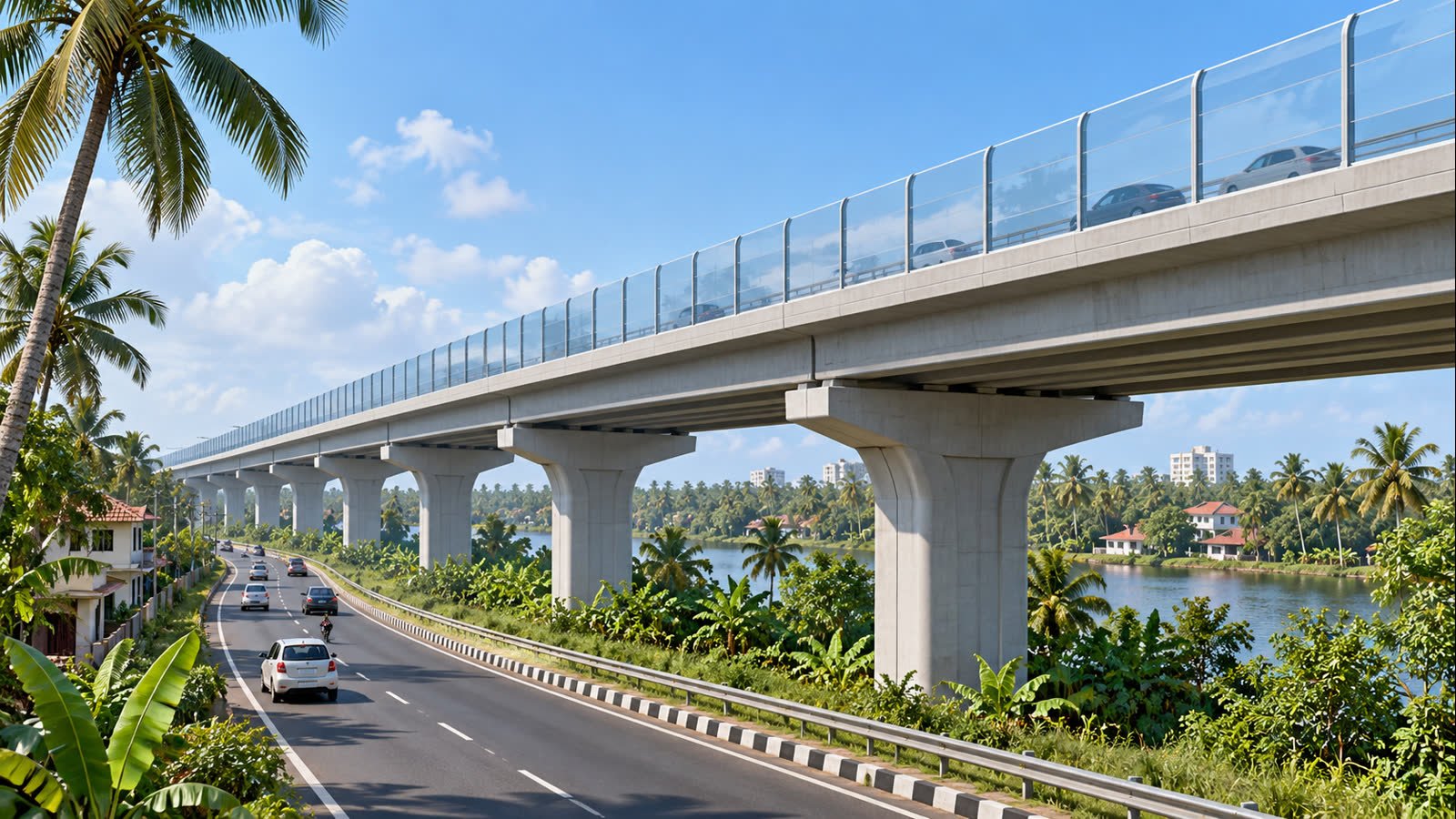
NHAI has started installing noise barriers along Kerala's Aroor-Thuravoor elevated highway, with more than half of the planned barrier work reported complete as of 24 Oct 2026. For drivers, this is a construction-progress update rather than an opening notice or a new toll announcement; the latest reported completion target is March 2027.
Key takeaways
- More than 50% of the noise barriers had been installed by 24 Oct 2026, according to The New Indian Express, which reported that the remaining work could finish in about a month.
- The translucent polycarbonate panels are about 1.5 metres high and are expected by NHAI to cut traffic noise by around 20 to 30 decibels.
- The wider project is a six-lane elevated NH 66 corridor with an Aroor toll plaza and access ramps at Chandiroor and Pattukulangara, according to a 26 Sep 2026 progress report by Onmanorama.
- The completion schedule has changed in recent reports: Onmanorama cited December 2026, while the newer 24 Oct 2026 report from The New Indian Express cited March 2027.
- No toll amount, vehicle-class schedule or FASTag deduction date is announced in the latest barrier update.
What NHAI is installing
The latest development concerns the core 12.75-km Aroor-Thuravoor elevated section. In its 24 Oct 2026 report, The New Indian Express said NHAI had begun installing barriers along the corridor, with over half already in place and the full installation expected to finish in a month. That is a reported work estimate, not a confirmed commissioning date for the highway.
The barriers use translucent polycarbonate panels fixed above boundary walls along the outside edges of the elevated road. An NHAI officer quoted by the report said the panels are intended to intercept and absorb noise from horns, engines and heavy vehicles. The panels are about 1.5 metres high, and NHAI expects them to reduce traffic noise by around 20 to 30 decibels.
The 20-to-30-decibel figure is an expected performance level attributed to NHAI, not an independent measurement of noise after the road opens. That distinction matters because actual sound levels will depend on traffic volume, vehicle mix, horn use, weather and the layout of nearby buildings.
Why the barrier work matters to local communities
The elevated structure is being built above the existing four-lane NH 66 without additional land acquisition, according to the NHAI officer quoted by The New Indian Express. Houses, multi-storey buildings, schools and hospitals are close to parts of the alignment, making noise mitigation a local concern as well as a construction detail.
For residents, the immediate benefit is the inclusion of a physical noise-control measure before regular traffic starts on the deck. For road users, however, the barriers do not yet change the route, travel time, speed rules or toll payable. The potential driving benefit will come only when the elevated corridor is opened and traffic patterns actually shift.
People travelling between Kochi and Alappuzha should therefore continue to plan around the current road arrangement until NHAI issues an opening or traffic-diversion notice. The road-trip planner can help compare route distance and timing once an official access arrangement is available.
Project progress and the changing opening target
A 26 Sep 2026 report by Onmanorama said the overall project was 93% complete and described the six-lane corridor as 13.23 km long after an extension beyond the original 12.75-km section. The same report put the project cost at ₹2,200 crore, listed 366 pillars and said the Aroor toll plaza was 90% complete. It also identified ramps at Chandiroor and Pattukulangara.
The different length figures refer to different scopes: the 12.75-km figure is used for the original elevated corridor and current barrier report, while the 13.23-km figure includes the later extension and approach work described by Onmanorama. Ashoka Buildcon's project listing separately identifies the Aroor to Thuravoor Thekku section as a 12.752-km elevated corridor for NHAI.
The timeline needs particular care. Onmanorama's 26 Sep report said the revised completion target was December 2026. The newer 24 Oct report from The New Indian Express says the revised deadline is March 2027. Until NHAI publishes a formal opening date, March 2027 should be treated as the latest reported target, not a guaranteed date.
What it means for toll and trip-cost planning
The project progress report mentions an Aroor toll plaza, but the latest barrier update does not publish a fee table, vehicle classes, a toll start date or a change to FASTag deductions. Drivers should not add a hypothetical new charge to a trip budget merely because construction is nearing completion. Use the toll-charge calculator with the currently published route information until a formal fee notification is issued.
There is also no verified fuel-saving figure in the reports. A less congested elevated route could change the distance or time profile for some journeys after opening, but the effect cannot be calculated responsibly before the final access points, traffic rules and operating route are confirmed. Once those details are official, the fuel-cost calculator can be used to compare the fuel component separately from tolls.
For fleet operators, the practical takeaway is to keep the corridor in the watchlist rather than revise a route-cost model today. A new road opening can affect turnaround time, idling and toll exposure, but each of those inputs needs a confirmed route and operating schedule.
What drivers should watch next
- A confirmation that the remaining noise-barrier installation is complete.
- Updates on surface paving, lane markings, approaches, streetlights and other final operational works.
- An official NHAI notice specifying the opening date, permitted movements and access from the two reported ramps.
- A separate toll-fee notification stating the amount, vehicle classes and effective date, if toll collection is to begin on the elevated route.
The reader takeaway is straightforward: the latest confirmed step is noise-barrier installation, not highway opening. The work should improve protection for communities beside the elevated corridor, while the driving and toll benefits remain conditional on completion, an opening notice and a published fee schedule.
Sources
- The New Indian Express: NHAI sets up noise barriers along Keralam's Aroor-Thuravoor elevated highway — 24 Oct 2026.
- Onmanorama: India's longest single-pillar elevated highway from Aroor to Thuravoor nears finish — 26 Sep 2026.
- The Times of India: Aroor-Thuravoor elevated highway structural works to be completed by Oct 15 — 1 Sep 2026.
- Ashoka Buildcon: EPC Projects — accessed 24 Oct 2026.