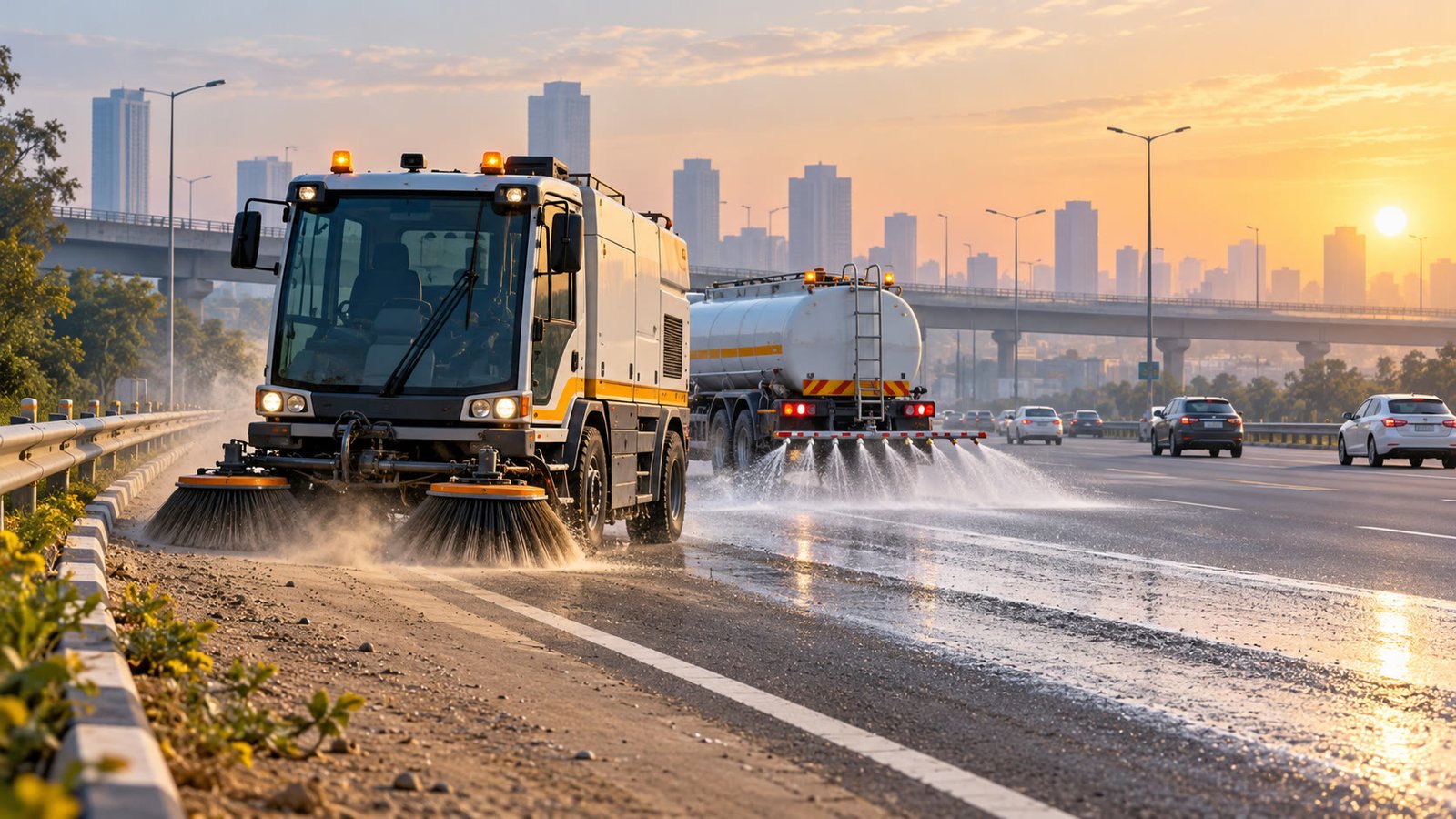
NHAI said on 22 October 2026 that it has intensified dust-control operations on national highways and expressways across Delhi-NCR, deploying about 60 water sprinklers and tankers, 14 anti-smog guns, 23 mechanical road-sweeping machines and more than 900 workers. For drivers, the immediate change is more active cleaning and water-spraying around highway corridors; the announcement does not introduce a new toll fee or a blanket ban on private cars.
The action follows the Commission for Air Quality Management's (CAQM) decision on 21 October to bring all 25 actions under Stage I of the Graded Response Action Plan (GRAP) into force across the National Capital Region. It is a new NHAI operating response to the current pollution episode, not a replacement for the separate GRAP rules already in force.
Illustrative visual by FuelPrice; this is not a photograph of the reported deployment.
Key takeaways
- NHAI said its current deployment includes about 60 sprinklers and tankers, 14 anti-smog guns, 23 mechanical sweepers, two tractor-mounted brooms and more than 900 workers.
- Field teams have been told to operate the equipment regularly, maintain dust-free surfaces and submit daily progress reports with geo-tagged photographs.
- CAQM's Stage I action plan applies across NCR and includes road sweeping, water sprinkling, traffic management and stricter checks on visibly polluting vehicles.
- There is no toll revision or blanket private-car traffic restriction in the NHAI announcement. Existing vehicle and pollution-control rules continue to apply.
What NHAI has changed on Delhi-NCR highways
According to NHAI's statement reported by PTI and carried by Rediff Moneynews on 22 October, the authority has placed the equipment and manpower across national highways and expressways in the region. NHAI Member (Technical) Alok Deepankar reviewed the arrangements and directed field teams to ensure full deployment of the machines, regular water sprinkling, routine anti-smog-gun operation and daily mechanical sweeping.
The same review covered decongestion work on the Urban Extension Road-II, Dwarka Expressway, DND-Sohna Expressway and Delhi-Dehradun Expressway. NHAI said these projects are intended to reduce traffic congestion and vehicular emissions, but their inclusion in the review does not mean that every project has opened a new route or that travel times will immediately fall.
The equipment figures are a deployment snapshot rather than a guarantee that every highway stretch will receive the same coverage. Drivers may therefore see moving maintenance vehicles, wet road surfaces or lane-side work at different times. The practical effect can be a short slowdown near a work zone even when the wider corridor remains open.
What GRAP Stage I means for drivers
CAQM invoked Stage I with immediate effect after Delhi's daily average AQI reached 244 at 2 pm and 245 at 4 pm on 21 October 2026, both in the 'Poor' category. The official PIB release says Stage I requires periodic mechanised sweeping and water sprinkling on roads, stronger dust suppression at construction and repair sites, traffic personnel at congestion points and strict enforcement of pollution-under-control (PUC) norms.
It also calls for action against visibly polluting vehicles and continued enforcement of existing court directions on over-age petrol and diesel vehicles. The Stage I schedule separately says inter-city and inter-state buses from specified neighbouring states may enter Delhi-NCR only if they are electric, CNG or BS-VI diesel. That is not the same as a new restriction on every private car entering the region.
For the background and vehicle checklist, see the earlier GRAP Stage I driver update. CAQM's citizen charter asks motorists to keep PUC certificates current, maintain tyre pressure, avoid idling at red lights and avoid using visibly polluting or end-of-life vehicles. These are compliance and pollution-control checks, not a promise that the new NHAI deployment will remove congestion.
How the deployment can affect a trip
The likely effect is operational rather than financial: a cleaner shoulder or carriageway may reduce dust, while a sweeper, tanker or safety vehicle can briefly reduce usable lane space. NHAI has not published a corridor-by-corridor delay estimate, so drivers should not assume a fixed time saving or delay from the announcement.
If a diversion adds distance, the extra fuel cost can be estimated as additional kilometres × fuel price per litre ÷ vehicle efficiency in kilometres per litre. The fuel cost calculator can handle that comparison without treating a traffic estimate as a confirmed saving.
Existing toll charges also remain separate from the dust-control work. Use the toll-charge calculator hub for the route's applicable toll information, and use the road-trip planner if you need to compare a main highway with an alternate corridor. These tools do not replace a live traffic or weather advisory.
What to check before setting out
- Check the AQI and the GRAP stage on the CAQM website or the SAMEER app before departure.
- Keep the vehicle's PUC certificate, tyres and lights in order, particularly if travelling through a pollution-control checkpoint.
- Allow for a moving work zone near sprinklers, tankers and sweepers. Follow lane instructions and do not stop on the shoulder to watch or pass maintenance equipment.
- Check a route's tolls and likely detour distance separately. A pollution-control deployment does not change the toll amount by itself.
What to watch next
CAQM said it will keep reviewing air quality and meteorological forecasts and may take further action under the GRAP schedule if conditions worsen. NHAI has asked field teams to monitor the deployment daily and submit geo-tagged progress reports. The useful next signal for drivers will therefore be a change in the official GRAP stage, a corridor-specific traffic advisory or an NHAI update on where the equipment is operating—not a social-media claim that a new vehicle ban or toll hike has begun.
Sources
- Press Information Bureau — “CAQM invokes Stage-I of GRAP in Delhi-NCR with immediate effect amid sharp rise in AQI” — 21 Oct 2026
- Press Information Bureau — “CAQM holds meeting with Delhi Government agencies to review Dust Pollution issues and strengthen Air Pollution Mitigation” — 21 Oct 2026
- Rediff Moneynews / PTI — “NHAI Boosts Pollution Control in Delhi-NCR Amid Poor Air Quality” — 22 Oct 2026
- News On AIR — “CAQM Invokes Stage-I GRAP Across NCR as Delhi AQI Enters Poor Category” — 21 Oct 2026