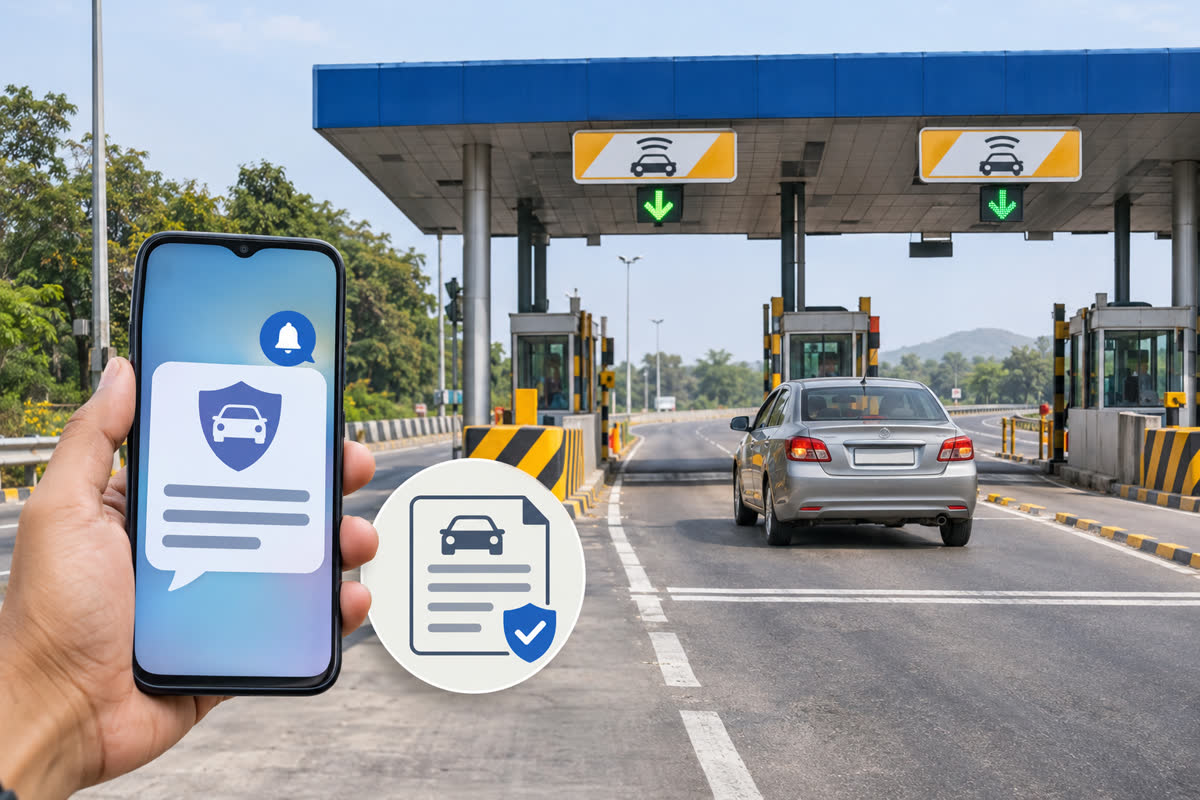
On 19 Nov 2026, the National Highways Authority of India (NHAI) clarified that insurance-renewal SMS alerts being sent to some National Highway users are part of a proposed awareness test, not a toll-plaza challan. The message is meant to flag an approaching or recorded expiry and encourage renewal; NHAI says the alert itself is not connected to a fine or enforcement action.
Key takeaways
- The messages are being tested with select National Highway users as a proposed public-awareness initiative.
- NHAI says the alert is informational and advisory, with no challan or penalty at a toll plaza linked to the message.
- The clarification does not remove the legal requirement to carry valid third-party motor insurance on public roads.
- There is no announced nationwide rollout date in the 19 Nov clarification.
What NHAI clarified on 19 Nov
In a release issued through the Press Information Bureau, NHAI said the SMS notifications received by select highway users are part of an ongoing testing process for a proposed public-awareness system. The authority described the initiative as purely informational and advisory.
The important point for drivers is that NHAI has specifically said there is no provision for issuing a challan or imposing a penalty at a toll plaza in connection with these alerts. The system is not being described as an automatic enforcement or payment mechanism. Its stated purpose is to remind owners about an upcoming motor-insurance expiry and encourage timely renewal.
That means an SMS should not be read as a toll demand, a new toll fee or proof that a penalty has already been imposed. It is a reminder connected to a proposed information service. The clarification is also relevant because earlier reports about the pilot were widely read as suggesting that a fine would be generated as soon as a vehicle crossed a toll plaza.
How the reported pilot is expected to work
Before the clarification, an ETInfra report dated 17 Nov 2026, citing an official and earlier reporting by The Times of India, described a pilot at the Mundka toll plaza on Delhi’s Urban Extension Road-II. It said a vehicle’s passage could be checked against insurance information associated with the Vahan database and that an alert could be sent when the record showed an expired policy.
The reported alert can contain the vehicle registration number, the date and time of the toll-plaza crossing and the policy expiry date. Those are details of the reported reminder workflow, not a statement that every toll plaza is already running the system. NHAI’s 19 Nov release calls the project an ongoing test for a proposed initiative and does not announce a date for nationwide implementation.
FuelPrice had earlier covered the reported pilot in NHAI’s toll-plaza insurance SMS pilot. The new development is the authority’s clarification that the SMS itself is not a toll-plaza enforcement action.
What the message does not change
Section 146 of the Motor Vehicles Act, 1988 requires a policy of insurance against third-party risk for a motor vehicle used in a public place. That existing legal requirement is separate from the NHAI alert. In other words, the absence of a challan from an SMS does not make an expired policy valid, and receiving an alert does not by itself establish that a fine has been issued.
Vehicle owners should therefore treat the message as a prompt to verify their records, not as a substitute for the policy document or for checking the insurer’s official records. The alert service is also not a guarantee that every insurance record is current or that every expiry will be detected immediately. Data can be delayed or mismatched, especially after a policy renewal, vehicle transfer or change in contact details.
What vehicle owners can check now
- Check the expiry date on the existing policy document and independently confirm it through the insurer’s known app, website or customer channel.
- Do not treat an unfamiliar SMS link as an official renewal route. Avoid sharing one-time passwords, card details or other sensitive information in response to a message.
- If the vehicle record appears wrong after a renewal, keep the updated policy documents and contact the insurer or the relevant transport authority through an official channel.
- For a longer trip, keep the vehicle’s insurance, registration and pollution documents accessible. The road-trip document checklist covers the records drivers commonly need to verify before leaving.
Owners checking policy dates can also use the car-insurance renewal and policy-date guide for a record-keeping checklist. It explains the difference between checking an expiry date and deciding what insurance cover or product is suitable, which remains a matter for the vehicle owner and insurer.
Does this affect FASTag or toll costs?
NHAI’s clarification concerns the insurance reminder and its enforcement status; it does not announce a change to toll rates or FASTag deductions. A driver who receives the message should not assume that an extra toll charge has been added. For route budgeting, the toll-charge calculator remains the relevant tool for estimating toll costs separately from insurance compliance.
The practical distinction is simple: a FASTag transaction pays the applicable toll, while the proposed SMS system is intended to communicate an insurance-expiry reminder. If NHAI later expands the test, it would need to publish the scope, effective date and process for correcting inaccurate records before drivers could treat it as a nationwide service.
What to watch next
NHAI has not announced a nationwide start date in its 19 Nov statement. The next useful updates would be a formal pilot assessment, a clear list of participating toll plazas, the data sources being used, and a documented grievance route for owners whose insurance has already been renewed but whose record is out of date.
Until then, the reader takeaway is that an NHAI insurance SMS is an advisory alert, not an automatic toll-plaza fine. The separate responsibility to keep legally required third-party insurance valid continues to apply, and the most reliable way to confirm cover is through the policy and official insurer records.
This article is for general information only and is not financial, insurance or legal advice.
Sources
- Press Information Bureau — “NHAI Clarifies Vehicle Insurance Renewal SMS Alerts Are Part of Awareness Initiative; No Challans or Penalties at Toll Plazas” — 19 Nov 2026
- Daily Excelsior — “NHAI clarifies vehicle insurance renewal SMS alerts are part of awareness initiative” — 19 Nov 2026
- ETInfra — “NHAI Introduces SMS Alerts for Uninsured Vehicles at Toll Plazas to Promote Insurance Compliance” — 17 Nov 2026
- India Code — “The Motor Vehicles Act, 1988”, Section 146 — accessed 19 Nov 2026