NHAI said on 23 Nov 2026 that barrier-less Multi-Lane Free Flow (MLFF) tolling lifted combined net revenue by 19.84% across seven operational fee plazas. For drivers, the update points to faster passage and tighter toll recovery, but it does not announce a new toll rate or remove the need to act on an official e-notice.
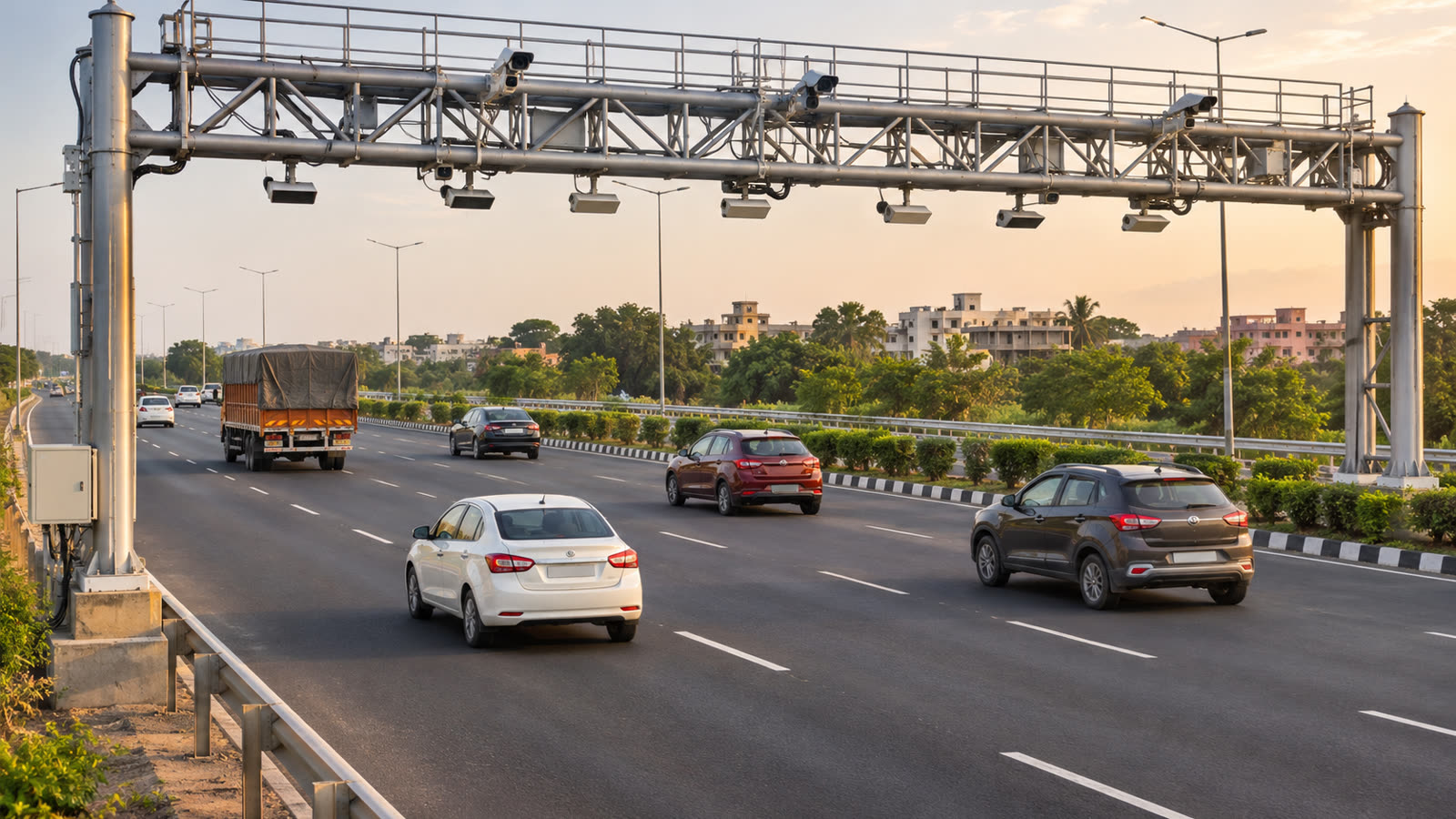
The result comes from a performance comparison with the period before MLFF began at each plaza. The system uses electronic identification, including cameras and FASTag-linked technology, so vehicles can pass without stopping at a conventional toll lane.
Key takeaways
- Combined weighted net revenue rose 19.84% across seven plazas, according to the Ministry of Road Transport and Highways release dated 23 Nov 2026.
- The plazas generated about ₹538.95 crore against a pre-MLFF benchmark of approximately ₹449.72 crore, an additional ₹89.23 crore.
- About 60% of the value of e-notices issued across the plazas had been realised when the update was released.
- MLFF changes the way toll is detected and collected; the release does not announce a blanket reduction or increase in the applicable toll fee.
- Drivers should check genuine e-notices promptly because the existing enforcement framework gives a 72-hour window for payment at the original user fee or for raising a representation.
What NHAI reported on 23 Nov
The Ministry of Road Transport and Highways said the MLFF system was first launched at Choryasi Fee Plaza in Gujarat on 1 May 2026. It was then operationalised at eight more plazas. The comparison released on 23 Nov covers seven plazas; Nemili and Chennasamudram, which went live on 12 Nov 2026 and 21 Nov 2026 respectively, were not included in the performance snapshot.
The release describes the comparison as cumulative performance from each plaza's go-live date to 1 Nov 2026 against the corresponding pre-MLFF period. It reports both an average increase of 21.10% and a combined weighted increase of 19.84%. The weighted figure is the headline result because it combines the plazas according to their collection base rather than treating every plaza as identical.
| MLFF fee plaza | State or region | Go-live date | Net-revenue change |
|---|---|---|---|
| Choryasi | Gujarat | 1 May 2026 | 23.06% |
| Mundka | Delhi | 11 May 2026 | 23.55% |
| Daulatpura | Rajasthan | 19 June 2026 | 15.66% |
| Gharaunda | Haryana | 25 June 2026 | 17.39% |
| Manoharpura | Rajasthan | 1 July 2026 | 24.51% |
| Shahjahanpur | Uttar Pradesh | 1 August 2026 | 16.57% |
| Paranur | Tamil Nadu | 1 October 2026 | 26.95% |
Source for the table: Ministry of Road Transport and Highways, PIB release dated 23 Nov 2026; performance comparison through 1 Nov 2026.
What MLFF changes for a driver
At a barrier-less plaza, the driver is meant to continue along the highway while the system identifies the vehicle and records the applicable user fee. The practical benefit is less stopping, which can reduce queueing and idling on busy corridors. The ministry and The Financial Express have described the system as supporting shorter waits, lower collection costs and more complete toll realisation.
That does not mean every trip becomes cheaper. The 19.84% figure is NHAI's change in net collection compared with an earlier baseline, not a discount passed directly to motorists. The applicable toll remains tied to the relevant fee-plaza notification. Drivers can check the likely toll charge for a planned route before leaving.
Fuel use can also be affected by how long a vehicle waits in a queue, especially for commercial vehicles and repeated local trips. That is a possible operational benefit, not a guaranteed rupee saving for every journey. A route-level estimate can be paired with the fuel cost calculator when comparing a trip.
E-notices are the practical watchpoint
NHAI said around 60% of the value of e-notices issued across the seven plazas had already been realised. The release also says the authority is using vehicle fingerprinting and VAHAN integration to identify vehicles whose plates are concealed or tampered with, while police check posts have been established at some locations, including Gharaunda.
The current recovery rules are important for anyone who receives a genuine notice. Under the National Highways Fee Rules framework described by the government on 18 March 2026, an unpaid user fee recorded by electronic toll collection can be notified to the registered vehicle owner. If the amount is paid within 72 hours of the e-notice, only the original user fee is payable; otherwise, the notified amount can be twice the applicable toll. A vehicle owner or driver can also submit a representation within 72 hours, and the rules provide five days for that representation to be examined. Where dues remain unpaid beyond 15 days and no representation is pending, the amount may be recorded in VAHAN and vehicle-related services may be restricted until it is cleared.
Use only the official MLFF e-notice road-user portal for a notice check. Do not treat an unsolicited payment link as proof of a toll debt. The portal itself warns users about impersonation attempts and provides the National Highway helpline 1033 for technical problems.
For background on how the system works, the earlier MLFF and FASTag e-notice explainer covers the basic payment flow and dispute window.
Why the revenue result matters
The seven-plaza comparison suggests that MLFF can improve collection efficiency while vehicles keep moving. NHAI attributed the higher realisation to increased transaction volumes, lower collection costs and reduced leakage. The Financial Express reported the same official figures and noted that the system had produced an additional ₹89.23 crore against the earlier benchmark.
For road users, the next question is scale and consistency. Two newer plazas were excluded because they began operations in November, and NHAI has said it intends to expand barrier-less tolling across the National Highway network. Future updates should show whether the same combination of smoother traffic, reliable identification and prompt e-notice recovery holds as more corridors are added. Until then, the driver takeaway is straightforward: keep FASTag and vehicle records current, watch for official notices, and treat the new system as a change in collection method rather than a change to the toll rate.
For longer journeys, the road-trip planner can help organise the route and toll checks before departure.
Sources
- Press Information Bureau — NHAI’s Barrier-less MLFF Tolling System Boosts Net Toll Revenue by 19.84% Across Operational Fee Plazas — 23 Nov 2026
- The Financial Express — Barrier-less tolling seen to boost NHAI revenue by a fifth — 23 Nov 2026
- Press Information Bureau — National Highways Fee Rules, 2026 Amended to Strengthen Toll Compliance and Digital Enforcement — 18 Mar 2026
- MLFF e-Notice Road User Portal — official payment and representation guidance — accessed 23 Nov 2026