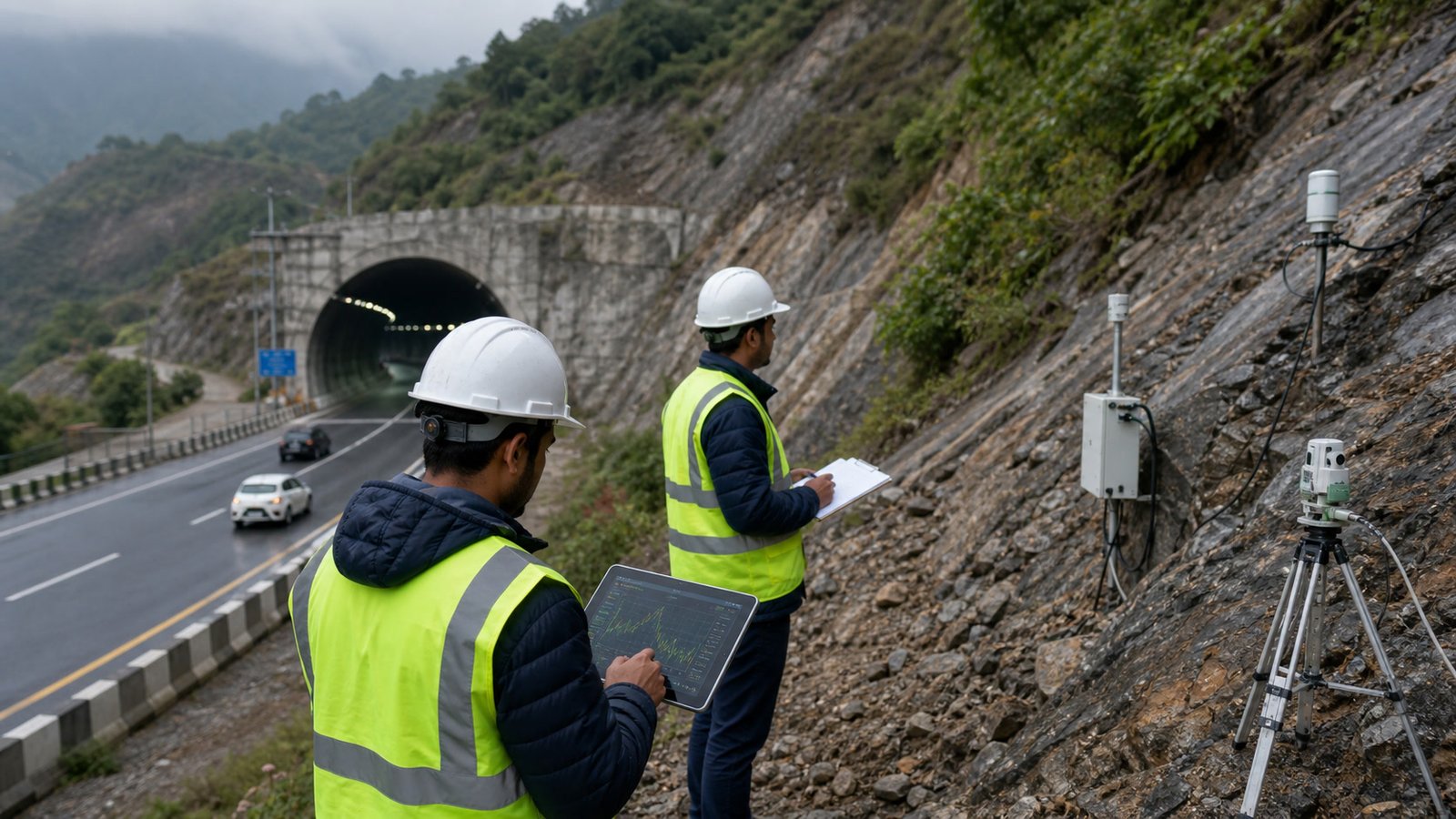
India’s highway programme has taken a technical turn with long-term implications for tunnel safety, slope risk management and logistics reliability. The National Highways Authority of India (NHAI) has signed a Memorandum of Understanding with the Norwegian Geotechnical Institute (NGI) in Oslo to strengthen consultancy support in tunnel engineering, slope stability and institutional capacity building. The announcement, issued by the Ministry of Road Transport and Highways through PIB on 22 May 2026, positions geotechnical risk management as a core part of the next phase of national highway expansion.
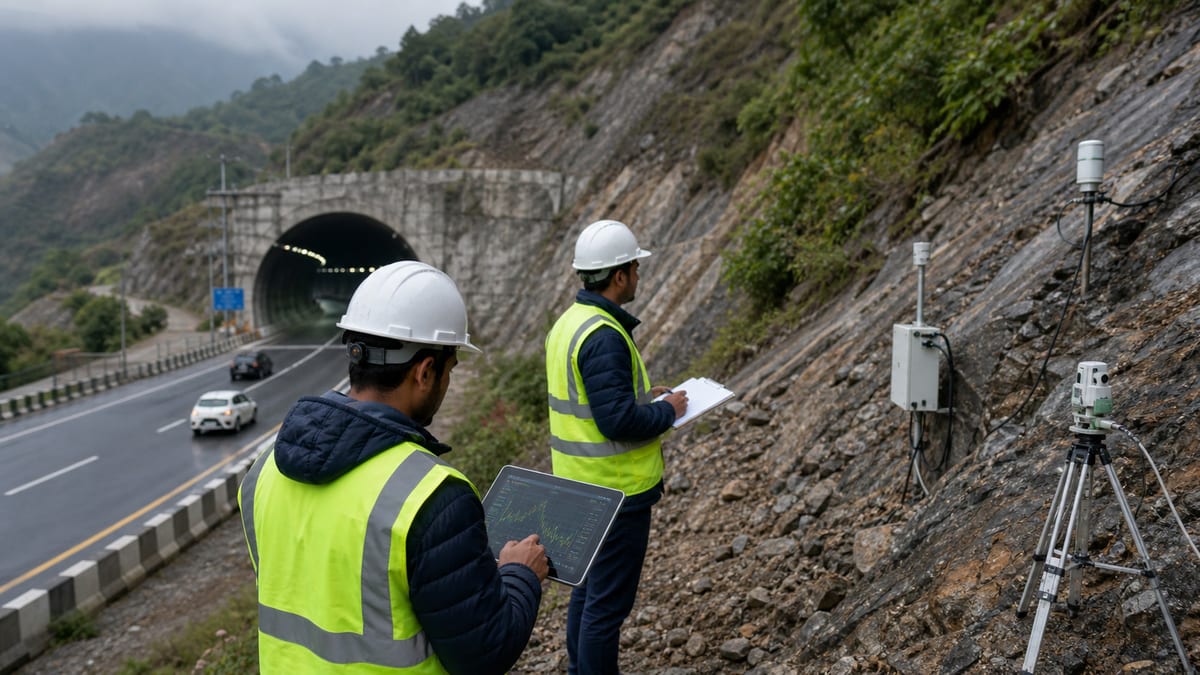 The NHAI-NGI partnership focuses on safer tunnel engineering, slope monitoring and early-warning oriented geotechnical practices for national highways.
What Has Been Signed and Why It Matters
At first glance, this is an MoU between two institutions. In practice, it is a policy signal that India’s highway buildout is moving from pure speed-and-scale metrics to deeper engineering resilience. NHAI said the partnership will leverage NGI’s globally recognised expertise in geotechnical engineering and natural-hazard mitigation, especially for geologically sensitive and challenging terrains where slope behaviour, water ingress, rock conditions and tunnel safety can become critical risks.
The agreement is expected to support planning, design, assessment and monitoring in areas where traditional civil execution alone is not enough. In hilly corridors and high-rainfall regions, even a completed highway can face operational vulnerability if slope movement, drainage instability or portal-zone distress is not monitored continuously with the right methodology.
Scope of the NHAI-NGI Collaboration
Based on official and follow-up sector coverage, the collaboration is expected to cover technical and advisory support across the full project lifecycle, including:
- Site characterisation and geotechnical inputs for tunnel projects.
- Support for feasibility studies and DPR-quality technical evaluation in upcoming tunnel-linked projects.
- Slope stability assessment, hazard identification and mitigation planning for vulnerable stretches.
- Monitoring methodologies, including interpretation-oriented support for slope monitoring datasets.
- Institutional capacity building through workshops, technical training and knowledge exchange.
- Potential early-warning oriented frameworks where terrain conditions demand proactive response capability.
The MoU is reported to be valid for five years, giving enough runway to institutionalise practices rather than limiting support to one-off consultation.
Before vs After: The Operational Shift for Highways
Before: Many highway risks were addressed project-by-project, often after warning signs became visible on the ground. Technical know-how existed, but specialised international geotechnical methods were not always embedded early and consistently across planning, execution and post-construction monitoring.
After this MoU: NHAI is setting up a structured channel to bring advanced geotechnical and hazard-mitigation expertise into mainstream highway workflows. That can improve design quality in difficult corridors, lower lifecycle risk, and reduce costly emergency interventions after asset commissioning.
For fuel and mobility users, this shift matters because reliability is not only about having a road; it is about having a road that remains safe and open across monsoon cycles, slope stress events and traffic growth years.
Impact on Fuel Users, Freight, Toll Corridors and Mobility
Even though the MoU is technical in nature, its downstream impact is highly practical:
- Truck operators and logistics fleets: Better slope-risk mitigation can reduce unplanned closures, diversions and idle time that increase diesel burn and trip uncertainty.
- Passenger and bus mobility: Safer tunnel and hillside corridors can improve route dependability in monsoon and high-risk terrain windows.
- Toll-road operators and users: Fewer geotechnical disruptions can help sustain predictable corridor performance, supporting both traffic throughput and service quality.
- Supply-chain planners: Improved infrastructure resilience reduces disruption risk in time-sensitive freight movements, including industrial and perishable cargo.
- Insurance and project-finance perspective: Stronger technical controls and documented risk frameworks can strengthen confidence in long-gestation corridor assets.
In simple terms, advanced geotechnical discipline can become a cost stabiliser for the mobility economy by reducing avoidable disruptions that quietly raise transport costs and fuel consumption.
Why This Is a High-Niche but High-Value Story
This is not a headline about pump prices or vehicle launches, yet it directly intersects with fuel economics. Corridor closures and safety slowdowns have a measurable effect on freight turnaround, diesel usage per tonne-km and delivery reliability. When critical routes are engineered and monitored better, the system-level benefit shows up as lower disruption intensity and more stable mobility costs.
That is why this MoU should be read as an enabling move for India’s wider mobility stack: roads, tunnels, toll operations, freight efficiency, regional connectivity and user safety. For a country expanding high-speed and high-volume highway corridors into complex terrain, geotechnical depth is no longer optional.
What to Watch Next
- Which specific tunnel and slope-sensitive corridors are prioritised first under the MoU framework.
- Whether NHAI publishes measurable technical outcomes such as reduced closure incidents or faster hazard response.
- How training and capacity-building modules are institutionalised across regional implementation units.
- Whether data-driven monitoring and early-warning protocols become standard practice in high-risk highway stretches.
- How this collaboration aligns with India’s broader climate-resilience and infrastructure safety strategy.
FuelPrice Takeaway
The NHAI-NGI MoU is a strategic infrastructure-quality decision, not a symbolic bilateral note. By bringing advanced geotechnical and hazard-mitigation expertise into tunnel engineering and slope safety workflows, India is strengthening the reliability backbone of road mobility in difficult terrains. For transporters, toll users, fleet operators and corridor-linked businesses, the long-term value is clear: safer roads, fewer disruption shocks and better continuity in movement-dependent economic activity.
Sources: