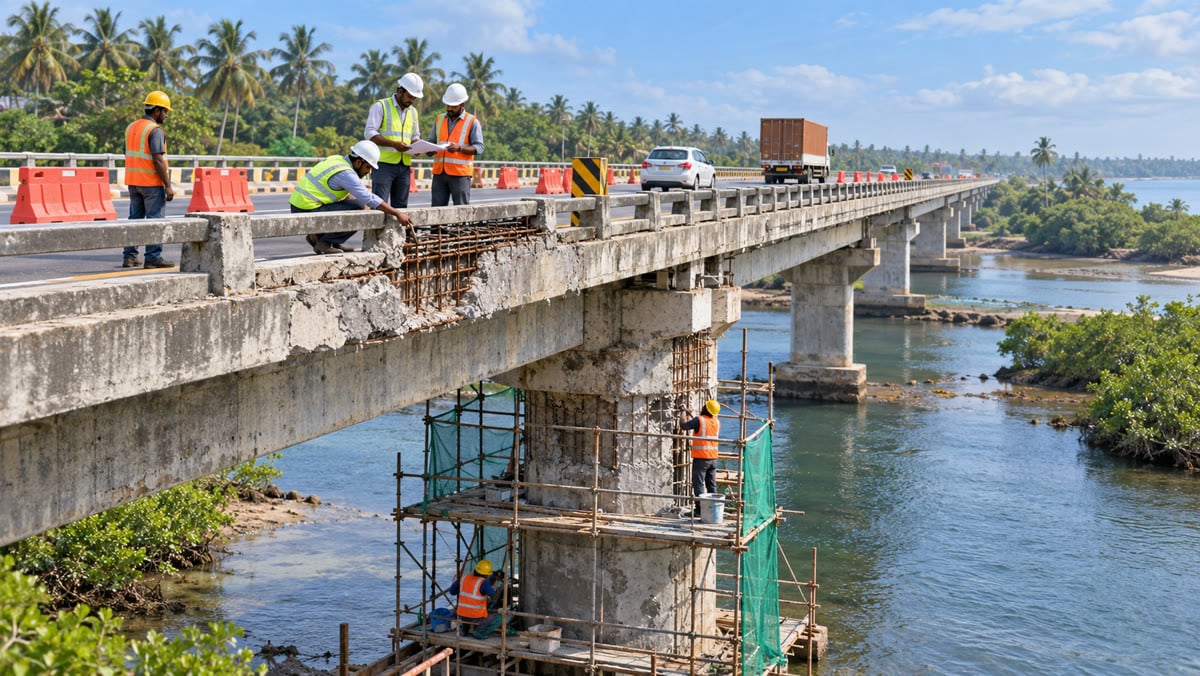
NHAI has floated a ₹10.57 crore tender to repair, rehabilitate and structurally strengthen 12 distressed bridges on the Nagapattinam–Ramanathapuram stretch of NH-32 in Tamil Nadu, with the development reported on 12 Oct 2026. The tender notice does not announce a new toll or FASTag fee, but the repair programme could bring lane controls or short-term delays once a contractor is appointed.
Key takeaways
- The National Highways Authority of India (NHAI) has invited bids for repairs to 12 bridges on NH-32.
- The official tender value is ₹10,57,25,513, or about ₹10.57 crore, and the listed work period is 365 days.
- The tender was published on 3 Oct 2026; bids are scheduled to close on 24 Oct 2026 and open on 26 Oct 2026.
- A structural audit reported corrosion, concrete deterioration, cracks, spalling and damaged bridge bearings at multiple locations.
- Static deflection load testing is proposed after the work and before the bridges are cleared for heavy traffic.
What NHAI is repairing
The project covers a group of distressed bridges along the NH-32 corridor between Nagapattinam and Ramanathapuram. The New Indian Express reported that the audit identified affected structures around Palliodaivayal, Marudangavayal, Vallikkollaikadu, Maravanvayal, Manamelkudi, Kottaipattinam, Nattanipurasakudi, Kanatangudi, A Manakudi and Chitturuvadi. The official tender identifies the work through bridge chainages, including locations at km 83/900, km 92/400, km 98/200, km 107/600, km 133/140, km 136/650, km 138/750, km 139/850, km 140/850, km 180/200, km 182/170 and km 184/600.
The reported defects are not limited to surface wear. The audit found exposed and corroded reinforcement, loss of concrete section, cracked or debonded protective layers, spalling, seized or corroded bearings and blocked expansion joints. Water seepage and salt deposits were also reported around some bridge components. These findings explain why NHAI has put structural strengthening, rather than only routine resurfacing, into the work scope.
What the tender document says
The official NHAI e-procurement notice describes the job as repair, rehabilitation and structural strengthening of 12 distressed bridges on the Nagapattinam-to-Ramanath corridor. It lists a tender value of ₹10,57,25,513 and a 365-day period of work. The notice was published on 3 Oct 2026, with bid submission scheduled through 24 Oct 2026 and opening scheduled for 26 Oct 2026.
Those dates mark the procurement process, not the start of construction. The tender is an invitation for eligible bidders; it is not a contractor award, a completion certificate or a public notice that every bridge will be closed. The 365-day period should likewise not be read as a guaranteed finish date from 3 Oct 2026, because mobilisation and the contract start follow the award process.
What the repair package includes
According to the audit findings reported by The New Indian Express, the proposed package includes removing deteriorated concrete, treating and strengthening corroded reinforcement, pressure-grouting cracks, adding concrete jacketing to piers and other structural members, and using carbon-fibre-reinforced polymer where vulnerable components need additional strengthening.
Consultants have also recommended temporary structural propping before damaged concrete is removed from load-bearing members. After rehabilitation, static deflection load tests are proposed before the bridges are cleared for heavy traffic. That sequence matters for freight operators: the tender points to a safety validation step before heavy vehicles are allowed to use a repaired structure, but it does not announce a current weight restriction.
What it means for drivers and transporters
For people using this coastal NH-32 corridor today, the tender alone does not confirm a diversion, lane closure, toll revision or change in FASTag deductions. Those would need separate traffic-management or fee notices. Once work begins, however, bridge-by-bridge repairs can affect lane width, speed, waiting time and the route available to buses, trucks and private vehicles.
Drivers planning a journey through the corridor can use the road-trip planner to keep the route and expected travel time visible, then check local NHAI or district traffic advisories close to departure. If an official diversion adds distance, the extra kilometres will affect fuel use even when the toll payable stays unchanged. The fuel cost calculator can help compare that revised trip with the original plan using the vehicle’s own mileage and the dated fuel price.
There is also no basis in this tender to assume that the repair will change the toll collected on NH-32. Travellers who want to review the toll side separately can check the toll-charge calculator; any fee revision would have to be communicated through the relevant highway authority notice.
What to watch next
- Bid outcome: NHAI’s evaluation and contractor appointment will establish who carries out the work.
- Traffic plan: users should look for bridge-specific notices on lane controls, diversions, speed limits or heavy-vehicle restrictions before work reaches a particular location.
- Repair progress: the important milestones will be safe removal of damaged material, structural strengthening and completion of the proposed testing.
- Clearance for heavy traffic: the audit recommendation points to static deflection testing before a repaired bridge is cleared for heavy vehicles.
Reader takeaway
NHAI has moved the 12 NH-32 bridge issue from audit findings to a formal repair tender. That is a concrete maintenance step, but it is not yet a live closure or toll change. For now, corridor users should treat the road as open unless a separate authority advisory says otherwise, and recheck the route before travelling when repair work is formally mobilised.
Image note: The hero is an illustrative editorial visual of bridge inspection and rehabilitation on an Indian coastal highway; it is not a photograph of a specific NH-32 bridge.