NHAI has released a document on wildlife mitigation measures and structures used or proposed along India’s National Highways. The release says more than 2,150 structures are covered and around ₹19,700 crore has been invested in wildlife mitigation infrastructure and related environmental safeguards over the last five years.
For drivers, the practical message is about how a highway can behave in a wildlife-sensitive corridor: fencing may guide animals towards an underpass, warning signs may mark a collision hotspot, and speed regulation may be used on selected stretches. The document is a reference framework and account of measures, not a new nationwide toll, fuel-price or speed-limit order.
Key takeaways
- NHAI says more than 2,150 wildlife mitigation structures have been constructed or proposed along National Highways.
- The reported five-year investment is around ₹19,700 crore across underpasses, overpasses, viaducts, tunnels, bridges and related safeguards.
- Guide fencing and noise barriers cover more than 300 km of National Highway alignments, according to the government release.
- Drivers should treat wildlife signs, fencing and posted speed controls as corridor-specific safety instructions, not as optional scenery.
What NHAI released on 8 October
The Ministry of Road Transport and Highways said on 8 October 2026 that NHAI had released a document titled Wildlife Mitigation Measures & Structures during National Wildlife Week. The document was released by Road Transport and Highways Minister Nitin Gadkari at the Chintan Shivir in Ekta Nagar, Gujarat, and is intended to record how conservation measures are being built into highway planning, design and implementation.
The government says the planning approach considers the ecological sensitivity of each project corridor, known wildlife movement patterns and the technical feasibility of the engineering design. That matters because the right intervention can differ sharply between a forest edge, a river crossing, a hilly corridor and a highway cutting through a habitat connection.
The New Indian Express independently reported the same-day figures and described the measures as addressing habitat fragmentation, barriers to animal movement and wildlife-vehicle collisions while keeping traffic moving. The report also confirmed that the 2,150-plus figure includes structures already built as well as those proposed, so it should not be read as a count of completed crossings open to drivers today.
What the 2,150-plus figure includes
The release groups the work into structural crossings and supporting safeguards. The investment figures below are approximate amounts reported for the last five years by NHAI and reported independently by The New Indian Express on 8 October 2026.
| Measure | Approximate investment | Why it matters |
|---|---|---|
| Animal underpasses | ₹4,600 crore | Allows wildlife to cross below the carriageway. |
| Animal overpasses | ₹650 crore | Creates a dedicated crossing above the road. |
| Viaducts | ₹8,300 crore | Can keep the road elevated through sensitive terrain. |
| Tunnels | ₹2,800 crore | Reduces the surface barrier through selected terrain. |
| Major bridges | ₹2,500 crore | Can preserve movement across rivers and habitat links. |
| Minor bridges | ₹500 crore | Supports smaller crossings and local drainage routes. |
These category figures are rounded, so they do not have to add exactly to the separately reported overall total of around ₹19,700 crore. NHAI also lists non-structural measures such as noise barriers, reptile crossings, rainwater harvesting, guide fencing, camera trapping and speed-regulation signs.
What changes for people using highways
Safety instructions become more location-specific
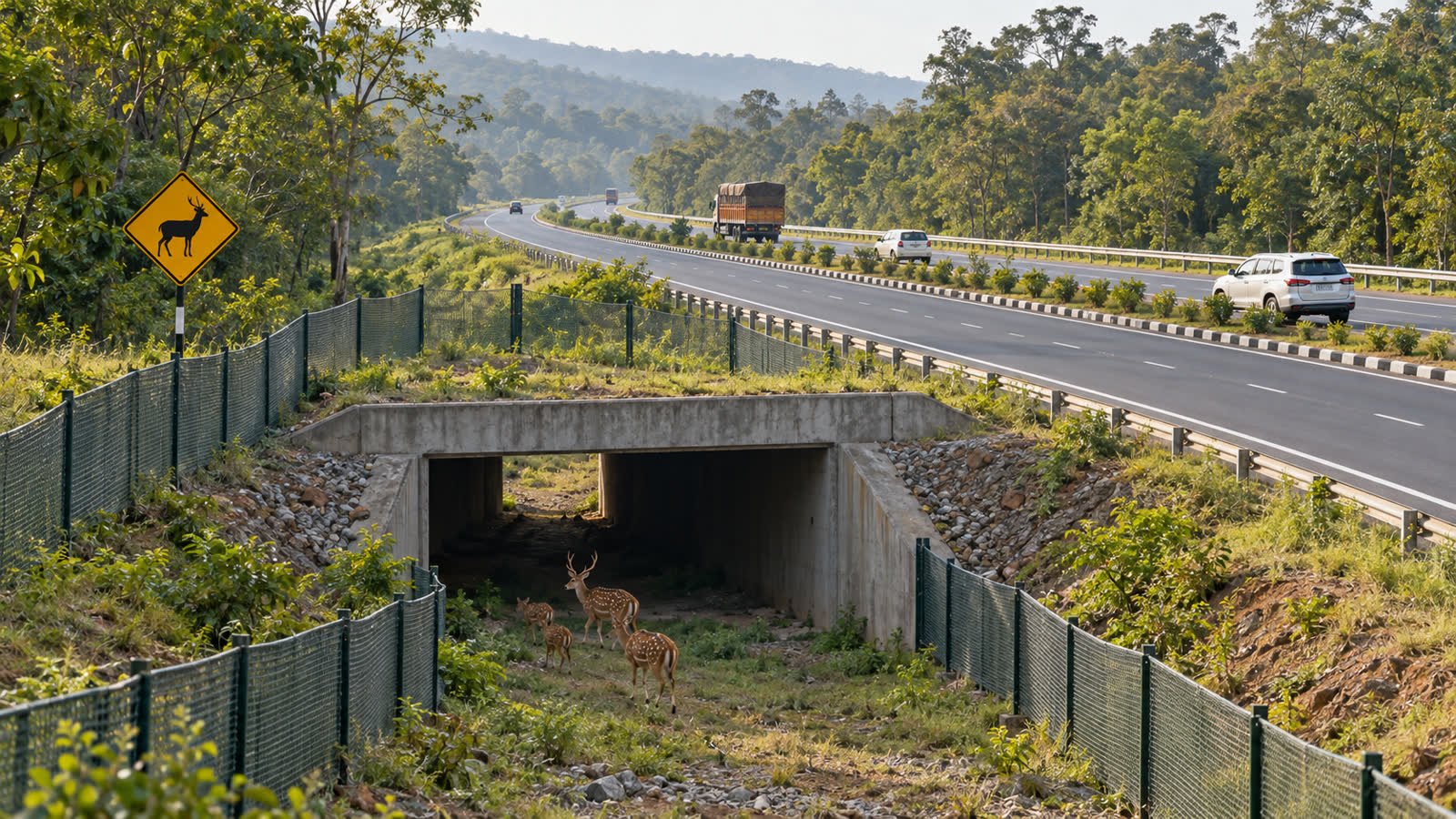
NHAI says guide fencing and noise barriers have been provided along more than 300 km of National Highway alignments. The purpose is to direct animals towards designated crossing points and reduce the chance of animals entering the traffic lanes. In a signed zone, the fence, barrier and warning board are part of one safety system; a driver may see the sign before the structure itself becomes visible.
Wildlife-vehicle collision hotspots are identified through monitoring, including camera trapping, and the release says speed-regulation boards and signs are used at such locations. The exact restriction, if displayed, will depend on the corridor and the sign in front of the driver. This is why a trip that is normally a continuous high-speed run can include short sections where slowing down is essential.
No new toll or fuel charge is announced here
The document should not be confused with a toll revision. It does not announce a new FASTag fee, fuel-price change or blanket speed limit for all National Highways. The direct effect for a road user is more likely to be the design and management of particular stretches, including marked wildlife crossings and controlled-speed areas.
That distinction matters to fleet operators and long-distance travellers. A route can remain financially unchanged while still requiring a more realistic time allowance for signed safety sections, temporary works or traffic management around a crossing project. Toll budgets can be checked separately with the toll-charge calculator.
What to check before a long drive
First, check the route rather than assuming that every National Highway has the same wildlife risk. The road-trip planner can help organise the corridor, stops and likely journey time before departure.
Second, read every wildlife warning, speed board and lane instruction as soon as it appears. Do not stop on the carriageway to photograph animals, do not try to cross a fenced section, and do not overtake simply because the road ahead looks clear. The safe crossing has been designed to separate animal movement from the live lanes; driver behaviour needs to preserve that separation.
Third, build the fuel plan around the actual trip rather than an idealised average speed. A slower section may not change the fuel used by much on its own, but idling, diversions and repeated acceleration can change the result. A fuel-cost calculator gives drivers and transporters a clearer baseline before they compare routes.
Why the framework matters beyond one project
Highway expansion can fragment habitats even when the road itself improves connectivity between towns and freight markets. Underpasses, overpasses, viaducts, tunnels, bridges and fencing are attempts to solve both problems in the same corridor: keep people and goods moving while retaining a path for wildlife.
The release also makes clear that mitigation is not a single standard structure copied everywhere. NHAI says planning is based on corridor ecology, movement patterns and engineering feasibility. That site-specific approach means the driver takeaway should be practical rather than broad: watch for the controls on the road being used, and do not assume that a familiar highway behaves the same way after a widening or new package is opened.
What to watch next
The NHAI document is described as a reference framework covering recent initiatives and project implementations. The next useful signals for road users will be route-level announcements, new warning signs, fencing or crossing works, and any traffic-management instructions issued for a specific corridor. The 2,150-plus figure will also need to be read carefully in future updates because it combines completed and proposed structures.
FAQs
Are all 2,150-plus wildlife structures already complete?
No. NHAI’s wording covers structures that have been constructed or proposed. The count is a national programme snapshot, not a list of crossings that every driver can currently use.
Does this announcement change toll charges?
No toll change is announced in the 8 October document. FASTag and toll charges remain separate questions tied to the relevant fee plaza or pass.
What should a driver do in a wildlife-sensitive stretch?
Follow the posted speed, warning and lane instructions, keep attention on the road, and allow extra time where signs or traffic management require slower movement. Never treat a wildlife crossing as a place to stop on the highway.
Illustrative visual: a generic Indian highway wildlife crossing created for this article; it does not depict a specific NHAI project.
Sources
- Press Information Bureau, “NHAI Releases Document on ‘Wildlife Mitigation Measures & Structures’ Highlighting Strengthened Wildlife Conservation Measures Along National Highways” (8 Oct 2026)
- The New Indian Express, “NHAI spends Rs 19,700 crore on wildlife mitigation measures in five years” (8 Oct 2026)
- NHAI, Wildlife Mitigation Measures & Structures (document linked by PIB, 8 Oct 2026)