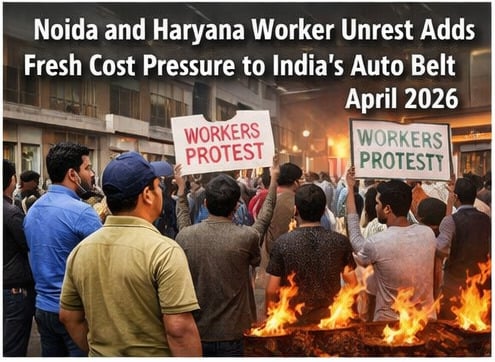
India’s auto and industrial ecosystem is facing a more complicated challenge than rising crude and freight alone. Worker protests in Noida and Haryana, followed by wage hikes and violent unrest, have introduced a fresh cost and labour-stability concern into the manufacturing belt that supports major automotive activity. This is the kind of issue that can quietly become a production problem if left unmanaged.
The trigger is not purely industrial relations in the narrow sense. It is the wider cost-of-living stress created by the current fuel and gas crisis. That makes the story especially relevant to the auto sector: energy shocks are no longer only hitting factories through costs. They are now influencing labour conditions, wage demands and operating continuity.
Key points
- Haryana raised minimum wages after unrest in auto-linked industrial zones.
- Noida later saw violent worker protests with police intervention.
- Higher living costs linked to the energy crisis are a central background factor.
- The auto sector now faces labour-cost pressure in addition to fuel and input inflation.
Why this is an auto-industry story
Auto production depends on large ecosystems, not just final assembly plants. Supplier belts, component factories, contract labour pools and transport hubs all need to function with reasonable predictability. When labour unrest spreads through these clusters, the consequences show up in attendance, shift continuity, dispatch timing and vendor reliability. That is why a wage protest in an industrial hub can very quickly become a vehicle-production issue.
This matters even more in the current environment, where the industry is already dealing with energy-related cost pressure. If wages rise sharply at the same time that fuel and gas remain expensive, the combined effect can be much more significant than either factor alone.
How the fuel crisis feeds into labour pressure
Workers do not experience oil shocks as abstract macroeconomic events. They experience them through more expensive cooking fuel, transport, food and rent-linked daily pressures. In that sense, the current energy crisis is entering factories through household budgets. Once that happens, wage demands become harder to separate from geopolitics and fuel economics.
That is why the unrest deserves close attention from the auto industry. The sector can manage higher metals or higher freight mathematically. Labour stress is harder because it affects morale, attendance, local politics and operational continuity all at once.
Cost implications for manufacturers and suppliers
A wage hike can be absorbed if overall margins are healthy and productivity remains steady. But in a year when gas shortages, fuel inflation and freight volatility are already squeezing the industrial cost base, fresh labour-cost additions can become more disruptive. Large OEMs may be able to manage better than smaller suppliers, but the vendor ecosystem is often where cost stress shows up first.
If smaller units face worker shortages, plant disruptions or operating instability, that can ripple into the broader auto chain. In modern manufacturing, the weakest supplier can become the strongest bottleneck.
Why this matters for buyers too
At first glance, labour protests seem distant from the showroom. In reality, they can affect production continuity, delivery timelines and eventually pricing. If cost pressure rises across inputs, energy and wages together, manufacturers may respond with price increases, selective output cuts or more cautious model allocation. That means buyers can ultimately feel the effect through waiting periods, reduced discounts or higher on-road prices.
This is especially relevant in segments where margins are thin and cost pass-through is difficult to avoid. In those categories, even a moderate rise in operating costs can quickly influence product strategy.
What to watch next
The crucial signals now are whether unrest remains localised or spreads to more clusters, whether additional states intervene with wage adjustments, and how suppliers respond to the combined energy-plus-labour cost shock. Market participants should also watch whether manufacturers begin talking more openly about labour retention, productivity measures or emergency support for suppliers.
FuelPrice view: The energy crisis is no longer just a fuel-cost story for India’s auto sector. It is now a labour-cost and operational-stability story as well. That makes the challenge much more complex — and much harder to solve with a single policy lever.