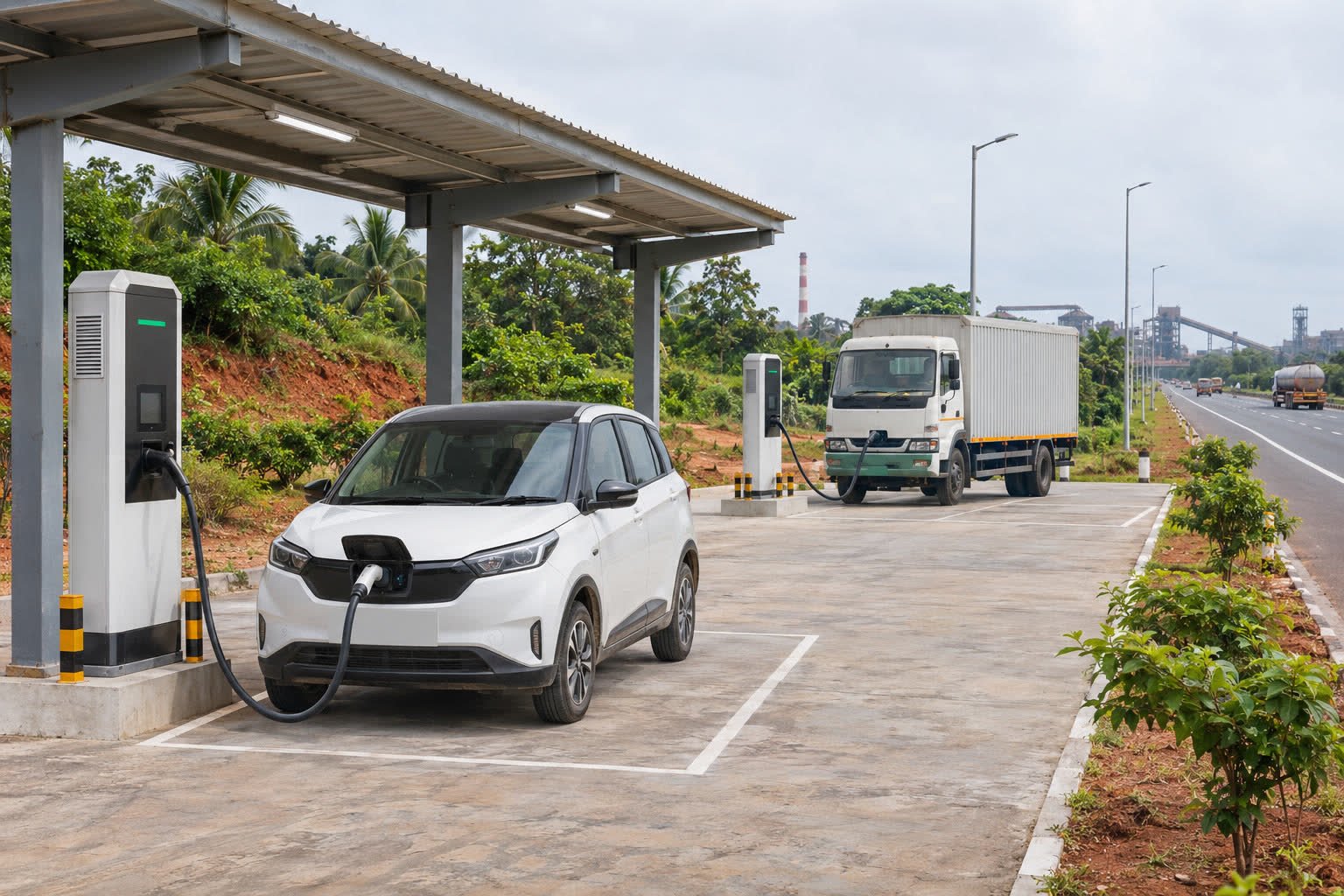
Odisha has sent the Centre a proposal for 290 public EV charging stations in 13 cities and highway locations under the PM E-DRIVE scheme. As of 4 Nov 2026, it remains a proposal rather than an approval or opening schedule, so the announcement does not yet mean the new chargers are available to drivers.
Key takeaways
- The proposed second phase covers 290 additional public EV charging stations across 13 Odisha cities and selected national and state highway locations.
- The named locations include Rourkela, Talcher, Sambalpur, Paradip, Barbil, Belpahar, Berhampur, Brajarajnagar, Chhatrapur, Jharsuguda, Joda, Keonjhar and Rajgangpur.
- Reports say 68 proposed sites are at tourism department Wayside Amenity Centres, while six other strategic locations are along highways, including the Paradip-Barbil corridor.
- The Centre has already approved 170 stations in seven cities under the first phase, but the new proposal still needs approval and implementation work.
What Odisha has proposed
The Odisha government has submitted the second-phase proposal under PM E-DRIVE to extend public charging beyond the state’s main urban centres. Business Standard, carrying a Press Trust of India report, and The Times of India both reported the 290-station proposal on 4 Nov and 3 Nov 2026 respectively. Both reports said the plan covers 13 cities as well as sites along national and state highways.
The location mix is important. The proposal names port-linked Paradip, mining and industrial centres such as Barbil, Joda and Keonjhar, and other urban locations including Rourkela, Sambalpur and Berhampur. It also identifies 68 tourism department Wayside Amenity Centres and six other strategic highway locations. The reports do not give a city-wise allocation, charger power rating, connector mix or tariff for any proposed site.
The Paradip-Barbil corridor is the clearest long-distance use case in the announcement. A dependable charging network on a corridor connecting a port area with mineral-producing districts could eventually matter to private EV users, delivery fleets and commercial vehicles. However, the proposal alone does not establish whether every planned site will support heavy commercial EVs or high-power charging.
Why the proposal matters to EV users
For an EV driver, the useful measure is not only the number of stations announced but whether a charger is built, connected, compatible with the vehicle and operating when the trip begins. The proposed network could widen the options available outside Bhubaneswar and other established centres, but it does not immediately change the live charging map.
Drivers can check currently listed public charging options through FuelPrice’s state-wise EV charging directory. That is the practical distinction between a proposed site and a usable stop: a station needs a confirmed location, working equipment, an available connector and a visible operating status before it can be relied on for a journey.
For longer trips, the proposed highway sites could eventually reduce the need to detour into a city for a charge. Until the sites are approved and commissioned, travellers can use the road-trip planner to review the route and keep a realistic charging buffer. The proposal does not announce an opening date, so existing chargers remain the relevant planning reference.
EV owners and fleet operators comparing running costs can also use the fuel cost calculator to establish a petrol or diesel baseline for a route. That comparison should be kept separate from charging economics because electricity tariffs, charging fees, parking charges and waiting time are not specified in the Odisha proposal.
What is confirmed and what is still pending
The confirmed development is the submission of a proposal. It is not a sanction from the Centre, a commissioning notice or a promise that all 290 stations will be built. The reports identify Bharat Heavy Electricals Limited as the project implementation agency for the central scheme, while the final locations and operating details remain to be established.
An official Odisha Motor Vehicle Department tender page lists a 1 Oct 2026 request for proposals to select charge-point operators for the supply, installation, commissioning, operation and maintenance of EV public charging stations under PM E-DRIVE. The Ministry of Heavy Industries’ PM E-DRIVE portal also lists operational guidelines for EV public charging stations. These official records show the implementation framework, but neither record confirms that the newly proposed 290 stations have received final approval.
How this relates to the first phase
Odisha’s first phase is a separate bucket. Business Standard and The Times of India reported that 170 stations in seven cities had been approved earlier and that work was underway. That figure should not be treated as 170 live stations: approval and construction are different stages, and the reports do not provide a complete operational count for the first phase.
The state is also pursuing more than 500 charging stations through its own initiatives, with 24 reported as operational in Bhubaneswar. Those state-led projects are separate from the 290-station PM E-DRIVE proposal. Keeping the categories separate helps avoid turning a combined announcement into a misleading claim about the number of chargers already available across Odisha.
What happens next
The next milestones are Centre approval, confirmation of the proposed sites, technical and power assessments, operator selection, construction, grid connection and public listing. The timing will matter as much as the headline number: a smaller network that is operational and well placed can be more useful on a road trip than a larger list of sanctioned sites that drivers cannot yet access.
For now, the reader takeaway is straightforward. Odisha’s proposal is a meaningful signal for EV infrastructure in eastern India, especially along industrial and highway routes, but it is not a live charging promise. Check current station availability before travelling and treat the 290 figure as a proposed expansion until the state or Centre publishes approval, site and commissioning details.
Sources
- Business Standard / Press Trust of India — “Odisha proposes 290 new EV charging stations under PM E-DRIVE scheme” — 4 Nov 2026
- The Times of India — “Odisha moves Centre for 290 new EV charging stations” — 3 Nov 2026
- Odisha Motor Vehicle Department — “Request for Proposal for selection of charge point operators for EV public charging stations under PM E-DRIVE” — 1 Oct 2026
- Ministry of Heavy Industries — “Scheme Guidelines” — 26 Sep 2025