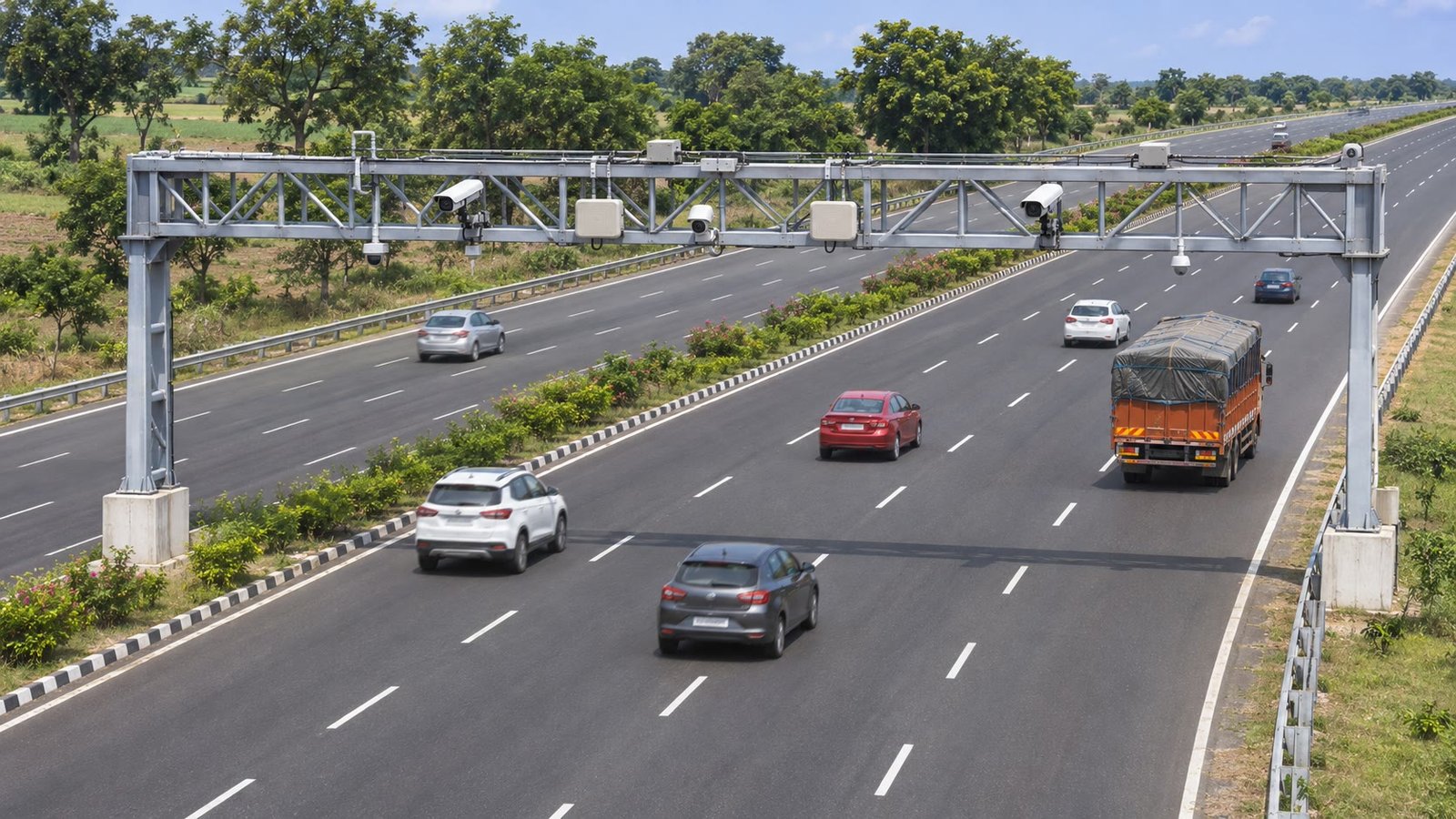
NHAI has issued new design guidelines for barrier-free Multi-Lane Free Flow (MLFF) toll plazas on four-lane-and-above National Highways. The policy targets future and under-construction projects, allowing vehicles to be identified and charged through FASTag while moving, but the announcement does not itself change toll rates at existing plazas.
For Indian drivers, the change is about how upcoming highway toll points are built rather than a new payment amount today. A vehicle should eventually pass under a gantry instead of stopping at a booth, while cameras and readers handle identification. The practical benefit will depend on when individual projects adopt the design and how well the digital back office handles exceptions.
Key takeaways
- NHAI’s guidelines apply to future and under-construction National Highway projects with four or more lanes.
- Standardised MLFF layouts set plaza-lane counts at eight, 10 and 12 for four-, six- and eight-lane highways, respectively.
- RFID readers and Automatic Number Plate Recognition cameras will identify vehicles without a physical toll barrier.
- A vehicle without a valid, working FASTag can generate an e-notice under Rule 14 of the National Highways Fee Rules.
- The 6 Nov 2026 announcement gives no project-wise activation date and does not announce a new toll fee.
What NHAI’s new MLFF design changes
The Ministry of Road Transport and Highways said in a Press Information Bureau release dated 6 Nov 2026 that NHAI has standardised the layout and supporting infrastructure for barrier-less toll plazas. The framework covers plaza layout, lane configuration, overhead gantries, road infrastructure, lighting, advance signs, Electronic Variable Message Signs and an operations-and-maintenance facility.
Under MLFF, the tolling equipment reads the vehicle as it passes. The Indian Express reported that the guidelines provide for gantry-mounted RFID readers and ANPR cameras, with the applicable user fee deducted through FASTag without requiring a stop at a toll booth. The same report said a second gantry can act as a backup read point after the main pay-axis gantry.
| Highway configuration | Standardised plaza lanes | What it means |
|---|---|---|
| Four-lane | 8 | Barrier-free tolling layout with spare capacity for emergencies |
| Six-lane | 10 | Gantry-based passage instead of a conventional booth queue |
| Eight-lane | 12 | Standardised design for wider National Highway corridors |
The lane counts above are the configuration reported by The Indian Express and Elets eGov from the NHAI guidelines. They describe the physical design of a plaza; they do not set the toll charged to a car, bus or truck. User fees will continue to depend on the applicable National Highway notification and vehicle category.
What the change means for drivers
Less stopping, but not a free toll
The stated objective is to remove queues and waiting at physical barriers. That could reduce idling and make a busy toll point easier to cross, particularly for freight vehicles and drivers making repeated highway trips. It does not mean the road becomes toll-free: the applicable user fee is still due and the digital transaction has to be matched to the vehicle.
For a trip already being planned, the toll charges calculator remains the useful place to check the route’s current fee. A new gantry changes the collection experience, not the published rate by itself.
FASTag status still matters
Barrier-free tolling puts more weight on a valid and functioning FASTag because there is no booth where a driver can pause and resolve a failed read immediately. The reported guidelines say vehicles without a valid working tag can trigger an electronic notice under Rule 14 of the National Highways Fee (Determination of Rates and Collection) Rules, 2008. Drivers can review common balance, recharge and wrong-deduction checks in the FASTag balance and recharge guide before a long trip.
Fuel and time benefits are possible, not guaranteed
MoRTH said the system is intended to reduce waiting time and fuel consumption at toll plazas. That is an official objective, not a guaranteed saving for every journey. Traffic levels, identification accuracy, network availability and the handling of vehicles that cannot be read will all affect the result. Drivers who want to compare a route’s fuel exposure can use the fuel cost calculator with their own vehicle’s mileage and the latest fuel price.
Which projects must adopt the design?
The guidelines apply to all future and under-construction projects covered by the four-lane-and-above framework. Projects still at the Detailed Project Report stage must include the new design in their documents. Projects that have already been awarded or are under construction are to adopt the changes through applicable contractual provisions, and NHAI field offices have been directed to include the requirements in upcoming work and facilitate adoption in ongoing projects.
This wording matters for existing road users. The announcement does not say that every operating toll plaza will be rebuilt immediately, nor does it list a nationwide switchover date. It also does not replace the separate notifications that revise user fees. Until a particular corridor publishes its implementation details, drivers should continue to use the toll and FASTag arrangements displayed for that route.
Why the back-office process will matter
Moving from booths to gantries should make the toll point physically smaller and reduce the need to build large queues of payment lanes. The more important operational shift is that tolling becomes a continuous recognition process: the system must read the FASTag, match the vehicle and plate, apply the right category and provide a way to resolve a disputed or failed transaction.
That creates a clear watch point for fleet operators and regular commuters. Faster passage has value only when notices, reversals and payment failures are handled predictably. Signage, lighting and the backup gantry included in the guidelines are therefore not cosmetic additions; they support safe passage and reliable identification at highway speed.
For longer journeys, the road-trip planner can still help compare fuel, toll and time before departure. The MLFF design may reduce one source of delay, but it does not remove congestion elsewhere on the corridor or change the route’s total distance.
What to watch next
- Project-level notices showing which new or under-construction corridors will use the standard layout.
- Separate user-fee notifications, because the design guideline is not a toll-rate revision.
- How e-notices, failed reads and disputed deductions are handled once more plazas move to gantry-based collection.
- Whether the promised reduction in queueing is visible on busy corridors after the systems are commissioned.
Reader takeaway
NHAI’s announcement points toward toll plazas where cars, buses and trucks can pass under cameras and FASTag readers without stopping at a barrier. For now, it is a project-design change, not an immediate change to the amount shown on a toll receipt. Keep using the current route information, keep the FASTag usable and check corridor-specific notices as new projects move from design to operation.
Illustration: AI-generated representative visual of barrier-free tolling; not a photograph of a named project.
Sources
- Press Information Bureau, Ministry of Road Transport & Highways — “NHAI Guidelines to Standardise Design and Infrastructure for Multi-Lane Free Flow Tolling on Four-Lane and Above National Highways” (06 Nov 2026)
- The Indian Express — “Barrier-less system to reduce toll lanes in new highways” (30 Oct 2026)
- Elets eGov — “NHAI MLFF Guidelines Standardise Barrier-less Toll Plaza Design” (07 Nov 2026)