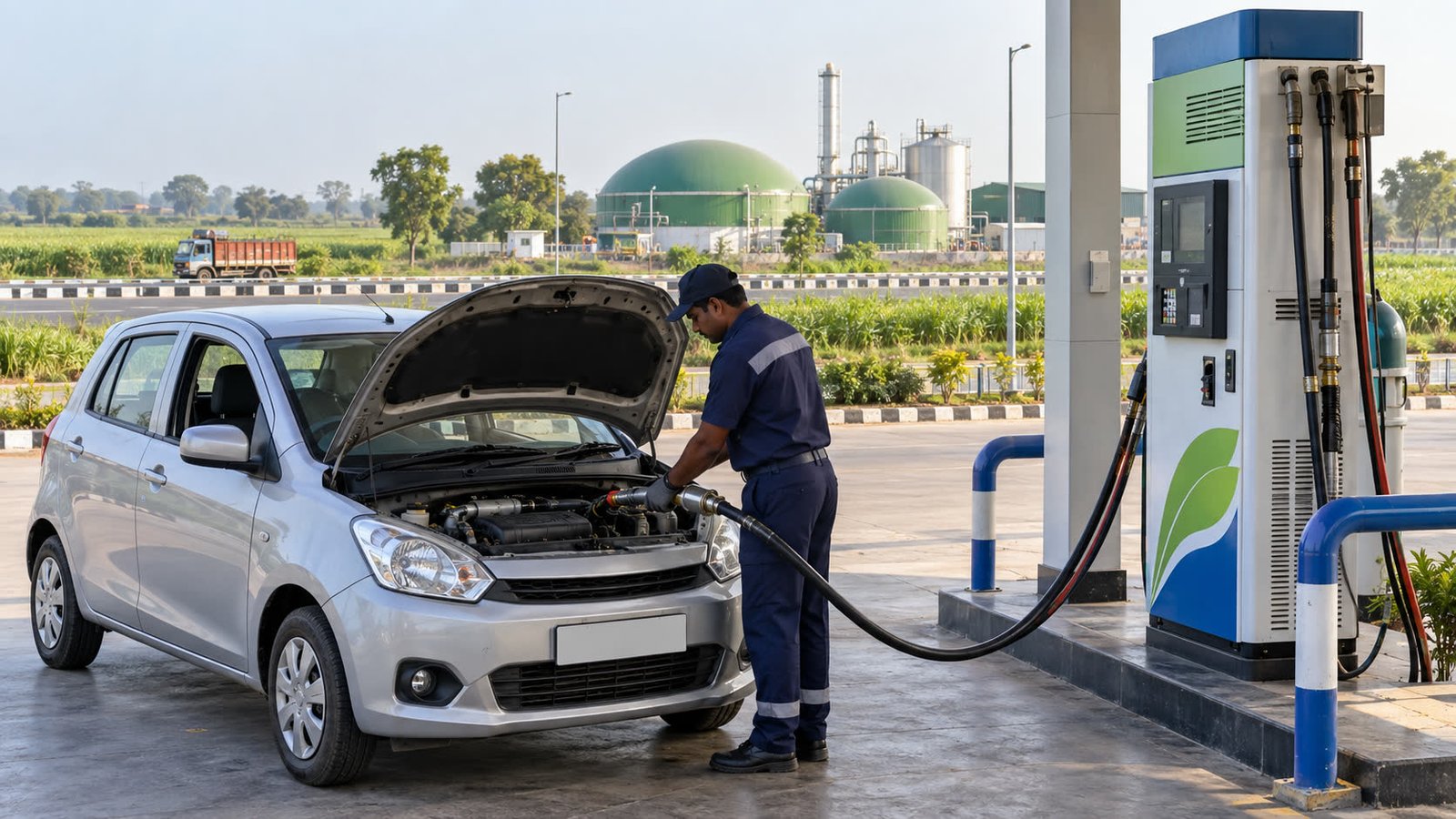
India’s Petroleum Planning and Analysis Cell (PPAC) posted a Compressed Biogas (CBG) Price Adjustment Factor notification on 24 Sep 2026 under its natural-gas pricing section. For CNG car owners, the important distinction is that this is a CBG procurement-price update; the posting itself is not a confirmed revision of the CNG price displayed at fuel stations.
Key takeaways
- PPAC’s 24 Sep 2026 notification concerns the price-adjustment mechanism for CBG.
- The Petroleum Ministry says the revised CBG procurement price is separate from the retail price paid by CNG and PNG consumers.
- Under the ministry’s 29 Aug 2026 explanation, the CBG procurement benchmark moved from about ₹1,478 per MMBtu to ₹2,110 per MMBtu under the GOBARdhan framework.
- Government support and a wider domestic gas pool are intended to prevent a material consumer-price shock.
- Drivers should check the actual CNG rate in their city rather than infer a pump-price increase from the PPAC notification alone.
 AI-generated editorial illustration by FuelPrice; not an official station photograph.
What PPAC has notified
PPAC’s gas-price page records the CBG Price Adjustment Factor notification dated 24 Sep 2026. The notification is hosted as a government document in the natural-gas pricing section, alongside other gas-price and pricing-related notices. Its appearance gives producers and gas-sector participants a formal reference point for the CBG pricing mechanism.
The page does not present a new city-wise CNG retail-price list. That matters because a CBG procurement adjustment and a CNG pump-price change happen at different points in the supply chain. The first affects the price at which CBG enters the gas system; the second would need to be reflected in a retail price announcement or in the rate displayed by the relevant city gas distributor.
Why the CBG number is different from your CNG bill
In its 29 Aug 2026 clarification, the Ministry of Petroleum and Natural Gas said the earlier CBG procurement arrangement was linked to 85% of the retail selling price of CNG. The ministry calculated that reference at approximately ₹1,478 per MMBtu. Under the revised GOBARdhan framework, it said the CBG price was fixed at ₹2,110 per MMBtu, a rise of about 43% at the procurement level.
That increase is not the same as a 43% increase in the amount paid by a CNG vehicle owner. The ministry said the government would provide affordability support of ₹10 per kg of CBG, equivalent to about ₹215 per MMBtu for CBG with 95% methane content. On that basis, the effective CBG cost to be recovered through the gas system was described as approximately ₹1,895 per MMBtu, or about 28% above the earlier ₹1,478 reference.
The ministry also said CBG is pooled with other domestically produced natural gas rather than sold directly to city gas distributors at the producer procurement price. It said the revised framework spreads the net cost across a domestic gas base about 2.5 to 3 times larger than the earlier base, which is why it expects the impact on an individual gas consumer to be negligible.
Who is affected now?
CBG producers and gas-sector buyers
CBG producers and the entities that procure or pool the gas are the parties most directly connected to the notification. The adjustment factor helps define how the notified procurement framework is applied over the relevant period. It does not, on its own, tell a driver what a kilogram of CNG will cost at a specific outlet.
CNG car owners and fleet operators
For private motorists, taxis, autos and commercial fleets, the practical question is the local retail rate. The PPAC posting does not provide evidence of a new pump-price hike. A driver calculating a daily commute or a long-distance trip should therefore use the rate actually published for the destination city. FuelPrice’s CNG price directory for Indian cities can help with that check, while the fuel cost calculator can translate the chosen rate into a trip estimate.
What drivers should watch next
The next useful signals will be any retail-price circulars from city gas distributors, changes in the CNG rate shown at local stations, and future PPAC notifications under the same framework. Those are the updates that can affect a vehicle owner’s rupees-per-kilometre calculation. A separate FuelPrice fuel-price check can be used to compare current fuel rates before a trip or monthly budget review.
The notification is still relevant to road users because CBG is being integrated into India’s wider transport-fuel system. But the reader takeaway is narrow and useful: a change in the producer-side CBG formula should not be reported as a confirmed CNG pump-price hike unless a retail distributor or an official retail-price notice says so.