At least 15 people were reported dead after a paddy-laden truck struck devotees near Gwalior's Sheetla Mata Temple in the early hours of 18 Oct 2026, with casualty figures changing as hospitals and officials issued updates. The crash is also drawing attention to a steep Chhinor Road stretch where heavy vehicles were restricted and a barricade was breached; the cause and the truck's route remain under investigation.
Key takeaways
- Later reports on 18 Oct put the toll at 15 dead, while earlier police and district updates gave lower figures as the incident was still being assessed.
- The truck was reported to have broken through a barricade on a steep approach where heavy vehicles were restricted.
- Police were examining the truck's route, the barricade breach and a possible mechanical failure; no final cause had been established in the reports reviewed.
- The PMO announced ex-gratia assistance of ₹2 lakh for the next of kin of each deceased person and ₹50,000 for each injured person.
- Drivers and transport operators should treat on-road restrictions and police directions as controlling information, even when a navigation app suggests another route.
What happened near Sheetla Mata Temple
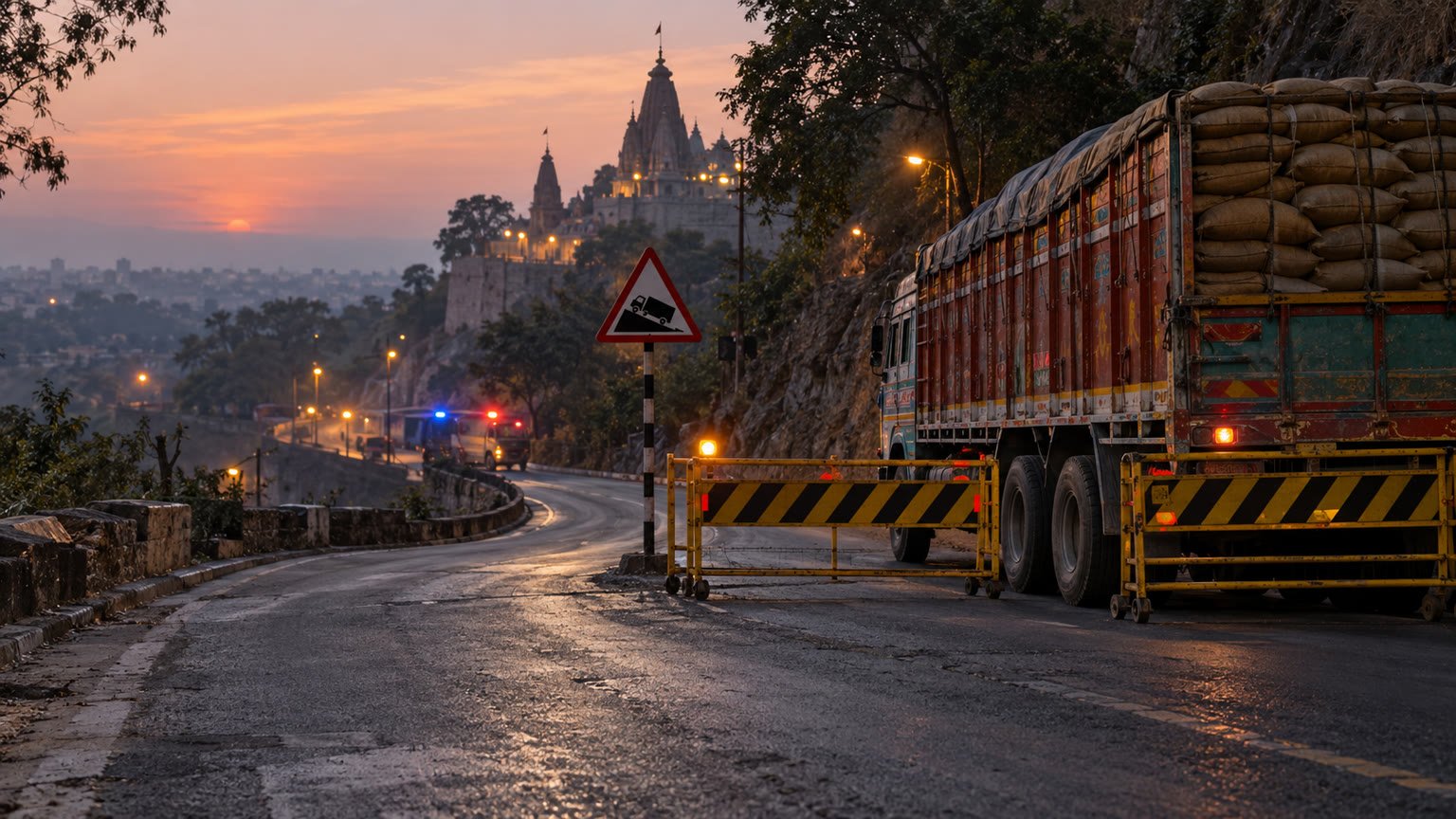
India Today reported that the crash happened at about 1:30 a.m. on 18 Oct, when a truck carrying paddy from Debra Mandi reached the Chhinor Road side of the Sheetla Mata Temple approach. The vehicle reportedly struck people near the temple after getting past a barricade. The location is a steep stretch, and reports said heavy vehicles were not supposed to use it.
The casualty count developed through the day. An early update carried by The Indian Express quoted the local police chief as saying that 39 people had been taken to hospital and 12 had died. Other early official updates cited by Indian Express and NDTV put the initial toll at 11 or 13, while later reports from India Today and Hindustan Times cited 15 deaths. India Today reported 33 injured people; Hindustan Times cited 27 injured. These differences reflect a developing incident and hospital updates, so the final official count remains important.
Two police personnel were also reported injured while trying to respond. Hindustan Times reported that the driver and the truck owner were arrested. The reports did not establish that either the vehicle's condition or the route choice alone caused the crash; both remain part of the investigation.
Why the restricted-road detail matters
A heavy-vehicle restriction at a steep, crowded approach is a safety control, not just a route preference. A loaded truck has less room to recover if it loses braking or steering control on a slope, and a temple approach can place pedestrians close to moving traffic. A barricade is intended to make that restriction visible and physical, so investigators will need to establish how the truck reached the stretch and whether the control was correctly placed, staffed and maintained.
India Today reported that police were examining whether the truck had reached the road after following a route shortcut, including a possible navigation-app suggestion. That is an investigative line, not a finding that a particular app caused the crash. Hindustan Times reported a preliminary mechanical-failure angle, while India Today said an RTO mechanical inspection was being pursued. The mechanical report and the inquiry into the barricade should clarify whether a vehicle defect, route violation, control failure or a combination of factors was involved.
What drivers and transport operators can do now
For anyone travelling through Gwalior or approaching a busy religious site, the immediate lesson is to check the road itself before relying on a route displayed on a phone. A driver should stop when a restriction sign, barricade or police direction conflicts with the suggested route, then seek an authorised alternative. Fleet operators can also reduce risk by checking the permitted approach before dispatch, confirming the vehicle's load and brake condition, and avoiding unfamiliar steep roads at night.
If a diversion adds distance, the FuelPrice road-trip planner can help compare the changed route before departure. A longer detour can alter the amount of fuel needed, so drivers can also use the fuel cost calculator to estimate that impact. Where the alternative uses a tolled highway, the toll charges tool can be checked separately. These tools support planning; local signs and instructions remain the authority on whether a vehicle may use a particular road.
Relief and official action
The PMO said on 18 Oct that the central government would provide ₹2 lakh to the next of kin of each deceased person and ₹50,000 to each injured person. Hindustan Times separately reported state assistance of ₹4 lakh for each deceased person's family, ₹2 lakh for a seriously injured person and ₹50,000 for other injured people. The two announcements should be treated as separate relief measures until the authorities publish a consolidated disbursement position.
Hindustan Times also reported that Madhya Pradesh Chief Minister Mohan Yadav ordered the removal of the local CSP and the suspension of eight police personnel, along with a detailed investigation. That action focuses attention on route enforcement and emergency response as well as on the truck itself. Further official findings will matter for other steep, crowded approaches where heavy vehicles are restricted.
What to watch next
The next useful updates are the final casualty and hospital figures, the RTO's mechanical inspection, and the investigation into how the vehicle crossed the barricade. Drivers should also watch for temporary closures, revised heavy-vehicle controls and police advisories around the temple route. Until those findings are released, it would be unsafe to reduce the crash to a single explanation.
Reader takeaway
For drivers, the practical rule is simple: on a steep or crowded road, a physical restriction takes priority over a digital route suggestion. Verify the permitted approach, leave time for a detour and use route-cost tools to prepare for the extra distance, but do not treat a calculator or navigation app as permission to pass a barricade.
Sources
- Prime Minister's Office / PIB — Prime Minister expresses grief over loss of lives in mishap in Gwalior, Madhya Pradesh — 18 Oct 2026
- India Today — Gwalior temple truck crash: Google Maps shortcut suspected after 15 killed, 33 injured — 18 Oct 2026
- Hindustan Times — Gwalior temple tragedy: Police official removed, 8 others suspended after truck mows down 15 near Sheetla Mata Mandir — 18 Oct 2026
- The Indian Express — India News Today's Live Updates, 18 October 2026: Gwalior temple tragedy and other updates — 18 Oct 2026
- NDTV — 15 Killed As Truck Runs Over Devotees Near Temple In Madhya Pradesh — 18 Oct 2026